Schedule a Free Demo Schedule a Free Demo TALK TO AN EXPERT What is AI in EdTech apps? How does AI personalize learning? Which technologies power AI in education? Will AI replace teachers? How does OpenForge help build AI-driven EdTech apps?
Discover how AI in EdTech apps is transforming education through personalized, scalable learning. Learn how OpenForge builds adaptive AI-driven learning solutions.
Table of Contents
Every student learns differently. Some race ahead, others need time to absorb. Yet most learning platforms still treat them the same. That’s where Artificial Intelligence (AI) in EdTech apps is changing the game making personalized learning possible at scale.
For founders, product managers, and innovation teams, AI offers a bridge between technology and empathy: delivering education that adapts to each learner’s needs while scaling efficiently.
This guide explores how AI is transforming learning, the challenges holding many EdTech products back, and how OpenForge helps leaders build adaptive learning apps that truly perform.
The Problem with One-Size-Fits-All Education
Despite digital progress, most online courses still follow a linear path every learner gets the same content, the same pace, and the same assessments. Research syntheses show personalized approaches can lift outcomes, but results vary by implementation quality and context.
Flat engagement and low retention remain common complaints. Students drop out because the lessons are too slow, too fast, or simply not relevant. Teachers and EdTech teams often try manual “grouping” or conditional tracks, but that approach can’t scale and rarely adapts in real time.
The result? Businesses struggle to deliver true personalization, and learners lose motivation. This gap between promise and delivery is exactly what AI now solves. With the right data foundations, strategic app solutions, and experience design, AI can react to each learner’s behavior, strengthen weak spots, and keep them moving forward with confidence.
How AI Enables Personalized Learning
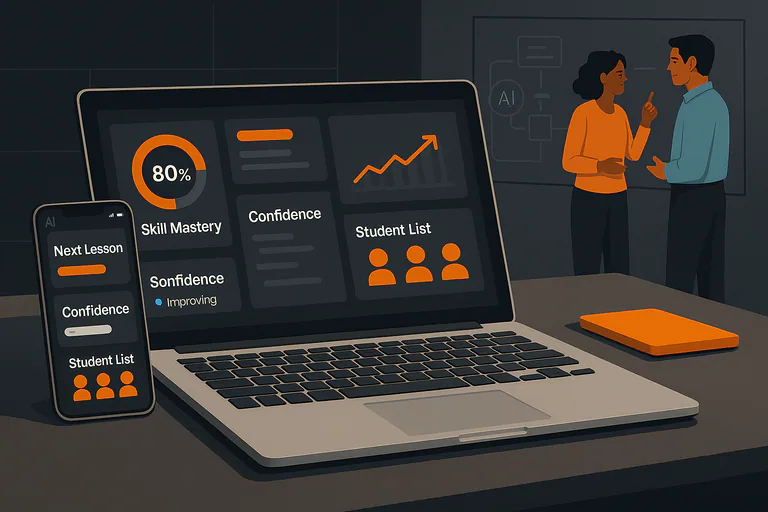
Artificial intelligence transforms static learning into dynamic, responsive experiences. Instead of a fixed curriculum, the system adapts continuously using real-time data, micro-assessments, and learner interactions. The best implementations feel invisible and supportive, never intrusive.
Adaptive Learning Paths
AI algorithms combine quiz accuracy, time on task, hint usage, and click patterns to estimate each learner's mastery. With that snapshot, the system chooses the next best step instead of a fixed sequence. It nudges difficulty, reorders lessons to target weak skills, and increases practice when forgetting appears. Learners who respond quickly advance to mixed problems that generalize the skill, then new concepts. Struggling learners get targeted support like a prerequisite refresher, a worked example, or a short explainer video, followed by low-stakes practice. Over time, the model learns formats and session length, keeping progress steady for learners and instructors, powered by intuitive UX/UI design and data-driven app strategies that enhance both learning and engagement.
Real-Time Feedback
No more waiting until the end of a course to see progress. With AI inside the lesson, feedback arrives the moment a learner responds. The system reads accuracy, speed, and hint usage, then chooses the most helpful next step. It can display a concise correction, offer a nudge before the next attempt, or open a short remedial micro lesson that targets the stuck concept. If errors persist, the app serves a one minute explainer or a worked example, followed by a low stakes practice set. This tight loop lowers frustration, sustains engagement, and guides learners forward with confidence building wins.
Predictive Analytics
Machine learning scans behavior patterns to spot risk early, such as shrinking session length, rising error streaks, skipped modules, or long gaps between logins. When thresholds are crossed, the system flags the learner and proposes interventions. Instructors receive a concise alert with context, timing details, and suggested actions, while the app adapts automatically. It can shorten the path, insert a refresher, schedule spaced review, or suggest office hours. Acting before grades collapse preserves confidence and keeps momentum pointed toward mastery.
Smart Recommendations
Just like Netflix curates shows, AI-powered apps recommend learning materials that match interests and knowledge gaps. Videos, articles, simulations, or interactive flashcards are tailored for each learner. Over time, recommendations get sharper as the model learns what style, length, and difficulty produce the best outcomes.
Automated Assessments
AI tools now handle grading for objective questions and can assist with evaluating short answers. This not only saves time but ensures consistent, unbiased evaluations. Coupled with item analysis, teams learn which questions are too easy, too hard, or misleading, improving content quality with each release.
Together, these elements create a deeply personalized learning journey, one that feels intuitive and alive, meets learners where they are, and keeps them progressing without guesswork.
Why Personalization Matters for EdTech Leaders
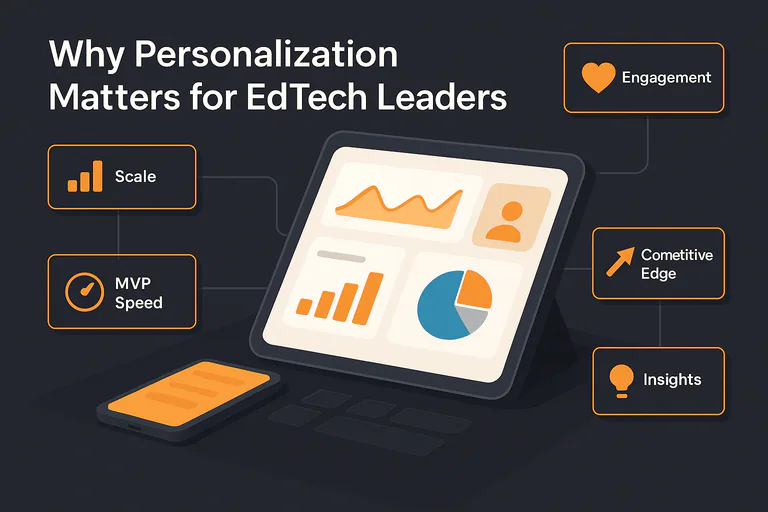
For product managers and CTOs, AI isn’t just a trend—it’s a business multiplier.
- Scale Without Cost Explosion Traditional personalization requires human tutors or large content teams. AI automates adaptation, allowing companies to serve thousands or millions without adding headcount at the same rate. You get a higher learning impact with stable unit economics.
- Better Engagement and Retention Personalized experiences improve motivation and comprehension. Adaptive systems help learners reach milestones faster and reduce churn caused by boredom or confusion. When users experience “just-right” difficulty, they stick around longer and complete more courses.
- Faster MVP Validation Building AI logic early lets product teams test adaptive features in controlled slices. You can ship a minimal adaptive quiz, measure outcomes, and iterate quickly tightening feedback loops and aligning roadmap decisions with clear learning impact.
- Competitive Advantage Personalization differentiates your app from generic learning tools. It signals maturity to investors, partners, and enterprise clients who increasingly expect intelligence, not just content hosting. It’s a clear value story in sales conversations.
- Smarter Data Use AI transforms raw usage data into actionable insights showing which lessons work, where students struggle, and how to refine future releases. Over time, your content strategy becomes evidence-led rather than intuition-led.
Get expert support to launch and scale your EdTech Apps
Why Many EdTech Platforms Fail at AI
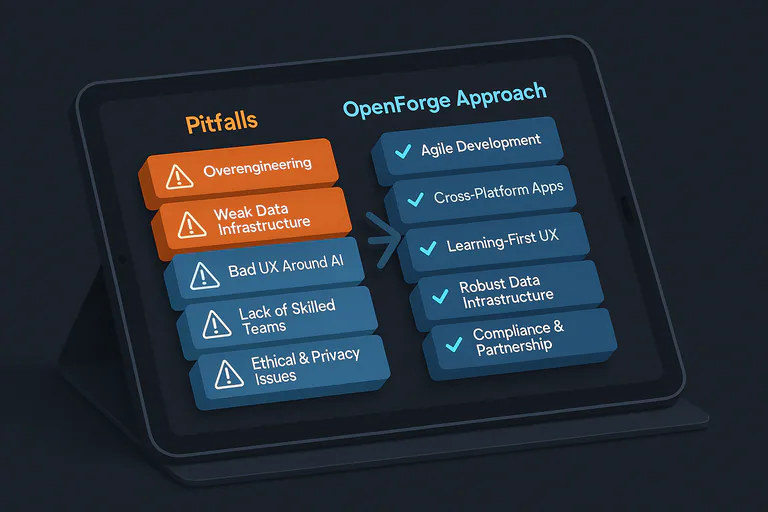
Putting “AI” on a roadmap is simple; effective delivery is hard: weak data, overengineering, opaque UX, skill gaps, and privacy missteps. See OpenForge Solutions to structure pilots responsibly with guardrails.
Overengineering Too Soon
Teams jump into complex frameworks before proving core value. Weeks vanish on models users do not need yet. Ship a narrow adaptive slice targeting one outcome, measure lift with an A or B test, and scale only what works. This reduces risk, shortens feedback loops, and builds data for smarter models.
Weak Data Infrastructure
Personalization fails without clean data. Inconsistent events, missing timestamps, and noisy IDs break features and models. Define a clear taxonomy, add privacy aware tracking, run nightly data quality checks, and maintain a small feature store for reusable signals. Solid pipelines stabilize experiments, speed debugging, and keep personalized learning outcomes auditable.
Bad UX Around AI Decisions
Learners lose trust when adaptation feels arbitrary. Avoid black boxes. Explain changes in simple language and show progress by skills, not vague percentages. Provide a “Why this next” note with one sentence reasoning and optional detail. Keep recovery paths obvious after repeated errors. Transparent UX reduces anxiety and improves persistence.
Lack of Skilled Teams
Education focused AI needs aligned product, data, and pedagogy. Many teams lack mastery estimation, recommendation ranking, and scalable inference experience. Pair internal engineers with a partner for early releases, plan a documented handoff, and invest in event design, metadata, evaluation, and privacy. Empower content and product teams with dashboards and experimentation. Few in-house developers specialize in educational AI systems. Partnering with experts like OpenForge Solutions shortens time-to-value.
Ethical and Privacy Issues
AI in education deals with sensitive data. Unregulated or careless handling can lead to major issues. International frameworks such as UNESCO’s AI in Education Guidelines emphasize transparency, fairness, and human oversight, values OpenForge builds into every project.
How OpenForge Builds Smarter EdTech Apps
OpenForge partners with innovators to turn AI vision into reality. Their process balances technical depth with human-centered design so the product serves both learners and the business.
Agile Development for Real Results
Instead of long build cycles, OpenForge works in rapid sprints. Each sprint delivers a working component like adaptive testing, a recommendation widget, or an educator dashboard validated through real user data. This approach keeps momentum high and priorities grounded in outcomes.
Cross-Platform Expertise
Using Ionic and React Native, we deliver parity across iOS, Android, and web. The modular architecture lets you plug in, swap, or scale AI models without heavy refactors. Our mobile app development process keeps releases fast and maintainable.
Learning-First Design
OpenForge prioritizes clarity. Learners always understand what the system is doing and why. Friendly microcopy, visual progress cues, and optional “why this recommendation?” links build trust and reduce abandonment.
Robust Data Infrastructure
The team helps set up real-time analytics, feature stores, model pipelines, and feedback loops. That means smoother personalization, faster experimentation, and less downtime. As your dataset grows, the system learns and improves without disrupting users.
Ethical and Privacy-Ready Systems
Compliance with GDPR, FERPA, and similar standards is considered from day one. Fairness testing, anonymized data practices, and clear consent flows ensure AI remains responsible and enterprise ready.
True Partnership, Not Just Code Delivery
OpenForge empowers clients to manage, retrain, and expand their own AI capabilities helping teams grow long after launch. Documentation, enablement sessions, and handoff plans make internal ownership sustainable.
Example: A mid-sized EdTech platform partnered with OpenForge to develop an adaptive quiz engine. Within three months, engagement rose by 15% and average lesson completion rates improved by 20%. The system now scales to thousands of learners daily while giving instructors clear insight into class-wide strengths and gaps.
Wondering what EdTech Apps really looks like with AI?
The Future of AI in Education
AI’s next frontier in learning will merge data with empathy, pairing real time evidence with humane design so products feel intelligent and caring. Expect transparent adaptations, teacher centered controls, and measurable outcomes. For a practical path to build this, connect it with Our Roadmap for staged rollout, metrics, and safeguards.
Human + AI Collaboration
AI handles routine checks, pacing, and data aggregation. Teachers lead mentoring, context, and higher order feedback. A “coach view” highlights who needs help now with suggested actions. The result is more individualized attention, faster interventions, and better classroom time allocation without increasing workload.
Responsible AI and Fairness
Establish bias tests, representative datasets, and clear review workflows. Monitor outcomes by subgroup, track false positives or negatives, and document mitigations. Provide consent choices and human override. Routine audits during each release cycle keep models equitable, predictable, and aligned with institutional and regulatory expectations.
Explainable Intelligence
Replace black boxes with short, human language reasons for each recommendation or difficulty change. Show which signals influenced the decision and offer an optional details view. Transparent explanations reduce anxiety, improve persistence, and satisfy administrators who must verify alignment with pedagogy and policy requirements.
Immersive and Multimodal Learning
Blend voice, AR or VR, simulations, and interactive labs to match learning preferences and skills requiring spatial or experiential practice. Keep sessions short, measurable, and accessible. Use adaptive branching so difficulty and guidance adjust in real time based on performance and engagement signals.
Offline Intelligence
Use edge inference and local caching to keep key features working without reliable internet. Preload the next lessons and a small review set. Sync outcomes and analytics when connectivity returns. This supports field learning, travel, and bandwidth constrained regions without compromising continuity.
Stronger Data Compliance
Adopt regional storage, role based access, and auditable data flows. Minimize collection, encrypt at rest and in transit, and respect retention windows. Provide admin controls for consent, exports, and deletions. Clear documentation and recurring reviews build trust with schools, districts, and enterprise buyers.
Building the Future of Learning Together
Personalized learning isn’t a luxury anymore, it's an expectation. AI gives EdTech leaders the power to serve every learner individually, while scaling efficiently and ethically.
OpenForge helps startups, enterprises, and innovation teams bridge the gap between idea and implementation combining agile development, data science, and beautiful design.
If you’re ready to build a smarter, faster, learner-first EdTech app:
Schedule a Free Consultation and see how OpenForge can help your vision come to life.
Frequently Asked Questions
AI in EdTech refers to technology that adapts content, pacing, and feedback using data and algorithms to match each learner’s needs.
AI tracks performance, behavior, and preferences, then dynamically adjusts lessons or recommends materials that fill gaps and build strengths.
Machine learning models, natural language processing, and recommendation engines drive personalization, often supported by mobile frameworks like Ionic or React Native.
No. AI enhances teaching by automating repetitive tasks and providing data insights—teachers remain central to learning.
OpenForge designs and develops scalable, ethical, and adaptive apps with robust data architecture and agile AI integrations,helping you launch faster and smarter.