Schedule a Free Demo Feature Traditional Onboarding AI-Powered Onboarding Flow Type Fixed, linear walkthrough Adaptive, real-time personalization Personalization None; same content for all users Dynamic; customized for each user Data Usage Basic signup info only Behavioral, contextual, and predictive data Adaptability Static, unchanging Learns and improves automatically Engagement Level Declines after initial use Increases through continuous relevance Tools Used Manual UX flows AI platforms (Whatfix, Pendo, CleverTap) Schedule a Free Demo The increasingly expanding landscape of AI onboarding tools provides specific solutions to various business requirements. The best platforms are the following: Tool Key Advantage Ideal For Whatfix Real-time onboarding with analytics-driven personalization Enterprises & SaaS apps Pendo Predictive churn prevention + in-app surveys Product-led growth teams Userpilot Event-triggered experiences without coding Startups & agile teams Appcues No-code visual onboarding builder with AI optimization UX & marketing teams CleverTap Predictive segmentation and retention automation Mobile apps with large audiences TALK TO AN EXPERT 1. ❓How does AI improve the onboarding process? 2. ❓Which tools are best for AI onboarding? 3. ❓Is AI onboarding suitable for small startups?
On the app success, user retention can be broken or made within the first few minutes. It has been discovered that over 25 percent of users drop an application after their initial interaction with it due to the perception that the onboarding is somewhat irrelevant or confusing. The traditional onboarding, which was believed to be enough, does not match the modern expectations. So, we will discuss AI Onboarding vs Traditional Onboarding.
AI onboarding is a dynamic, intelligent, onboarding strategy that leverages AIs to learn each user behavior and tailor tutorials and anticipate what they will need next. We are going to contrast AI-based onboarding and traditional onboarding, consider quantifiable gains, consider the top tools, and demonstrate how personalisation is transforming the interaction between users and mobile app usage.
Table of Contents
Traditional App Onboarding: The Linear Approach
Legacy onboarding is developed using a model that is straightforward and linear. The users are directed to operate in a sequence of fixed screens, step-by-step guidance or guided tours on major features. Although this approach brings functionality, it presupposes that all of the users learn and act in a similar manner.
The benefits are apparent - it is not hard to implement, consistent among all users, as well as it does not need a lot of data. Nevertheless, its flaws are very evident with the increasing complexity of the apps. Traditional onboarding:
- Handles all users equally as far as goals and behavior are concerned.
- Offers no live feedback or assistive support.
- Overloads too much information at a time.
Suppose there is a budgeting application that drags you through ten slides when all a user needs to do is expenses tracking. This fixed action causes mental exhaustion and premature disconnection, particularly in the situation where the user is not able to skip or customize the experience.
Get expert support to launch and scale your mobile app
AI-Powered Onboarding: The Adaptive Experience
Onboarding AI is the opposite of the model. It does not present the same journey to all people, but it relies on machine learning, predictive analytics, and behavior tracking to provide personal guidance in real time.
Here’s what sets it apart:
- Dynamic Personalization: Every user will be presented with onboarding content that is relevant to them.
- Predictive Guidance: AI can predict the situations in which users can lose control and offer contextual assistance before they can be frustrated.
- Constant Education: With each interaction, the experience is enhanced in the future with automated insights.
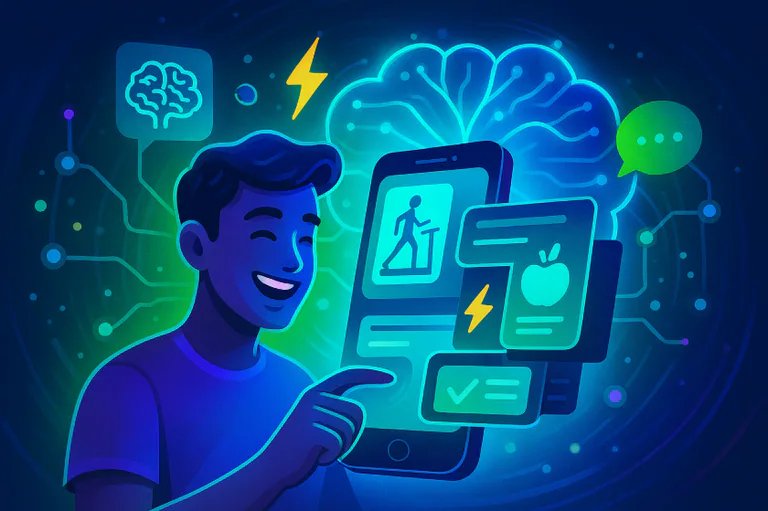
As an example, a health application may examine user habits when it comes to recording meals or exercises more frequently and change onboarding based on it - prioritizing nutrition-tracking by one user and training by another. Such a degree of customerization will make users feel that they are recognized and appreciated, increasing their level of interest and loyalty.
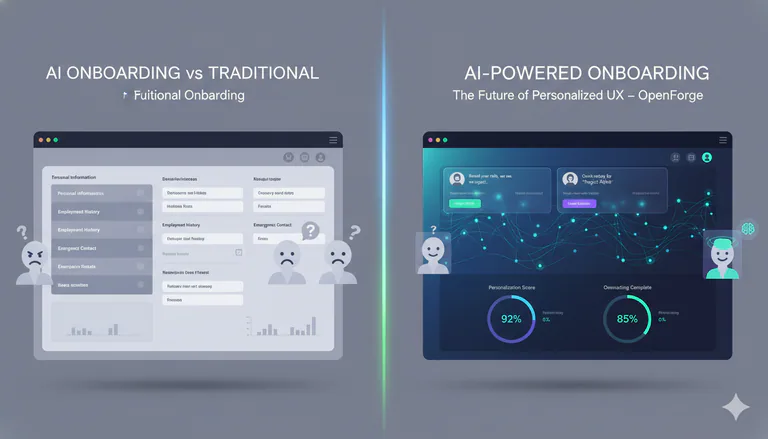
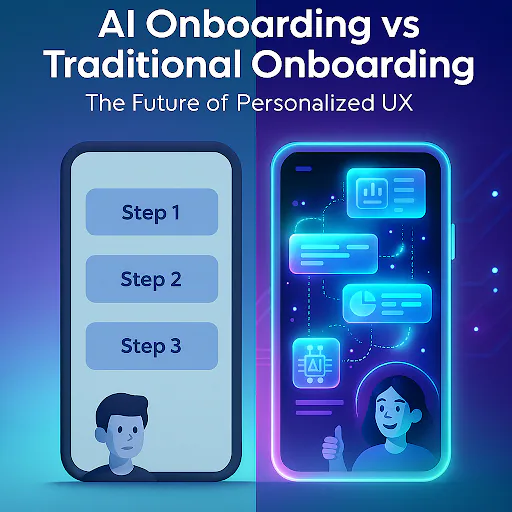
Side-by-Side Comparison: AI Onboarding vs Traditional Onboarding
Concisely, conventional onboarding educates the user on the functionality of an app, whereas AI onboarding educates users on what they require.
Wondering what mobile app development really looks like?
How AI Changes Each Stage of Onboarding
AI does not personalize the interface only, but it transforms all parts of the onboarding process.
1. User Segmentation
The conventional systems segment users into large demographics. AI, in its turn, applies deep clustering in order to detect micro-segments groups of behaviors and intent rather than age or location. As an example, an e-commerce application will differentiate browsers, deal hunters and repeat buyers within seconds.
2. Guidance Delivery
Intelligent prompts are made out of the tooltips that are not moving. AI will be able to recognize hesitation, offer useful propositions, or even bypass unnecessary procedures. The flow is developed depending on the speed of interaction as well as the type of device and the past sessions.
3. Engagement Measurement
AI does not just focus on completion rates but is also able to measure sentiment and forecast the likelihood of churning. This allows teams to operate in time before they disengage.
4. Content Optimization
Classical A/B testing is sluggish. AI does the experiments - learns what works with various audiences and real-time modifies copy, images, or timing.
Business Impact: Measurable Gains of AI Onboarding
AI onboarding does not only improve UX but provides real business outcomes.
- Activation Boost: Activation rates can be boosted with personalized flows by 35-40%.
- Retention Lift: Relevant is doubled in 90 days.
- Lower Support Costs: Predictive prompts and self-help content ensure that there is less confusion to the user.
An example is a wellness app that integrated AI when onboarding using Pendo (28% churn reduction early in the first year). The fact that AI is able to learn, test and develop allows each onboarding session to become smarter and more effective with time.
Comparison of Leading AI Onboarding Tools
Both these tools are based on machine learning, and they can make the onboarding management easier and provide the user with the experience of what he or she values the most.
We assist the startups and businesses in OpenForge to add AI-enhanced personalization to all levels of their mobile applications such as onboarding and engagement as well as retention in the long term.
When to Choose AI Onboarding vs Traditional Onboarding
The selection of the appropriate AI Onboarding vs Traditional Onboarding strategy is based on the maturity of your product and your audience.
Go Traditional When:
- Creating a minimal viable product or basic application including limited data.
- Applying to small groups of users that require regularity.
- You require fast implementation at minimal resource consumption.
Go AI When:
- You gather behavioral or contextual data on a large scale.
- You are concentrating on retention, upselling or personalization.
- Your audience desires to experience things dynamically and smartly.
The majority of modern applications develop into traditional onboarding and become AI onboarding. The most optimal solution is to integrate the two, i.e. AI-assisted onboarding, where a human-designed process is constantly being optimized using data-driven principles.
Future Outlook: Emotion-Aware and Predictive Onboarding
The next AI onboarding is more emotional intelligence than personalization. Facial expression, tone or the speed of navigation will be soon identified by advanced algorithms as a source of user frustration or pleasure.
Multimodal and voice-assisted onboarding will increase accessibility, whereby users will be guided by speech or gestures. Moreover, predictive onboarding will know the intent of the user before they take action and provide assistance before an issue emerges.
To designers of user experience and product teams, this implies the move toward anticipatory design, rather than a reactive one - an experience which changes not only in response to user data, but also to emotional context.
Conclusion: From First Click to Lasting Connection
AI Onboarding vs Traditional Onboarding: Conventional onboarding demonstrates users the way to do things. Onboarding AI is aware of the reason behind their doing. The behavioral data, predictive intelligence, and real-time personalization can transform the generic introductions into meaningful relations.
Our UX designers and AI developers create dynamic experiences to make people feel acknowledged, empowered, and felt connected on the first day.
👉 Ready to personalize your onboarding experience with AI? Visit OpenForge.io to learn how we can help transform your user experience through intelligent design and innovation.
Frequently Asked Questions
The AI personality examines the user behavior to customize the steps of the onboarding, adjusting tutorials and prompts in real time. It assists users to achieve the objectives much quicker and to create less confusion and enhance retention.
The best AI onboarding products are Whatfix, Pendo, Userpilot, Appcues, and CleverTap. Both tools automate personalization, anticipate churn, and increase onboarding with minimal coding.
To gauge your SEO effectiveness, focus on metrics like organic install ratio, keyword rankings, retention rate, conversion rate, and engagement duration.