
OpenForge insight
Should My App Be Using Apple’s Foundation Models?
AI is now a baseline expectation in mobile, at least in stakeholder conversations and competitive audits. But inside real product teams, the question isn’t…
January 25, 2026

OpenForge insight
By OpenForge editorial team · Published December 18, 2025 · Updated December 17, 2025

Schedule a Free Demo Schedule a Free Demo TALK TO AN EXPERT 1. What are app growth metrics? 2. What are the most important app growth metrics? 3. How do you measure app growth? 4. How often should app growth metrics be reviewed? 5. Do growth metrics differ for mobile apps?
Building an app is hard. Scaling it is harder.
Founders, product managers, and CTOs often know their app should be growing, but struggle to answer a more important question: Is it growing in the right way? Downloads spike, dashboards fill up with charts, yet clarity remains elusive. Teams chase vanity metrics, miss early warning signs, or realize too late that user engagement never translates into long-term value.
Tracking app growth metrics isn’t about collecting more data. It’s about measuring what truly drives sustainable growth, then acting on it with confidence.
In this guide, we’ll break down how to track app growth metrics that align with real business outcomes, and how the right development and analytics strategy can make growth measurable, predictable, and scalable.
Before diving into dashboards and KPIs, it’s important to clarify what “growth” actually means for a mobile app.
Growth is not just:
True app growth reflects increasing value over time, measured through:
Many teams fall into the trap of tracking everything and understanding nothing. Growth metrics should answer decisions, not just describe activity.
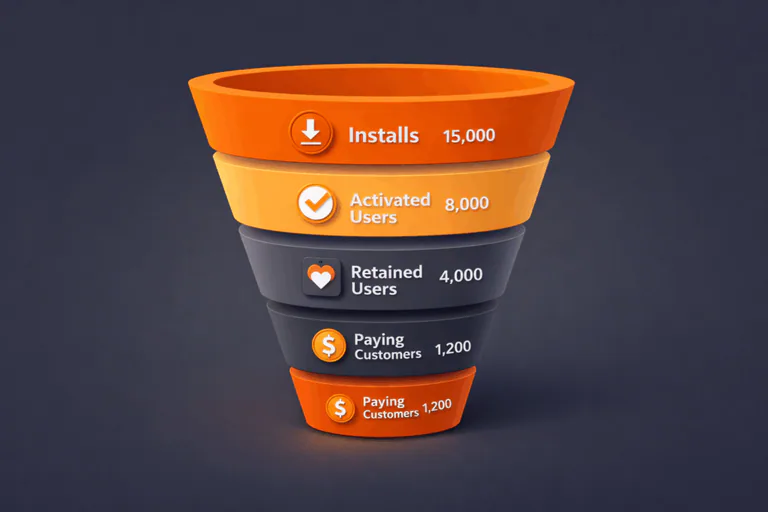
To measure growth properly, metrics should be grouped into logical categories. This avoids noise and creates clarity.
These metrics show how effectively your app attracts users.
Key app growth metrics to track:
Why they matter: They reveal which channels are working and which are burning budget without meaningful results.
Get expert support to launch and scale your mobile app
Activation measures whether users experience value quickly after installing.
Examples:
Why this matters: If users don’t reach value fast, retention collapses, no matter how strong acquisition looks.
Retention is one of the most important mobile app growth metrics.
Track:
Why it matters: Retention reveals product-market fit. Apps that retain users grow organically, reduce acquisition costs, and scale predictably.
Engagement shows how embedded your app is in a user’s routine.
Common engagement KPIs:
Pro insight: High engagement without retention often signals short-term novelty, not long-term value.
For growth to be sustainable, it must eventually translate into revenue.
Key growth KPIs for apps:
These metrics help align product decisions with business outcomes, especially critical for investor-backed or enterprise-grade apps.
Knowing what to track is only half the equation. Execution matters just as much.
Growth tracking should be:
Retrofitting analytics after launch often leads to blind spots and unreliable data.
Tools don’t create insights; frameworks do.
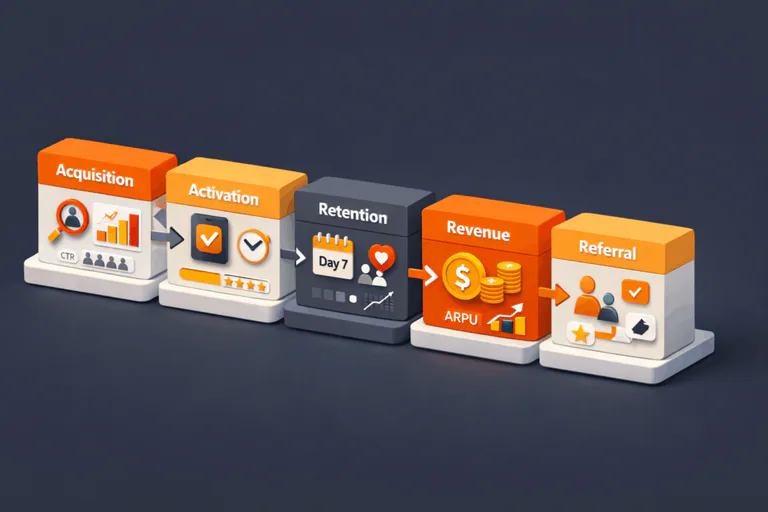
A common and effective structure is:
Mapping app growth analytics to this flow ensures no stage is ignored.
One-time spikes are misleading. Sustainable growth appears in:
This is especially important for mobile apps scaling across regions or platforms.
Metrics don’t exist in isolation from engineering decisions.
Poor performance, bloated builds, or slow iteration cycles directly affect:
Modern frameworks like Ionic and React Native enable faster iteration, consistent cross-platform experiences, and easier analytics instrumentation, all of which improve the quality of growth data.
This is where many teams struggle: they track growth symptoms without fixing the technical causes.
Wondering what mobile app development really looks like?
Tracking app growth metrics only creates value when teams can act on them.
Common blockers include:
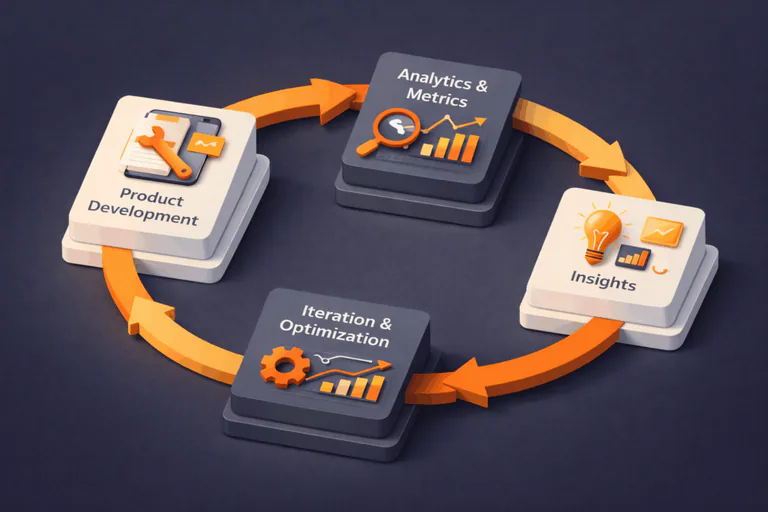
High-performing teams pair clean analytics with agile development, enabling rapid testing, optimization, and scaling.
This is where a strategic development partner can dramatically change outcomes, not by adding more dashboards, but by aligning product execution with growth signals.
Growth metrics are not a reporting exercise. They are a decision-making system.
When tracked correctly, they reveal:
If your team is struggling to translate growth data into real progress, it may be time to rethink not just what you’re measuring but how your app is built and evolved.
OpenForge helps teams design, build, and scale high-performance mobile apps with growth baked in from day one.
App growth metrics are KPIs that measure how effectively an app acquires users, retains them, drives engagement, and generates revenue over time.
Retention rate, activation rate, engagement (DAU/MAU), and customer lifetime value are among the most critical metrics for sustainable growth.
App growth is measured by tracking user behavior across acquisition, activation, retention, and monetization stages using analytics frameworks and cohort analysis.
Core metrics should be reviewed weekly or monthly, while cohort and trend analysis should guide quarterly strategic decisions.
Yes. Mobile app growth metrics emphasize retention, performance, and engagement more heavily due to shorter attention spans and higher competition.

Continue reading
OpenForge insight
January 25, 2026
OpenForge insight
October 15, 2025
OpenForge insight
February 16, 2026