
OpenForge insight
Apple External Payments Explained: A 2025 Beginner’s Guide
Apple App Store external payment now lets U.S. iOS apps link to external payment systems. Learn the new rules, cost scenarios & compliance.
May 6, 2025

OpenForge insight
By OpenForge editorial team · Published May 2, 2025 · Updated August 26, 2025

The Apple App Store external payment era has begun. Late Thursday, Apple rewrote its guidelines for the U.S. storefront after Judge Yvonne Gonzalez Rogers blasted the company’s 27 percent “external purchase” fee as “malicious compliance” with her 2021 injunction in Epic Games v. Apple. The update, published on Apple’s developer portal, lets iOS apps show one web‑checkout link with zero Apple commission—ending a decade‑long blockade on direct billing.
Put simply: apps on the U.S. App Store can now include a button or link to your own website’s checkout page, and Apple can’t take a cut. Apple said it will comply with the court order while it appeals the decision.
Beyond a technical update, this marks a major legal blow to Apple’s longstanding control over in-app purchases—removing a key revenue lock-in that critics have called monopolistic.
✅ External links allowed – U.S. iOS apps can now add an external checkout link without a StoreKit entitlement (as long as they only operate in the U.S.).
✅ Zero Apple commission – The 27% “external fee” is barred while the injunction is in effect.
✅ One-link rule stays – Apple still limits developers to a single, clearly labeled external URL or button.
✅ No more scare screens – Apple removed prior requirements for warning messages (“scare screens”) when linking outside the app.
These changes apply only to the U.S. App Store. Apps operating globally must continue complying with existing rules elsewhere.
This shift in Apple’s App Store rules could reroute billions in subscription revenue away from Cupertino and back into the hands of app developers. Early movers will be able to demonstrate to regulators, investors, and users that lower prices and higher margins can go hand-in-hand.
Here’s what’s at stake:
By shifting new U.S. sign-ups to your own web checkout, you avoid Apple’s 30% commission - letting you keep 100% of your subscription revenue on those transactions.
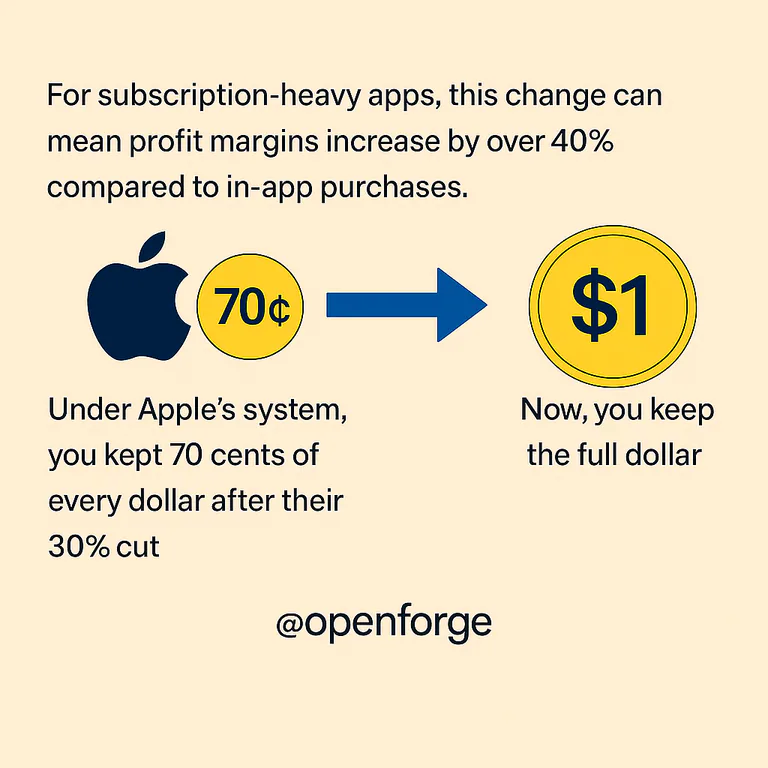
That 30% you used to lose to Apple now stays in your business. For subscription-heavy apps, this change can lead to a profit margin increase of over 40% compared to using in-app purchases.
Put another way: ➡ ️ Under Apple’s system, you kept 70 cents of every dollar after their 30% cut. ➡ ️ Now, you keep the full dollar.
That extra 30 cents doesn’t just increase revenue—it makes each sale more profitable by over 40% compared to what you earned before.
And you don’t need to build a billing system from scratch: payment processors like Stripe and RevenueCat are already offering plug-and-play solutions for external paywalls, making it faster and easier to launch direct billing.
You’re now free to display real-time discounts, promo codes, or tier-swap offers (Individual → Duo) directly in the app—no more Apple restrictions on pricing transparency, messaging, or bundling rules.
In Spotify’s words, users can finally “see how much something costs” inside the app without artificial obfuscation.
Unlike Apple’s 30 - 60 day payout cycle, web processors like Stripe and Paddle typically pay out within days. Faster cash flow means a shorter payback window for paid acquisition and reduced pressure on working capital.
Major platforms moved swiftly to capitalize:
The tools and platform support are already here—developers just need to activate them.
This App Store rule change could put billions back into app companies’ pockets and prove that lower prices and higher margins can coexist.
Book a free 30-minute consult with OpenForge’s development team to discuss how to integrate external payment links compliantly and efficiently: openforge.io/contact
Continue reading
OpenForge insight
May 6, 2025
OpenForge insight
May 6, 2025
OpenForge insight
November 24, 2025

