Schedule a Free Demo Book Your Free Consultation Claim Your Free App Strategy Call TALK TO AN EXPERT 1. ❓What is an AI app builder? 2. ❓Why did Builder.ai fail? 3. ❓Are no-code platforms a good solution for startups? 4. ❓Will AI replace developers in the future? 5. ❓What’s the best alternative to no-code app builders?
Does Custom App Development Still Win in 2025?
Builder.ai promised a no-code revolution, what founders got instead reveals what to avoid when choosing an AI app builder in 2025.
Table of Contents
The Rise and Fall of Builder.ai: Lessons for App Founders in 2025
Before you trust an AI app builder with your startup idea, consider the cautionary tale of Builder.ai.
Why Builder.ai’s Collapse Matters for Aspiring App Founders in 2025
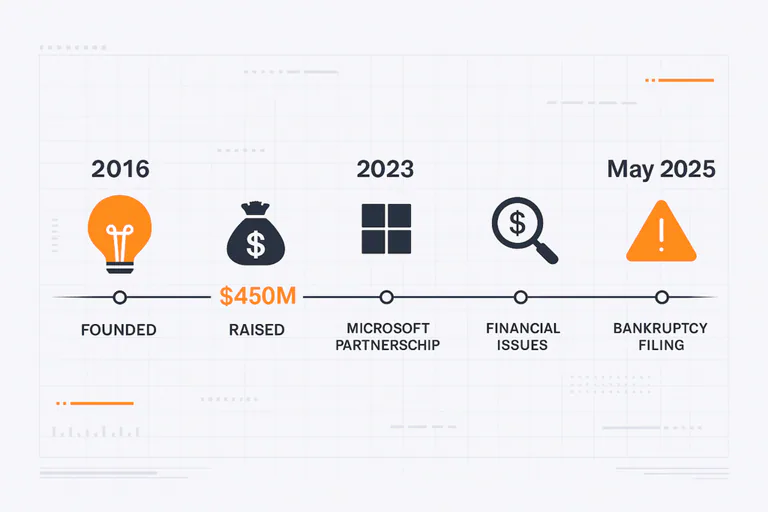
In 2025, Builder.ai, once hailed as a revolutionary AI app builder backed by Microsoft and QIA, filed for insolvency after burning through over $450 million in funding . At its peak, it promised to democratize software creation using no-code AI tools. Yet beneath its sleek branding and Silicon Valley buzzwords, Builder.ai was plagued by financial mismanagement, inflated metrics, and overreliance on underpaid human developers pretending to be "AI assistants" .
The fall wasn’t just a failure of leadership, it was a failure of transparency. Founders who trusted Builder.ai for custom app development were left with unfinished products, locked-out accounts, and no clear roadmap for recovery .
This collapse serves as a stark reminder that AI startups, even the most hyped, must be vetted with due diligence. If your app is core to your business, placing your future in the hands of a black-box no-code app builder is not only risky, it may be irreversible.
The Risk of Trusting AI App Builders Without Transparency
The tech press dubbed Builder.ai “AI-powered,” but insiders revealed that 85% of app development was done manually by contractors across India and Eastern Europe . Its flagship AI product “Natasha” was little more than a glorified project tracker. This disconnect between branding and reality left over 1,200 small businesses with broken, incomplete apps and zero recourse .
Today’s founders must ask hard questions:
- Do I own my app’s code?
- What happens if the platform disappears?
- Is this AI-powered or just people behind the curtain?
At OpenForge, we’ve seen firsthand how no-code AI platforms can shortcut success, then sabotage it. That’s why we advocate for transparent, scalable custom app development, built with real engineers and future-proof technology.
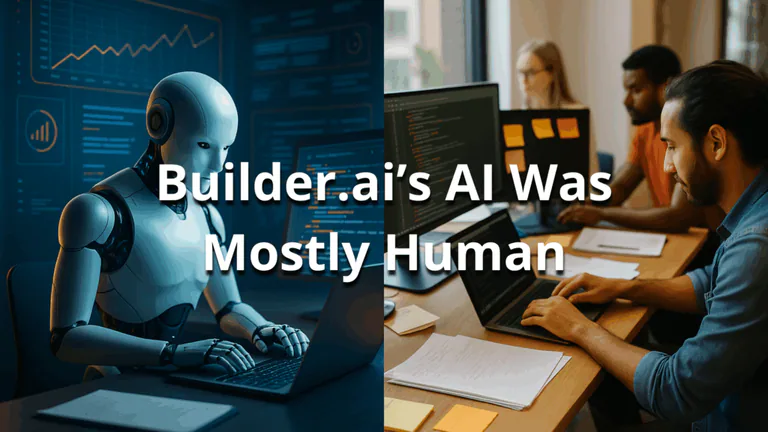
Builder.ai’s AI App Builder Was Mostly Human: What Founders Didn’t See
At first glance, Builder.ai looked like the dream solution for non-technical founders: an AI app builder that could spin up software like magic, no code required. But under the hood? It wasn’t AI doing the heavy lifting, it was people.
Why No-Code AI App Builders Still Depend on Human DevelopersWhy No-Code AI App Builders Still Depend on Human Developers
Despite all the talk about no-code platforms and automated development, Builder.ai's collapse exposed a core truth: building apps still takes real engineers, real code, and real problem-solving. While Builder.ai positioned itself as an AI-powered platform for fast, scalable app creation, an investigation later revealed that 85% of its apps were manually coded by contracted developers in India and Eastern Europe .
To be clear, there’s nothing wrong with using human devs. What’s dangerous is selling automation and delivering outsourcing, especially when founders believe they’re investing in long-term tech infrastructure.
The gap between branding and reality here wasn’t just misleading, it was catastrophic. Thousands of users were promised “build it with AI” but ended up with a mix of incomplete apps, fragile codebases, and no actual custom app development strategy. As reported, over 1,200 small businesses were left with unfinished projects after Builder.ai’s collapse.
The Mechanical Turk Problem in AI App Development Platforms
If it feels like this isn’t the first time we’ve seen AI overpromise and underdeliver, you’re right. This entire situation echoes the old Mechanical Turk problem: when a machine looks smart but is secretly powered by humans behind the curtain.
The original Mechanical Turk was an 18th-century chess-playing automaton that fooled audiences with its brilliance, until it was revealed that a human chess master was hiding inside. Fast-forward to 2025, and platforms like Builder.ai are doing the same trick with software.
Their “AI assistant” called Natasha? It turned out to be little more than a fancy task manager. It didn’t write code, architect features, or build anything scalable. According to reporting from Josh Weiner, most Builder.ai apps were held together by humans manually patching components together, with costs spiraling to $18 million/month at their peak .
So here’s the question every founder should ask:
💡 “Is this tool really AI? Or just a spreadsheet with lipstick?”
AI App Builders vs. Real Development: Know the Difference
Today’s market is flooded with AI-powered platforms. Some are great for prototypes or MVPs. But once you're serious about scalability, compliance, performance, especially if you’re building in healthcare, fintech, or enterprise, you need a custom app development partner, not a no-code shortcut.
At OpenForge, we’ve helped dozens of founders transition off failed AI builders and into sustainable app strategies. If Builder.ai’s story teaches us anything, it’s this:
🚫 Don’t outsource your startup’s future to a platform you don’t control.
✅ Build it right, build it for the long run, with code you own.
Wondering what custom app development really looks like with AI done right? Let’s walk you through it.
Builder.ai’s Financial Problems: How AI Startups Can Implode at Scale
If you think AI startups are automatically "smarter" with money, think again. The spectacular collapse of Builder.ai in 2025 shows just how fast things can fall apart, especially when branding outpaces business fundamentals.
Insolvency and Revenue Misreporting: What Sank Builder.ai
By the time headlines declared Builder.ai insolvent, the damage was already done. Backed by Microsoft, QIA, and other major players, the company had raised over $450 million in funding . But beneath the hype, the numbers didn’t add up.
In early 2025, Builder.ai laid off 40% of its workforce, even after a $250M Series D in 2023. It had revised down its revenue figures, and auditors began digging into years of financial records. Turns out, the company had allegedly inflated customer counts by 300% and counted demo projects as real sales .
It gets worse. A forensic audit triggered by investors revealed $120 million missing from corporate accounts, and the company owed $88 million to AWS just to keep customer apps online. When lender Viola Credit seized $37 million, Builder.ai was left with only $5 million in restricted funds, not even enough to make payroll across five countries .
In the end, they couldn’t recover. Bankruptcy filings are now underway in the U.K., U.S., UAE, India, and Singapore, a global unraveling for what was once considered one of the hottest AI app builder startups of the decade .
Why Financial Problems Are Common in AI Startups Chasing Growth
So, how does a no-code unicorn with celebrity investors lose everything? It’s not just about bad leadership, it’s a pattern we’re seeing more often in the AI startup world.
Many AI platforms scale fast with investor cash, but skip core fundamentals like:
- Revenue visibility
- Cash flow discipline
- Transparent cost structures
- Clear unit economics
Instead, they bank on “future potential” while bleeding money in the present. For Builder.ai, monthly burn rates reportedly reached $18–$21 million, despite marketing claims of profitability .
This isn’t just a one-off. According to Info-Tech Research Group, a growing number of AI companies are "rushing to scale on hype" with “little differentiation or financial oversight” .
The takeaway? AI hype may land you VC cash and headlines, but it won’t guarantee product-market fit, or keep your startup afloat.
At OpenForge, we’re transparent with clients from day one, about cost, timeline, and what’s human vs. automated. In a world of smoke-and-mirrors AI, that kind of trust is the new premium.
You’ve got the idea. We’ve got the team. Let’s explore how to bring your app to life, custom, scalable, and future-ready.
Avoiding the No-Code Trap: How to Choose the Right AI App Development Approach
So now that we’ve unpacked what went wrong with Builder.ai, the next question is simple:
How do you avoid the same trap and still leverage the power of AI in your mobile app development? Let’s break down what actually works in 2025, and how to tell real innovation from empty promises.
Will AI Replace Programmers? No-Code App Builders vs. Custom App Development
Short answer? No, but it will replace bad processes.
The idea that AI will replace programmers is floating all over the web, but the truth is more nuanced. According to Greg Qualls in his 2025 write-up “Why AI Won’t Replace Developers,” platforms may help accelerate development, but they still rely on people who know how to structure logic, troubleshoot, and build product strategy.
As Qualls puts it, “AI can’t manage the production launch without human oversight.” Builders like ChatGPT and GitHub Copilot still need hand-holding, and using them without experienced devs is like trying to build IKEA furniture with no instructions.
That’s why custom app development is still the gold standard for real businesses. You don’t want your healthcare app or fintech tool crashing because your “AI builder” forgot to implement proper security.
AI App Development in 2025: Tools That Work vs. Platforms That Promise
Here’s what we’ve seen in the trenches:
✅ AI coding assistants like Copilot, Cursor, and Claude can boost developer efficiency developers who used Copilot completed tasks 55% faster than those coding without AI assistance, in a controlled production environment, according to a study by GitHub
❌ But no-code app builders often fall short when scaling, integrating APIs, or maintaining security and compliance.
“Best AI for coding” doesn’t mean best for building a product, it means best for supporting smart humans who know what they’re doing.
How OpenForge Builds Scalable Apps with Real AI, Not Buzzwords
At OpenForge, we don’t sell buzzwords. We build.
Our team blends AI app development tools with custom engineering, giving you speed, flexibility, and code you actually own. We support product teams across industries, from healthcare to fintech, using scalable architecture, secure infrastructure, and real-time analytics. Whether you’re building on Flutter, React Native, or something AI-infused, we’ve got your back with humans, not just bots.
Because in 2025, winning apps aren’t built by hype, they’re built by partners who care about outcomes.
Not sure where to start? A 30-minute strategy session can clarify your roadmap.
Builder.ai’s Collapse Proves One Thing: Founders Need Real Tech, Not Just Buzzwords
The fall of Builder.ai isn’t just another startup story, it’s a clear warning to founders chasing shortcuts. Hype, bold promises, and flashy AI branding couldn’t make up for a lack of technical transparency. And when that gap caught up to them, everything crumbled. For aspiring app founders, the takeaway is simple: when you're building your business, trust matters more than marketing.
The Safer Alternative: Custom App Development That Scales
AI tools are amazing when used right, but no tool replaces a solid foundation. Relying on no-code platforms might feel fast and easy at first, but things get messy when you try to scale, customize, or grow your product. Choosing a custom development partner means you keep full control over your tech, and your future.
Partner with OpenForge to Build an App That Won’t Fail You
We help founders turn real ideas into real products, designed to perform, evolve, and win. We don’t just code, we co-create scalable, secure, and user-centric mobile apps with teams like yours. Let’s build something your users (and your investors) can believe in.
Frequently Asked Questions
An AI app builder is a platform that claims to automate the process of app development using artificial intelligence, often allowing users to build apps without writing code. However, many of these tools still rely heavily on human developers behind the scenes, offering less automation than advertised.
Builder.ai failed due to a combination of inflated marketing promises, hidden reliance on human developers, and major financial mismanagement. Despite branding itself as an AI-powered platform, it struggled with transparency, scalability, and trust, key pillars for sustainable app development.
No-code platforms can be useful for testing ideas or MVPs, but they come with serious trade-offs: limited customization, vendor lock-in, and poor scalability. For mission-critical or long-term apps, custom development is often the safer, more flexible path.
AI won’t replace good developers, it’ll empower them. Tools help automate repetitive tasks, but complex problem-solving, architecture, and strategy still require human intelligence and domain expertise.
The best alternative is partnering with a custom app development firm like OpenForge, where you get full control, scalable infrastructure, and real AI integration, without the buzzwords. This approach helps future-proof your product and build lasting value.
References