
OpenForge insight
How Can Generative AI Help Businesses Launch Smarter Mobile Apps?
Learn how generative AI mobile app development helps businesses launch faster, reduce costs, and improve ROI. 2026 guide by OpenForge.
February 20, 2026

OpenForge insight
By OpenForge editorial team · Published January 17, 2026 · Updated January 21, 2026
Schedule a Free Demo Schedule a Free Demo Schedule a Free Demo TALK TO AN EXPERT 1.Which is faster for development: Capacitor or Flutter? 2. Can Flutter replace native apps in 2026? 3. Is Capacitor suitable for enterprise apps? 4. Is on-device AI only for high-end phones? 5. How can OpenForge help with on-device AI in my mobile app?
The mobile development environment is still undergoing a rapid change in 2026 as organizations strive to accelerate releases, build cleaner architectures, and cross-platform experiences.
In this comparison of Capacitor vs. Flutter, with a CTO focus, including architecture, performance implications, recruitment issues, the presence of a robust and vibrant ecosystem of plug-ins, the total cost of ownership (TCO) and suitability to AI-driven apps and apps that go offline.
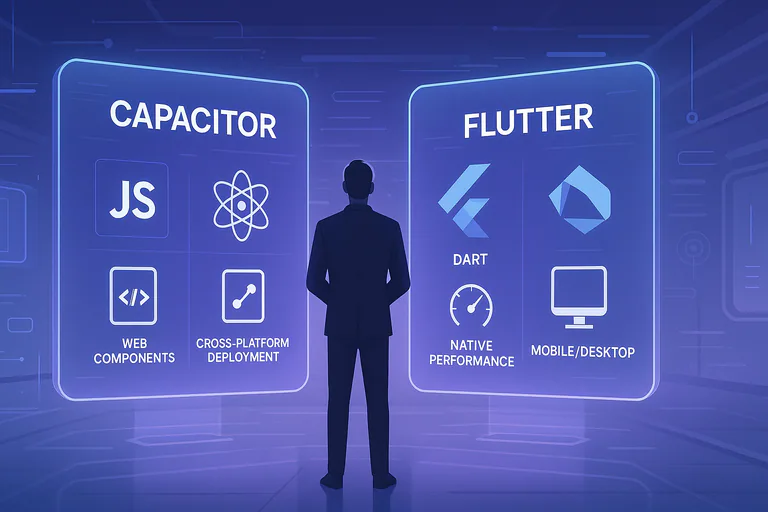
Two new technologies have now become the topics of CTO discussions: Capacitor (to create web-native hybrid apps), and Flutter (to create cross-platform apps that are compiled).
They both have grown up, both provide production-quality applications, and both boast of best developer experience. However, they come up with solutions in different ways.
The decision between Capacitor and Flutter in 2026 is not only a matter of performance and flexibility anymore, it is a strategic decision that has implications on long-term velocity, team design, employment, scalability, and compatibility with the contemporary web ecosystems.
“On-device AI” is a broad term, but in a mobile context it usually means:
This includes things like:
Platform owners are leaning in here. Apple highlights privacy-friendly on-device ML throughout its machine learning resources, and Google pushes developers toward on-device ML with ML Kit for low-latency use cases on Android.
On the product side, teams like OpenForge use on-device AI as one part of broader AI app development strategy: you mix local and cloud inference depending on what the user is trying to do and what the business needs.
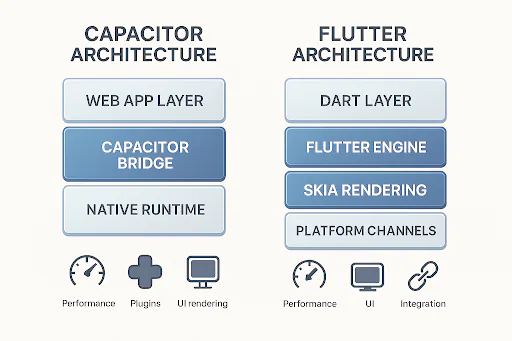
Capacitor, created by Ionic, is a native web application runtime, which enables developers to create mobile applications with React, Vue, Angular, or plain JavaScript and deploy them to iOS, Android, and the web. The app is based on a WebView but applies to native functionality via the use of a plug-in.
It’s ideal for:
It has products that are supposed to run on browsers, mobile platforms, and desktops.
Get expert support to launch and scale your mobile app
Flutter is an open-source project by Google that compiles Dart code to native ARM binaries and renders with the Skia rendering engine to paint all the pixels on the screen. This enables Flutter to develop the same UI on iOS, Android, desktop and even embedded systems.
It’s ideal for:
Statista 2025 developer survey in the year 2025 had Flutter as the most utilized mobile framework in the world, after React Native.
Capacitor is used to wrap a web program within a native shell. Native plugs connect the device APIs (camera, geolocation, biometrics, etc.) to a JavaScript layer.
Pros:
Cons:
There is a difference in WebView among the devices.
Flutter generates Dart into native machine code and renders the UI using Skia without using OEM UI components.
Pros:
Cons:
Performance usually dictates a CTO to approve or disapprove of a framework.
Capacitor applications are much improved over the hybrid ones such as Cordova. With the help of the WKWebView and Android modes of hybrids, apps have good performance with the common business and productivity applications.
Strong for:
Limitations:
Wondering what mobile app development really looks like?
| Feature | Capacitor | Flutter |
|---|---|---|
| Primary language | JavaScript/TypeScript | Dart |
| UI rendering | WebView | Skia engine |
| Performance | Medium–high | High |
| Web support | Excellent (native web) | Improving but limited |
| Learning curve | Low for web teams | Medium |
| Hiring availability | Very high | Medium |
| Native plugin support | Strong (Ionic ecosystem) | Very strong |
| Desktop support | Through PWA or Electron | Native desktop builds |
| Ideal use cases | Enterprise apps, portals, and cross-device web-first apps | High-performance and design-centric apps |
| AI-driven UX support | Web-based toolchains | Native-level ML integration |
Onboarding can be completed in less than a week in case your team already knows React, Vue, Angular, or Svelte. It runs on a common codebase both on the web and mobile, which allows an engineer to be fast.
Dart is simple and yet unknown to the majority of the JS-first developers. But the teams having mobile experience (Android/iOS) are more likely to adapt fast due to the unified rendering pipeline of Flutter.
Capacitor boasts of a large, mature library of:
In addition, it is easy to write native plugins by a team.
Flutter itself enjoys the support of a colossal open-source ecosystem provided by Google, including thousands of high-quality packages including:
In complex integrations, Flutter continues to offer more tooling.
The following are the factors that CTOs consider when comparing TCO:
Perfect in teams that do not have the limitations of WebView performance.
Capacitor relies heavily on:
Flutter supports:
Flutter leads the pack in the case of apps that handle extremely sensitive information (fintech, medical records).
Want to explore solutions tailored to your team?
Limit: WebView state management may be difficult with large offline data.
In the case of heavy offline-first applications (field teams, logistics, warehouse tools), Flutter is more robust.
Choose Capacitor If:
Choose Flutter If:
Both frameworks are future-ready, but they’ll serve different types of companies.
Capacitor vs. Flutter is not a “better technology” debate, it’s a strategy debate.
Choose Capacitor when:
Choose Flutter when:
CTOs should choose based on:
The best framework is the one aligned with your business model, not just your technology preference.
Capacitor is typically faster for teams with web experience, while Flutter becomes faster once a team is fully trained.
Yes, for most use cases, except extremely performance-critical applications like 3D gaming or OS-level utilities.
Yes. Many enterprise SaaS platforms now run on Capacitor because it aligns with existing web infrastructure.
High-end phones benefit the most from powerful on-device accelerators, but many on-device models can be optimized to run on mid-range devices too. You may choose to degrade gracefully: richer experiences on newer devices, simpler behaviors on older ones. A good architecture makes those differences manageable, not chaotic.
OpenForge can help you:

Continue reading
OpenForge insight
February 20, 2026
OpenForge insight
February 18, 2026
OpenForge insight
January 23, 2026