
OpenForge insight
How Can Generative AI Help Businesses Launch Smarter Mobile Apps?
Learn how generative AI mobile app development helps businesses launch faster, reduce costs, and improve ROI. 2026 guide by OpenForge.
February 20, 2026

OpenForge insight
By OpenForge editorial team · Published December 26, 2025 · Updated January 16, 2026

Schedule a Free Demo Schedule a Free Demo TALK TO AN EXPERT How does ChatGPT improve mobile UX? Which tools are best for ChatGPT-powered mobile apps? Are ChatGPT apps suitable for small startups?
The mobile user experience (UX) world is dynamic, yet the launch of ChatGPT-driven applications can potentially become a paradigm shift. In March 2025, the ChatGPT mobile app was the most downloaded non‑game app in the world, with about 46 million installs in that month alone.
Similarly to how onboarding in AI-based applications has changed user interaction and retention, ChatGPT apps will bring in dynamic, intelligent, and conversational experiences that will radically change the process of the user navigating, viewing information, and performing tasks on mobile platforms.
We will discuss how the ChatGPT apps may disrupt the future of mobile UX, comparing the conventional UX methods with the AI-driven chat experiences, discussing the quantifiable positive impact, analyzing the predominant tools, and giving an overview of the future of app design.
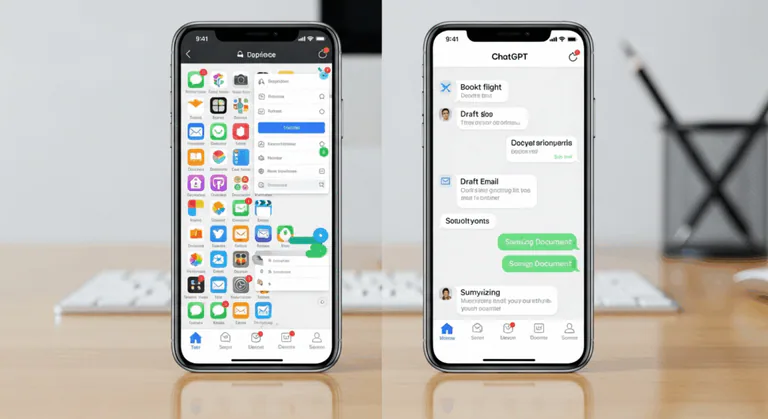
The UX design of mobile has been traditionally based on linear flows, menus, and fixed interfaces. Users go through a set series of pre-programmed screens with the help of buttons, forms and step by step instructions.
Though this method will guarantee uniformity and transparency, it presupposes that every user is going to use the app in the same manner and can be of limited assistance in addressing personal preferences.
The advantages of conventional UX are obvious:
But even in the age of AI its drawbacks become more and more noticeable:
As an example, one can take a mobile banking application with a fixed navigation menu. Every user must use the same flow to accomplish a transaction, view statements, or configure alerts no matter their familiarity or unique requirements. This usually causes frustration, lack of completion of tasks and reduced retention.
ChatGPT apps, however, use natural language processing, machine learning, and conversational AI in order to deliver adaptive, personalized experiences. These applications do not force the user to navigate through rigid menu selections, but instead encourage the user to chat or pose natural language questions and get real time, contextually sensitive directions.
Major features of ChatGPT applications are:
Take the case of a health application that uses ChatGPT. One of the users can be interested in monitoring his exercise routine, and another in nutritional guidance. The app is able to show relevant content and offerings by analyzing their queries and interaction modes, dynamically increasing the level of engagement and perceived value.
Get expert support to launch and scale your mobile app
| Feature | Traditional mobile UX | ChatGPT-powered mobile UX |
|---|---|---|
| Interaction flow | Fixed, linear navigation | Conversational, adaptive guidance |
| Personalization | Mostly static for broad user groups | Context-aware responses based on user goals and behavior |
| Data use | Basic profile and usage data | Conversation, behavior, context, and product data with appropriate controls |
| Iteration | Manual releases and A/B tests | Continuous analysis and guided adjustment with human governance |
| Typical tools | Standard UX design and analytics tools | GPT APIs, retrieval, product analytics, and safety layers |
Conventional segmentation is based on very general demographics like age, gender, or geographic position. ChatGPT applications, in turn, examine conversation patterns, query types, and behavioral cues to determine sophisticated user groups.
As an example, an e-commerce ChatGPT application can differentiate between first time shoppers and repeat customers, deal hunters and high-value customers in a few seconds and suggest tailored options to these customers.
Help in the form of static tooltips and tutorials is substituted with context-sensitive and interactive help. ChatGPT is able to monitor when the user feels confused or hesitant in the conversation and offer suggestions, explaining the steps, or even avoiding unneeded steps.
ChatGPT applications are able to calculate sentiment, tone of conversation and other engagement metrics than completion rates. Predictive algorithms recognize possible drop-offs and propose interventions, including nudges, reminders or personalized content.
Instead of using only slow A/B testing, ChatGPT apps are dynamically tested in dialogue, prompt, and content formats in real time. Through AI, responsive strategies to particular audiences are also learned and reactions, advice, and interface elements are automatically adjusted.
| Tool | Key advantage | Ideal for |
|---|---|---|
| OpenAI GPT APIs | Advanced natural-language and contextual capabilities | Enterprises, SaaS apps, and AI-first startups |
| Dialogflow | Multi-platform conversational agent deployment | Businesses seeking cross-platform UX consistency |
| Rasa | Open-source AI for highly customized assistants | Technical teams and large-scale deployments |
| IBM Watson Assistant | Enterprise conversational AI with analytics | Large organizations with complex UX needs |
| Microsoft Bot Framework | Integration with the Microsoft ecosystem | Businesses already using Microsoft products |
These technologies enable developers to add adaptive, context-sensitive and predictive conversational experiences that progressively learn as users interact with them.
Tool
Key Advantage
Ideal For
OpenAI GPT APIs
Advanced NLP and contextual understanding
Enterprises, SaaS apps, and AI-first startups
Dialogflow
Multi-platform conversational agent deployment
Rasa
Open-source AI for highly customized bots
Tech-savvy teams and large-scale deployments
IBM Watson Assistant
Enterprise-grade conversational AI with analytics
Microsoft Bot Framework
Seamless integration with Microsoft ecosystem
Businesses leveraging Microsoft products
Wondering what mobile app development really looks like?
Go Traditional When:
Go ChatGPT-Powered When:
The integration of both strategies will improve most contemporary mobile apps where assisted human-crafted UX can be mainly complemented by adaptive interaction based on ChatGPT and offer a hybrid experience that will be as intuitive as possible and as personalized.
Future versions of ChatGPT-driven UX will go beyond the personalization of conversations into the emotion-sensitive and predictive interface. More sophisticated algorithms can examine user text, tone and speed of interaction in order to determine whether they are satisfied (or not) in real time. The apps will become more accessible and intuitive through multimodal interactions, like voice or gesture-controlled UX.
Predictive UX will also be anticipatory in the user intent by offering guidance before the user even has a need. This forward-looking design strategy is a change between the user experience that is reactive to the proactive kind of the experience where all interactions would be valuable and frictionless.
Mobile UX can be fully transformed by the ChatGPT applications. Compared to the traditional UX, where the user is instructed in the interface, interfaces produced using ChatGPT have the ability to guess the intent of each interaction and deliver a dynamic, predictive and personalized experience. Conversational AI, behavioural intelligence and continuous intelligence can transform a one-time interaction to a long-term engagement with the assistance of mobile applications.
Are you prepared to make your Mobile UX personalized using AI? Go to OpenForge.io and find out how we can assist in changing your user experience by creating intelligent design and innovation.
ChatGPT is more interactive with real-time guidance, predictive help, and conversational support, which makes it more engaging and less frictionless to use by analyzing user behavior, and context which makes the interaction more personal.
The leading ones are OpenAI GPT APIs, Dialogflow, Rasa, IBM Watson Assistant, and Microsoft Bot Framework. These platforms allow developers to create flexible, contextual, and scalable conversational experiences.
Yes. Although only preliminary apps can be enhanced with ChatGPT, it can offer individualized advice and improve user engagement on the initial encounter, and it can expand as the app expands.
Continue reading
OpenForge insight
February 20, 2026
OpenForge insight
December 19, 2025
OpenForge insight
October 20, 2025