OpenForge insight
How Can Generative AI Help Businesses Launch Smarter Mobile Apps?
Learn how generative AI mobile app development helps businesses launch faster, reduce costs, and improve ROI. 2026 guide by OpenForge.
February 20, 2026

OpenForge insight
By OpenForge editorial team · Published December 2, 2025 · Updated December 3, 2025
Schedule a Free Demo Schedule a Free Demo TALK TO AN EXPERT 1. What is mobile app marketing in simple terms? 2. Which mobile app marketing channels usually deliver the highest ROI in 2026? 3. How should I split budget between organic and paid user acquisition? 4. Is app store optimization still worth it if I focus on paid ads? 5. When should I hire a mobile app marketing agency instead of keeping everything in-house?
If you run a mobile app in 2026, you already know the pattern. Installs used to come in steadily from a few core channels. Now costs keep rising, privacy changes keep rolling in, and the same budget buys far fewer users than it did two years ago. You are not just fighting competitors in your category, you are competing with every other app and brand pouring money into the same feeds and ad auctions.
This is the reality of mobile app marketing today. Global mobile ad spend keeps growing into the hundreds of billions, yet the average install is harder to win and easier to lose. At the same time, most leadership teams are still measuring channels purely by cost per install instead of looking at what actually matters: which channels bring users who stay, convert, and pay.
The goal of this playbook is simple. Instead of giving you another random list of tactics, it shows you how to think about high-ROI channels in a structured way. We will walk through:
Throughout, we will treat acquisition, product, and retention as one system. That is how OpenForge approaches growth work with clients: not “run campaigns in a vacuum,” but connect mobile app advertising, app experience, and analytics into a single loop that can be improved every quarter.
If you are a founder, product leader, growth marketer, or CTO trying to decide where to put your next dollar, this is written for you.
Before you obsess over TikTok versus Apple Search Ads, you need to ask a harder question: if you doubled your traffic tomorrow, would the app actually turn that traffic into revenue and long term users? High-ROI mobile app marketing starts with a product and measurement foundation that does not waste the attention you are paying for.
No channel can fix a weak value proposition or a confusing first-time experience. If users do not understand what your app does, do not hit a clear “aha” moment, or get stuck during setup, every marketing dollar you spend leaks out of the bucket.
Practically, this means you should be confident about three things before you scale:
If any of those are shaky, fix them before you pour more users into the funnel. This is also where OpenForge often brings in AI-guided onboarding, better empty states, and clearer first-run flows. Marketing becomes much easier when the app is designed to help new users win fast.
The second foundation is measurement. If you only track installs and a few vanity events, you cannot know which mobile marketing channels are high-ROI. At minimum, you need:
You do not need a giant data warehouse to start. You do need enough visibility to answer questions like “Users from this campaign cost 30% more, but do they retain and pay better?” High-ROI channels usually look expensive if you only stare at CPI. They make sense once you measure what happens after day 7, day 30, and beyond.
The third foundation is how you talk about your app. Every channel is powered by the same underlying story: who the app is for, what problem it solves, and why it is better than alternatives. If that narrative keeps changing, performance will keep bouncing around.
Instead of treating creatives as random one-offs, build a simple system:
This is what turns your channel mix into a playbook. When you launch on a new platform, you already know the positioning and creative beats that work. You are testing nuances, not reinventing your story from scratch every time.
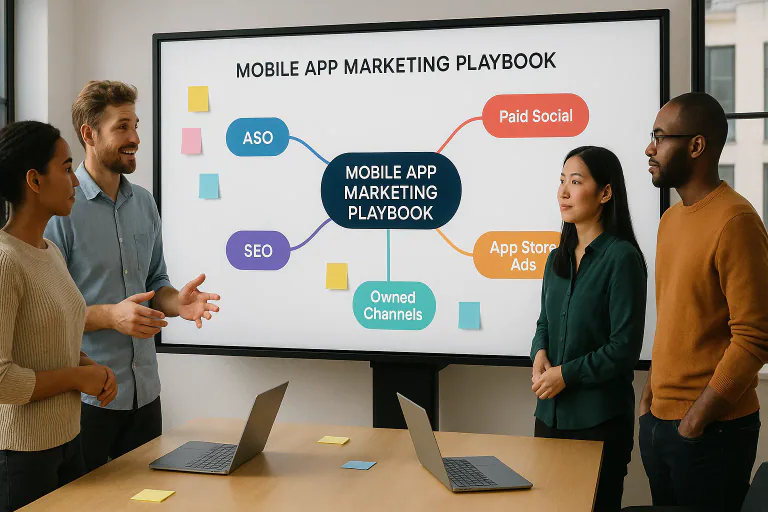
Once your foundations are in place, the smartest move is to lean into channels that compound instead of resetting every time you pause spend. This is where organic mobile app marketing quietly does most of its long-term work.
If you have an app, app store optimization is not optional. It is the one channel that works for you every hour of the day, whether you are running ads or not.
At a basic level, ASO means tightening your keywords, title, subtitle, description, screenshots, and ratings so that when someone searches for what you do, you actually show up and convert. In one well-known ASO case study, a startup reported a 700% increase in downloads after systematically improving its store presence, which is exactly the kind of lift you want from a “foundational” channel.
A practical ASO approach in 2026:
When your listing converts well, every mobile app advertising click becomes cheaper in real terms, because more of that paid traffic turns into installs and active users. That is why ASO sits at the top of any high-ROI channel playbook.
Your website should not just repeat what is in the store listing. It can be a serious engine for organic app installs if you treat it as part of your acquisition system instead of an afterthought.
For most apps, the pages that pull real weight are:
From there, you send visitors straight into the store listing, or into a “start on web, continue in app” flow if your product supports that. The point is to meet search demand, answer it well, and then give people a clean bridge into your app.
If you are not sure which numbers to watch around these flows, OpenForge has a deeper breakdown of the top mobile app metrics for growth marketing. Use that as a checklist when you wire analytics into SEO pages and web-to-app funnels so you can actually tell which content is moving installs and revenue.
Owned channels are rarely flashy, but they are often where the real ROI lives.
If you capture email or SMS on your site or inside the app, you can:
Push notifications belong in the same group. When they are tied to behavior and value, not just spammy reminders, they protect retention and act as a low-cost acquisition and re-engagement lever.
Recent email ROI benchmarks show why marketers keep investing here: one 2025 roundup found an average return of about $36 for every $1 spent on email campaigns, with many brands seeing even higher performance in the right segments. That is the kind of unit economics that can quietly subsidize riskier experiments in other channels.
The mindset shift is simple: email, SMS and push are not “support.” They are mobile marketing channels in their own right, with experiments, budgets and clear KPIs.
Organic social in 2026 is not about posting brand slogans and hoping something goes viral. It is about short, honest content that shows how your app fits into real workflows and daily life.
Platforms like TikTok are especially strong for apps because they blend discovery, social proof, and recommendation in one feed. A 2025 overview of TikTok statistics reports that 61% of users discover new brands and products on the platform, and 92% take some kind of action after seeing content that resonates, which is exactly the behavior you want when you are growing an app efficiently.
A simple way to approach this:
Think of organic social as a signal amplifier. When a concept or hook resonates, you support it with spend. When it does not, you learned cheaply.
Finally, there are your existing users. Referral and invite systems are not magic, but when they are designed well they become some of the highest-ROI app marketing channels you will ever build.
The mechanics are straightforward:
Real-world data backs this up. In one mobile referral case study, GoMechanic used deep-linked referral campaigns to achieve a 50% higher click-to-install rate than average and a 60% install-to-purchase conversion rate from referrals, making it one of their strongest growth levers.
This is why OpenForge usually treats referrals as a UX and product decision, not just a marketing tactic. When referrals, tracking and onboarding are aligned, they behave like a quiet compounding channel in the background while you experiment with everything else.
Get expert support to launch and scale your mobile app
Organic channels give you compounding wins; paid is how you turn the taps up on demand when you are ready. The problem is that paid has never been more competitive. Mobile now accounts for more than half of global digital ad spend, and in-app ads are projected to cross the $400 billion mark in 2024 alone.
That does not mean “turn off ads.” It means you need a tighter playbook for where you run them, what you expect from each channel, and how you measure return so you do not burn budget chasing vanity metrics.
For most products, the first serious mobile app marketing channel on the paid side is still social: Meta (Facebook/Instagram), TikTok, YouTube, and Snap. Social has the reach, the creative formats, and the targeting to get you from “we have a good app” to “we have real install volume.”
Global reports show social placements taking close to 30% of online ad budgets, with spend still growing year over year, which is a good proxy for where your competitors are fighting for attention.
How to think about social in your playbook:
You do not need to be everywhere on day one. Start with one or two platforms where your audience already lives, move beyond basic app install campaigns, and treat creative as the biggest lever you have. When you are planning budgets, it also helps to balance media spend against what you are investing in the product itself; if you still need clarity on build and maintenance ranges, OpenForge’s guide on how much it costs to develop an app in 2025 is a useful reference point when you are thinking about total ROI, not just cost per install.
While social is great for demand generation, app store ads are best for demand capture. These users are already in the store, searching for apps like yours.
Apple’s own documentation highlights that search is responsible for the majority of App Store downloads, and their ad product routinely sees strong conversion performance on search results campaigns when the app and keywords are well aligned.
In your playbook, store ads usually serve three roles:
On Google’s side, App Campaigns (formerly UAC) bundle placements across Search, Display, YouTube and the Play Store, using machine learning to optimize toward installs or in-app actions. Case studies regularly show these campaigns driving double-digit increases in installs when properly configured and fed with enough creative assets.
Store ads are not magic, but in a high-ROI playbook they are hard to ignore. They tend to be more efficient when your ASO is strong (your store page converts well) and when you are crystal clear about which keywords and events matter.
Beyond social and store ads, there is a third layer of mobile app advertising: programmatic in-app inventory and specialized gaming or vertical networks.
This is where you tap into banners, interstitials, rewarded video, and native placements inside other apps. It can be extremely scalable, but only if you have:
The upside is reach. Recent industry summaries estimate that mobile in-app ad spend will be well over $170 billion in 2024 alone, and that apps account for more than 80% of all mobile ad spend, which tells you where the bulk of attention and inventory really lives.
This layer is usually not your first move. It is where you go once you already know:
For heavily regulated verticals like healthcare, you also need to be selective about where and how you show up. If you are in that world, it is worth aligning your UA story with how you talk about the product’s value and compliance; OpenForge’s piece on mobile health apps and how they are redefining healthcare is a helpful companion when you think about messaging, trust and targeting in that space.
The last big pillar of paid in this playbook is creator and influencer marketing. This sits somewhere between paid and organic: you are paying for content and reach, but if the content lands, it keeps working beyond the initial flight.
Creator spend has exploded in the last few years. Industry bodies like the IAB now estimate that US creator-economy ad spend is growing several times faster than the overall media market, with brands increasingly treating creators as a “must-buy” channel rather than an experiment.
For mobile apps, creators can:
The risk is paying for vanity metrics: views and likes that never turn into installs or revenue. You avoid that by:
Creators become a powerful part of your high-ROI mix when they are plugged into the same measurement framework as everything else. You are not buying posts; you are buying performance.
If you step back, the structure is simple:
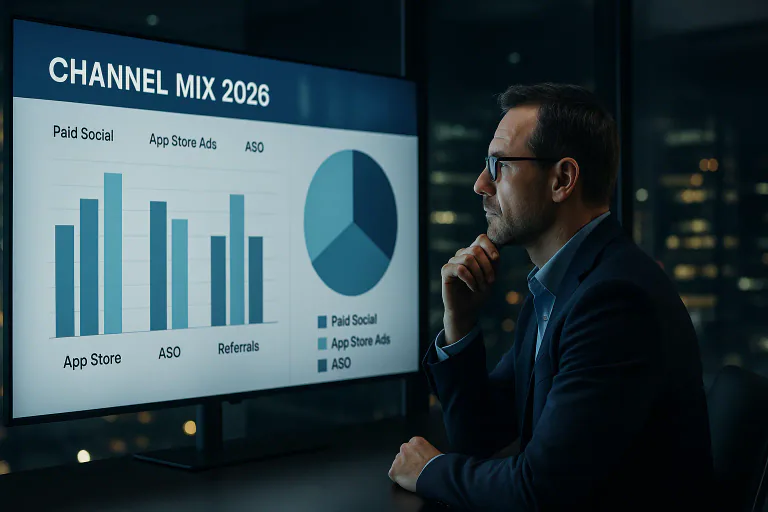
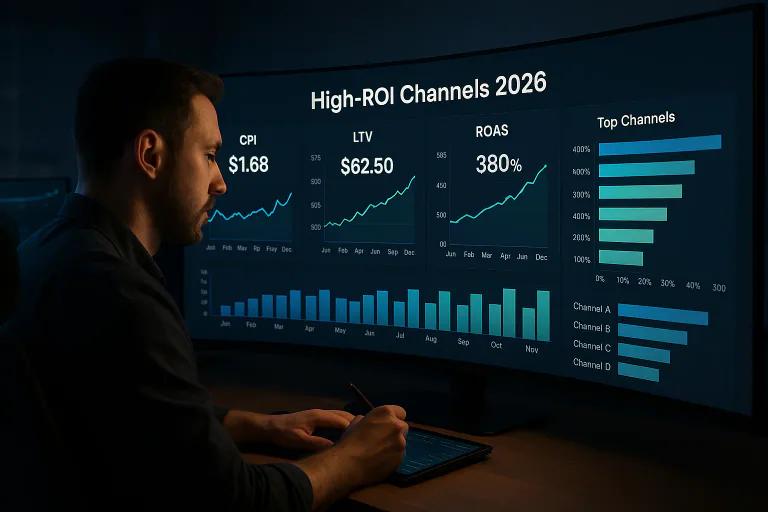
The hard part is running all of this as a system, not as disconnected campaigns. You need to understand what a realistic cost per install looks like in your category, using trusted global CPI benchmarks for your vertical instead of guessing and often higher in competitive niches), and then compare that against what a retained, paying user is worth over time.
That is also where the rest of your strategic picture matters: the category you are in, the business model, and the underlying tech and UX. OpenForge digs into those bigger forces in its breakdown of 9 mobile app development trends and future forecasts, which is worth reading alongside your channel plans so you do not optimize around trends that are already fading.
Paid UA will always be competitive. The point of a high-ROI playbook is not to make it cheap; it is to make it predictable. You know which channels do what, what “good” looks like for each, and how they connect back to product and retention so you can scale without flying blind.
Once you understand the main channels, the next step is deciding which ones to run now and which ones can wait. A good playbook changes with your stage, budget, and category instead of copying someone else’s media plan.
Wondering what mobile app development really looks like?
In pre-launch and early launch, your job is not “scale.” It is learning what works without burning months of runway.
For most apps at this stage, a lean, high-ROI mix looks like:
The KPI here is signal: people understand the value, they install, they activate, they come back. If you cannot get these behaviors with small budgets and tight loops, heavy media spend will just hide the problem for a while.
When you see consistent product fit and healthy retention curves for your best cohorts, you are in growth stage. Here, the main risk is scaling too fast on the wrong channels.
A typical growth-stage mix:
At this point you should be tracking mobile app user acquisition by channel, but judging those channels on downstream metrics like day-30 retention, trial-to-paid conversion, and early LTV, not just install counts.
For mature apps, the question shifts from “how do we get more users” to “which users and markets generate the best return.”
You start to:
Your mobile app marketing services and partners should be comfortable working with these more advanced questions. At this stage, a small improvement in LTV or retention often beats a big jump in top-of-funnel installs.
You do not need a perfect spreadsheet to start, but it helps to think in simple stacks:
The exact percentages will depend on your category, but the principle is the same: fund the channels that reliably bring users who stay and pay, trim or pause the ones that do not.
A lot of teams know the channels. Very few run them as a repeatable system. High-ROI marketing is less about “big ideas” and more about doing the boring parts consistently.
Creative is usually the biggest lever in mobile app marketing, especially on social and programmatic.
You need a simple, steady cadence:
Instead of searching for one miracle ad, aim for a pipeline that keeps your best channels supplied with new concepts every week.
Data is not only for reporting. It should tell you where money should move next.
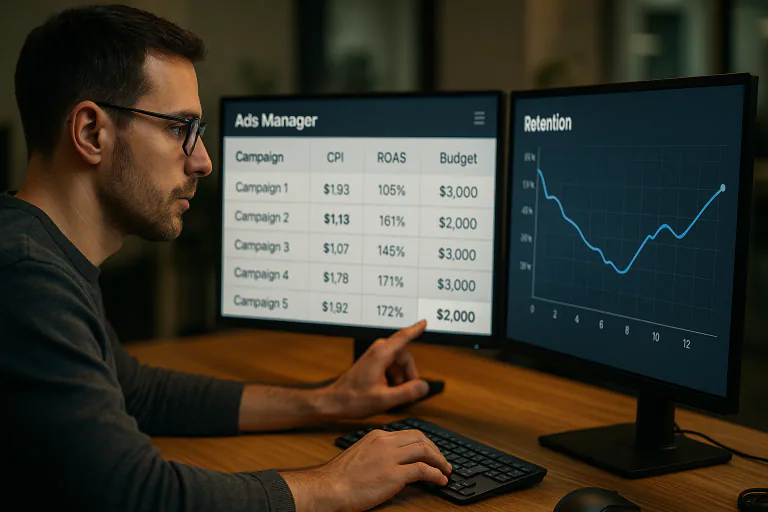
At a minimum, you should be able to see by channel and campaign:
Then you can make simple decisions:
This is the difference between “we spent more because everyone else did” and “we funded the channels that prove they deserve it.”
The last operational piece is alignment. If UA, product, and lifecycle are working in separate corners, channel performance will always feel random.
A healthier loop:
This is the way OpenForge prefers to work: not as “the marketing team,” but as a partner that helps make sure the app itself, the tracking, and the channels all tell the same story.
So how does this actually look when a company works with OpenForge instead of trying to duct-tape everything internally?
First, OpenForge spends time learning how your product actually performs:
From there, you co-design a channel strategy that fits your stage:
The output is a clear plan: which channels to prioritize, what “good” looks like in each, and how they link back to product and revenue.
OpenForge does not treat the app as fixed and marketing as a separate layer on top. The team prefers to design:
as one set of decisions. That way, when you launch campaigns, they point into an experience that is already set up to convert and measure.
This is particularly useful if you are still evolving the product itself. If you are balancing questions about features and budget, pairing this playbook with resources like your cost and roadmap planning makes the channel conversation much more grounded.
Once the system is live, the work becomes iterative:
Over time, you end up with a mobile app marketing machine that you understand: you know what inputs you control, what outputs are realistic, and how to troubleshoot when numbers move.
You do not need a partner for everything, but there are clear moments when teams usually reach out:
In those scenarios, having a team that understands both product development and acquisition can save a lot of expensive trial and error.
Mobile app growth in 2026 is not about finding one magic channel. It is about building a system where:
When you run mobile app marketing this way, channels stop feeling like a slot machine. You still test, but you test inside a structure where you know what you want from each lever and how to judge success.
If you are looking at your current mix and you are not sure which channels deserve more budget, which should be paused, or how to connect your acquisition work back to product and retention, that is where a partner can help. OpenForge lives in that crossover between mobile app design, development, and growth, and can help you turn ideas into a clear channel plan and a roadmap of experiments.
If you want to talk through your situation with someone who does this every day, you can contact the OpenForge team and map out what a high-ROI channel strategy could look like for your app.
It is the mix of channels and tactics you use to get people to discover, install, and keep using your mobile app, from app store optimization and SEO to paid social, app store ads, and lifecycle messaging.
There is no single winner, but most strong playbooks lean on ASO, SEO and content, a focused set of paid social and app store ads, plus owned channels like email, SMS, and push that keep users active once they arrive.
Early on, invest enough in paid to learn quickly, while steadily building organic foundations. Over time, you want a balance where organic channels carry more of the load and paid is used to scale what you already know works.
Yes. ASO improves conversion from both organic and paid traffic, which means you waste fewer clicks and reduce your effective acquisition cost in every channel that sends users to your store listing.
If you are about to increase spend, enter new markets, or relaunch a product and you do not have the in-house time or experience to design and run a proper playbook, bringing in a partner like OpenForge often saves money compared with learning everything the hard way.
Continue reading
OpenForge insight
February 20, 2026
OpenForge insight
February 17, 2026
OpenForge insight
January 20, 2026