OpenForge insight
How Can Generative AI Help Businesses Launch Smarter Mobile Apps?
Learn how generative AI mobile app development helps businesses launch faster, reduce costs, and improve ROI. 2026 guide by OpenForge.
February 20, 2026

OpenForge insight
By OpenForge editorial team · Published February 22, 2026 · Updated March 3, 2026
Schedule a Free Demo Schedule a Free Demo TALK TO AN EXPERT 1. What is the main cause of churn in B2B apps? 2. Are push notifications effective for B2B apps? 3. How does in-app messaging reduce churn? 4. Is email still effective for SaaS retention? 5. When should teams start focusing on churn reduction?
Churn is rarely about a bad product.
Most of the time, it’s about a product that stopped showing its value fast enough.
In 2026, B2B apps are competing in a brutal environment. Buyers expect consumer-grade UX, instant value, and personalization. Meanwhile, CMOs and founders are under pressure to prove ROI with smaller teams, tighter budgets, and less tolerance for experimentation that doesn’t move metrics.
If your app acquisition is strong but retention is flat or declining, the problem usually isn’t marketing volume. It’s how your product communicates with users after they sign up.
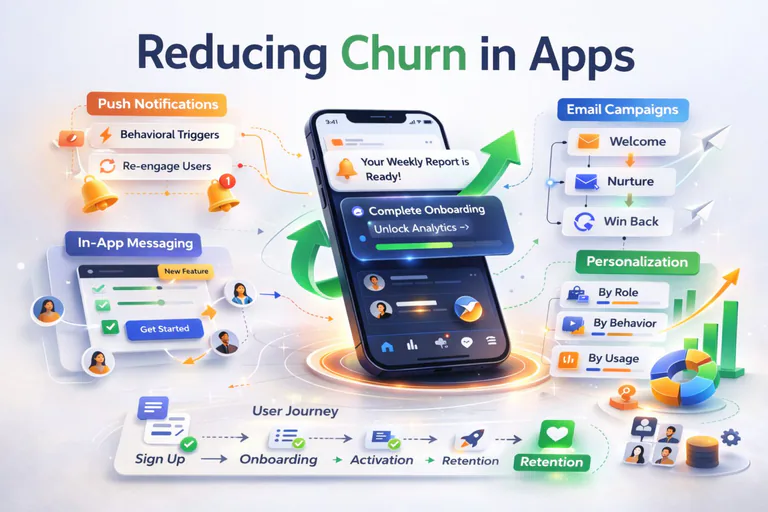
Push notifications, in-app messaging, and email are no longer “growth hacks.” They are core product infrastructure for churn reduction.
Let’s break down the best way to reduce churn in B2B apps in 2026, and how leading teams are executing it.
B2B churn is rarely emotional. It’s rational.
Users leave when:
In enterprise and SaaS environments, churn often starts weeks before cancellation. Usage drops. Logins slow. Core actions disappear.
Retention isn’t about convincing users to stay. It’s about preventing disengagement before it becomes irreversible.
That’s where messaging channels come in.
By 2026, crypto trading apps face real risk around:
This directly impacts product architecture, not just legal paperwork.
Push notifications get a bad reputation because most teams use them wrong.
Used correctly, push is one of the fastest ways to reduce churn in B2B apps.
Effective B2B push notifications are:
Examples:
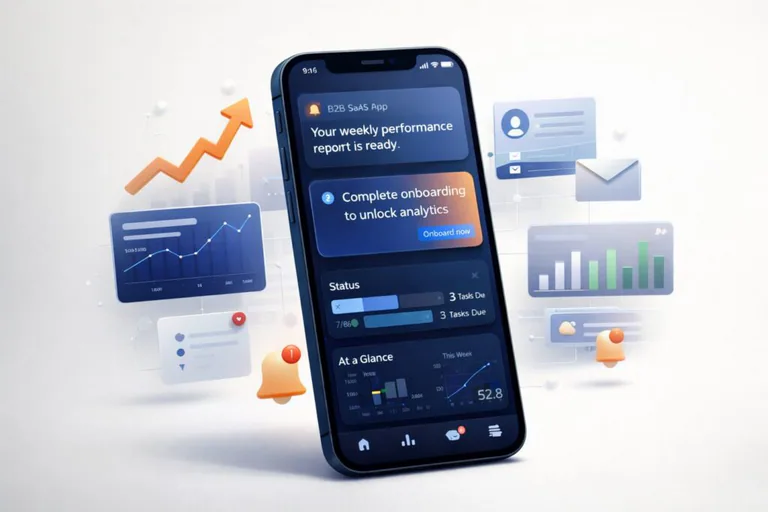
These pushes bring users back into the product at moments that matter, not just to boost DAUs.
Push notifications should never be:
If a push doesn’t clearly answer “why should I open this right now?”, it’s training users to ignore you.
📅 CTA: Want help designing behavioral push flows that don’t annoy users? Schedule a Free Consultation
Ready to turn your app into a retention engine, not just a feature list?
If push brings users back, in-app messaging keeps them there.
In-app messages are where activation, adoption, and retention actually happen.
Most churn happens before users ever see value.
High-performing B2B apps use in-app messages to:
Instead of long tours, they deploy:
This shortens time-to-value, one of the strongest predictors of retention.
In-app messaging is also critical post-onboarding.
Examples:
These nudges connect feature usage to business outcomes, which is exactly how B2B buyers justify renewals.
Is your app built to reduce churn, or just acquire users?
Email isn’t dead. It’s just overused.
In 2026, the highest-retention B2B apps use lifecycle email, not newsletters.
Lifecycle emails are triggered by:
Examples:
These emails feel helpful, not promotional.
When usage drops, silence kills retention.
Well-timed emails can:
The key is timing and relevance, not frequency.
📅 CTA: Struggling to connect email, in-app, and push into one retention system? Schedule a Free Consultation
Push, in-app, and email only work when personalized.
Personalization in 2026 goes beyond first names.
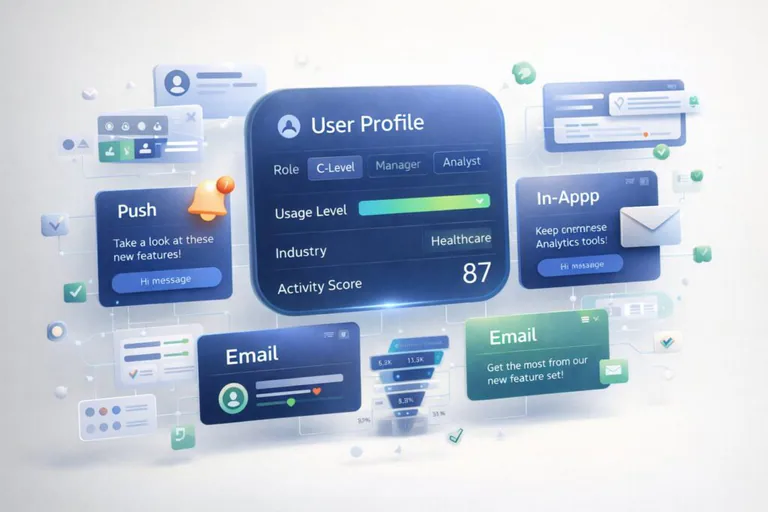
High-retention B2B apps personalize by:
A founder, a manager, and an analyst should never see the same messages.
Personalization makes users feel the product was built for them. That perception alone reduces churn.
Many teams lose users not because of bad strategy, but because of execution gaps.
Common mistakes:
Retention strategies fail when the underlying product can’t support them.
At OpenForge, churn reduction starts before the first message is sent.
We help B2B teams:
In our Summon Worlds case study, we helped build a high-engagement AI-powered app by focusing on:
Retention wasn’t an afterthought. It was designed into the product.
📅 CTA: If your app is growing but churn is holding you back, let’s talk. Schedule a Free Consultation
The best way to reduce churn in B2B apps in 2026 is to combine behavioral push notifications, contextual in-app messaging, and lifecycle email into a single, personalized retention system tied to user actions and business outcomes.
Apps that treat messaging as part of the product experience, not a marketing afterthought, consistently outperform those that rely on static onboarding or generic campaigns.
In 2026, the best way to reduce churn in B2B apps isn’t a single channel.
It’s a system.
The most common cause is users failing to reach or understand the app’s core value quickly enough.
Yes, when they are behavior-based, relevant, and tied to unfinished value.
It guides users at critical moments, improves feature adoption, and shortens time-to-value.
Yes. Lifecycle and churn-risk emails consistently outperform generic newsletters.
From day one. Retention should be designed into the product, not added later.
Continue reading
OpenForge insight
February 20, 2026
OpenForge insight
February 18, 2026
OpenForge insight
February 17, 2026