OpenForge insight
How Do Mobile Apps Increase Revenue Beyond Installs?
How mobile apps increase revenue goes far beyond installs. Learn the 2026 business case, proven monetization strategies, and how scalable app design drives ROI.
February 17, 2026

OpenForge insight
By OpenForge editorial team · Published January 29, 2026 · Updated January 28, 2026
Schedule a Free Demo Schedule a Free Demo Schedule a Free Demo TALK TO AN EXPERT 1. What is Liquid Glass UI design? 2. How is Liquid Glass different from glassmorphism? 3. Will Liquid Glass replace flat design? 4. Is Liquid Glass suitable for all mobile apps? 5. When will Liquid Glass become mainstream?
Mobile UI design is entering another transition phase.
After flat design, material design, and glassmorphism, each has reshaped how interfaces look and feel. A new visual language is beginning to emerge across concept work, operating system experiments, and advanced design systems: Liquid Glass UI.
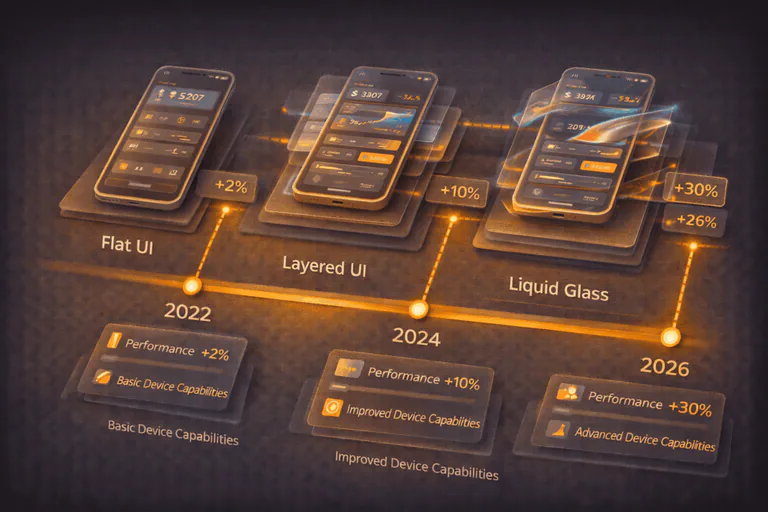
While still emerging, Liquid Glass is not just a stylistic trend. It represents a shift in how interfaces respond, move, and feel, particularly on high-performance mobile devices. By 2026, Liquid Glass principles are likely to influence how modern mobile apps communicate hierarchy, feedback, and depth.
This article explains what Liquid Glass UI is, how it differs from past UI trends, and what product teams should understand before adopting it in mobile app design.
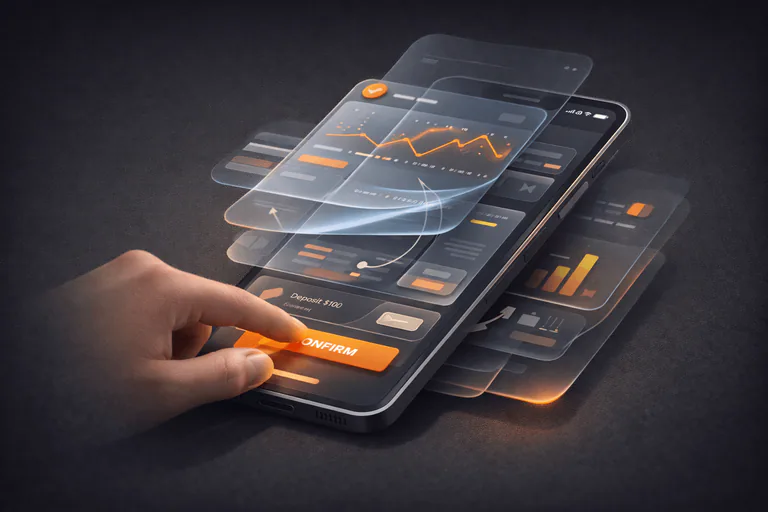
Liquid Glass UI is an interface design approach that blends transparency, fluid motion, layered depth, and real-time responsiveness to create interfaces that feel dynamic rather than static.
Unlike traditional glass effects that rely on fixed blurs or overlays, Liquid Glass emphasizes:
In practice, Liquid Glass UI feels less like stacked panels and more like living material, interfaces that subtly bend, flow, and react as users interact with them.
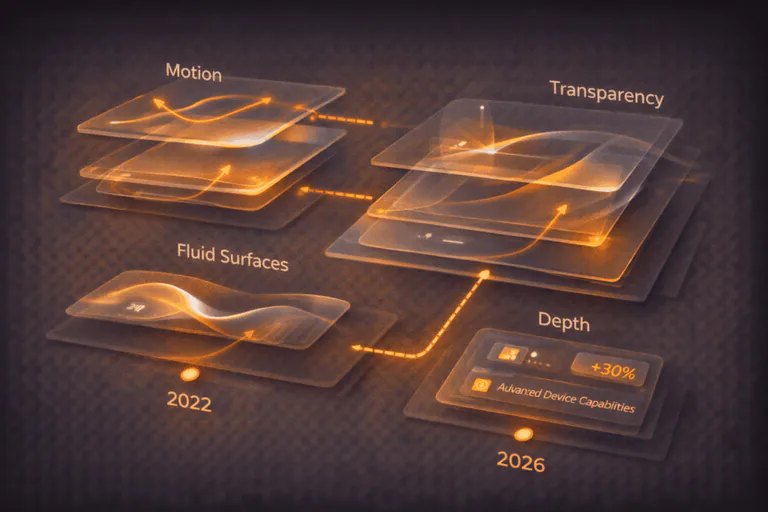
Liquid Glass is not appearing in isolation. It is a response to several converging shifts in mobile technology.
Modern smartphones now support:
What once caused performance issues can now be rendered smoothly, making fluid, layered interfaces practical rather than experimental.
As apps compete for attention, static UI feels increasingly lifeless.
Liquid Glass introduces:
This improves perceived responsiveness without adding cognitive load.
Design systems are evolving beyond static components.
Liquid Glass fits naturally into:
By 2026, many design systems will treat motion and material behavior as first-class primitives.
Get expert support to launch and scale your mobile app
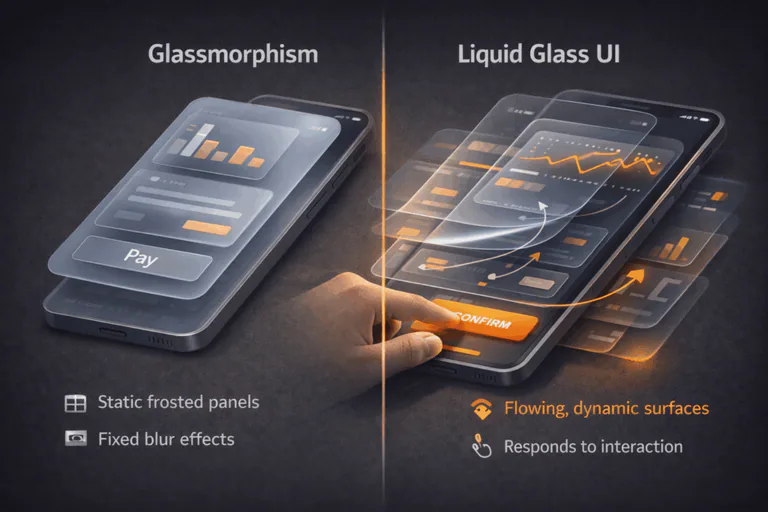
Liquid Glass is often confused with glassmorphism but they are not the same.
Glassmorphism focuses on:
Liquid Glass UI, by contrast, emphasizes:
Where glassmorphism is largely visual, Liquid Glass is behavioral.
Liquid Glass makes responsiveness visible.
Instead of relying solely on loading states or spinners, interfaces subtly:
This creates the perception of speed even when operations take time.
Traditional UI relies on sharp edges and static containers.
Liquid Glass introduces:
This helps users understand where they are and how actions relate to outcomes.
Depth in Liquid Glass UI is not fixed.
Elements move forward or recede based on:
This allows designers to guide attention without adding clutter.
Animations in Liquid Glass are not decorative.
They:
When done well, motion becomes part of usability, not just aesthetics.
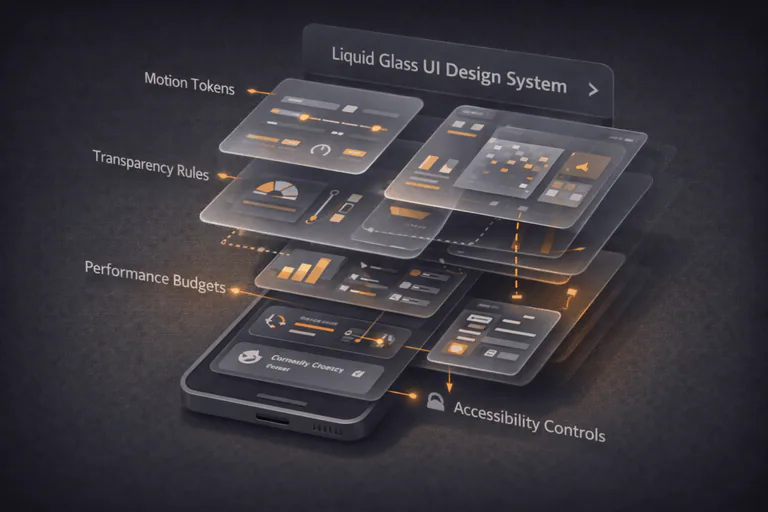
Liquid Glass cannot be “added later.” It must be designed at the system level.
Design systems will need:
Liquid Glass UI must respect:
Not every surface should move and restraint will matter.
Fluid interfaces must still support:
Liquid Glass done poorly increases friction. Done well, it enhances clarity.
Wondering what mobile app development really looks like?
Excess motion overwhelms users and degrades performance.
Liquid Glass is about interaction behavior, not just appearance.
Heavy effects without performance budgets lead to dropped frames and degraded UX.
What works at the OS level may not translate to complex app workflows.
Want to explore solutions tailored to your team?
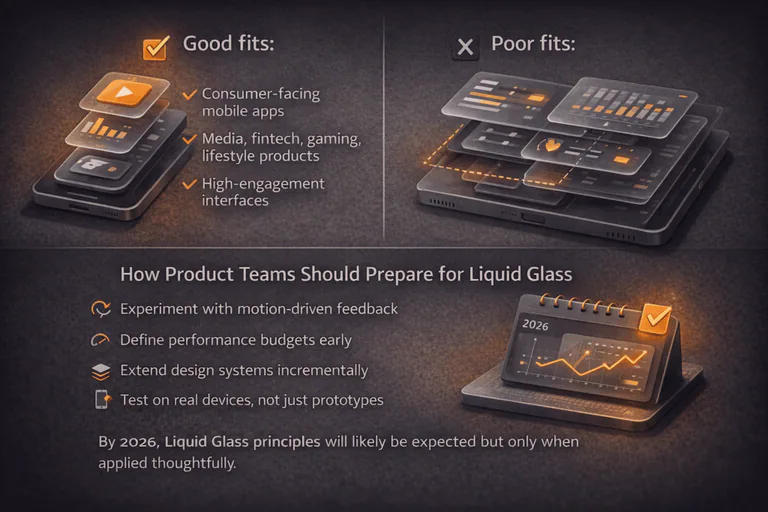
Good fits:
Poor fits:
Liquid Glass is not universal and restraint is part of maturity.
Rather than redesigning everything, teams should:
By 2026, Liquid Glass principles will likely be expected but only when applied thoughtfully.
Liquid Glass UI is not about making apps look futuristic.
It’s about making interfaces:
The teams that succeed will treat Liquid Glass as interaction design, not decoration.
OpenForge works with product teams to design and build mobile apps where UI innovation, performance, and scalability evolve together without sacrificing usability or clarity.
📅 Schedule a Free Consultation to explore how future-ready UI patterns fit your product roadmap.
Liquid Glass UI is a design approach that combines transparency, fluid motion, and adaptive depth to create interfaces that visually respond to user interaction.
Glassmorphism focuses on static visual effects, while Liquid Glass emphasizes interaction-driven motion and dynamic behavior.
No. Liquid Glass will complement flat design principles by adding motion and depth where appropriate.
No. It works best for high-engagement apps and should be avoided in performance-critical or data-dense interfaces.
Liquid Glass concepts are already emerging and are likely to influence mainstream mobile UI patterns by 2026.
Continue reading
OpenForge insight
February 17, 2026
OpenForge insight
January 20, 2026
OpenForge insight
January 18, 2026