Book Your Free Consultation TALK TO AN EXPERT 1. ❓What is fintech app compliance? 2. ❓What are the 5 D's of fintech? 3. ❓ What is AML compliance for fintechs? 4. ❓What are the regulations for fintech? 5. ❓What are the key areas covered by fintech regulations?
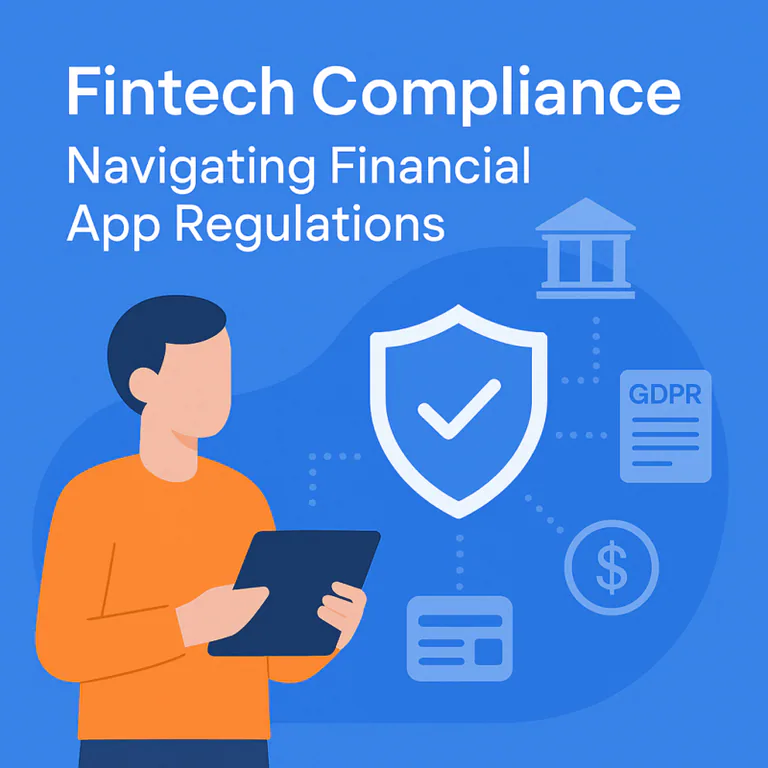
Struggling with fintech compliance? This guide covers AML, KYC, GDPR, and PCI DSS, and how OpenForge builds compliant fintech apps.
Table of Contents
Wise’s U.S. arm got a reminder no fintech firm founder wants. The company was fined $4.2 million for AML/CFT gaps. Even heavyweights trip on compliance.
If you’re planning to launch your fintech app, you need more than users downloading your app. You need an app that people trust with their data because anytime you can hear from regulators, “not so fast,” and your dream app hits a compliance brick wall, making it essential to follow regulatory compliance.
GDPR, AML, KYC, and PCI DSS evolve fast, and punish mistakes in risk management. For founders, compliance feels like dragging a heavy suitcase.
But are finance and compliance necessary? What if compliance became part of your strength instead of your speed bump?
This guide shows you exactly how to build fintech apps that are bold and compliant. You learn the key rules, the real traps, and how you can launch fast without sacrificing trust or getting flagged.
Why Fintech Compliance Matters Now
The global fintech or financial technology market will grow from $209.7 billion in 2024 to over $1.5 trillion by 2033, at a CAGR of 25%. With this surge comes a sharper regulatory spotlight on financial crimes. Fintech startups have raised almost 24 billion, distributed across 2,600 deals in the first half of 2025 alone, which gets investors examining compliance frameworks with the same scrutiny as business models.
Investors are reluctant to support high-risk and non-compliant ventures, and banks and financial institutions are becoming increasingly insistent on AML, KYC, and data protection protocols to be met by the fintech partner before signing deals. And your users will ditch an app the minute you break their loyalty. One breach of compliance can cost millions in fines and irreparably damage your reputation. Compliance often forms the foundation for funding, partnerships, and trust among users.
If you’re nodding along, then you're ready to take the next step
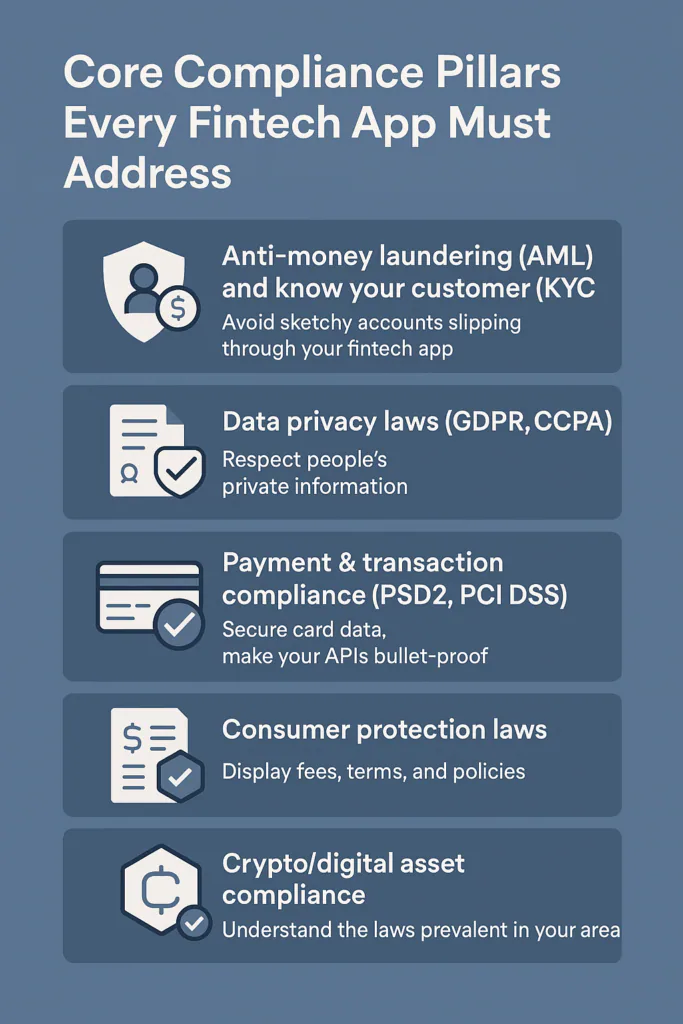
Core Compliance Pillars Every Fintech App Must Address
Here are the core compliance pillars for every fintech app:
Anti-money laundering (AML) and know your customers (KYC)
Avoid sketchy accounts slipping through your fintech app. Use identity checks, watch transaction patterns, and verify users before things go sideways.
Data privacy laws (GDPR, CCPA)
Respect people’s private information. Clearly explain what you collect, why you need it, and keep it locked down tight. Let users control their data.
Payment & transaction compliance (PSD2, PCI DSS)
If you’re handling payments in the financial systems, you need to follow rules. Secure card data, make your APIs bullet-proof, and prepare for audits.
Customer protection laws
All your customers hate surprises. You need to display fees, terms, policies, and all regulatory requirements set by regulatory bodies. Give users easy ways to raise concerns or request refunds.
Crypto/digital asset compliance
Digital assets bring extra oversight. Understand the laws prevalent in your area, mind the licensing requirements, and do not exploit the regulatory loopholes for your app’s benefits.
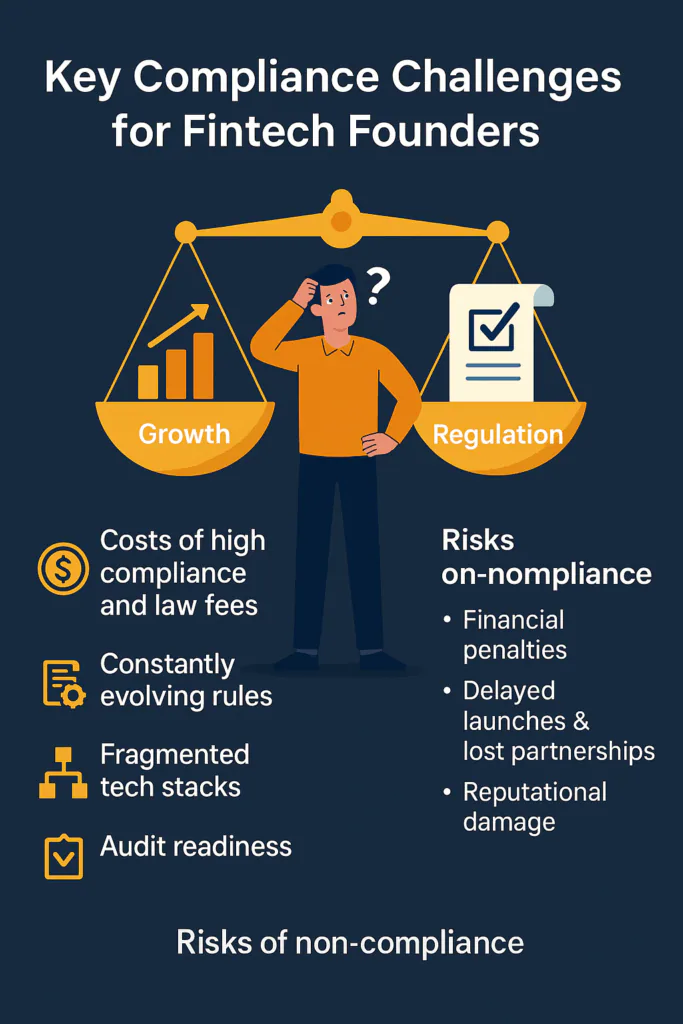
Key Compliance Challenges for Fintech Founders
Choosing between growth and regulation
Every fintech founder faces the same question: “How do you scale quickly while complying with regulators?” On the one hand, there’s the necessity to develop the product fast, find users, gain investor momentum, and navigate the regulatory framework. Compliance frameworks, such as KYC, AML, PCI-DSS, and General Data Protection Regulation (GDPR), are in growing demand.
In the early days, most startups don’t have a compliance expert on the team. That means product managers and engineers end up making their best guesses about complex regulations. Many of these guesses often miss the mark. The gaps might come back later, when investors or regulators point them out, leading to expensive costs and time wastage.
Common Pain Points
When compliance is taken seriously by the founders, there are several common pitfalls that put the brakes on your Android app development:
High compliance costs and law fees
Building compliance frameworks often eats into your budget because specialist lawyers and attorneys charge enterprise-level rates even for small startups.
- Constantly evolving rules
Global regulators issue frequent updates, leaving lean teams struggling to track changes across jurisdictions. Missing even a minor update can derail the app launch.
Startups stitch payment gateways, identity verification APIs, and accounting systems together. Without a central audit trail, monitoring compliance across fintech apps is a messy and inefficient process.
Preparing for audits without structured processes feels like starting from scratch every time. Teams scramble for documentation, introducing risk and unwanted stress.
Risks of Non-Compliance
For fintechs, not adhering to compliance regulations leads to:
Regulators around the globe have let down millions in fines on startups and businesses for failing to implement a compliance program and safety measures.
- Delayed launches and lost partnerships
Non-compliance stops partnerships with banks and payment providers. Enterprise apps fall dead in their tracks. Without trust, integrations can never move forward.
Perhaps the hardest to recover from, reputational loss can cause user churn and erode investor confidence in the eyes of regulatory authorities. In a trust-driven sector like fintech, even a small compliance failure is a deal-breaker.
Building a Scalable Compliance Strategy (Solutions and How-To)
How Founders can Include Compliance in App Development
The best way to avoid compliance headaches is to treat it as a design principle and not an afterthought. Rather than fixing issues later on, include compliance into your app from day one:
Privacy-by-design architecture
Encrypt information in storage and transit, keep important information safe, and make consent flow readily comprehensible and easy to deal with.
Audit logging and transaction monitoring
Embed these directly in your codebase to trace every action. You can share the trail whenever a partner or regulator asks for proof.
Automated KYC/AML integrations
Manage identity checks, transaction monitoring, and detect fraud using API-first compliance tools. They absorb much of the manual work, so when regulations change, your system does not require constant rework.
How to Stay Ahead of Regulations
You need to build compliance with every product. Processes and governance are necessary for seamless scaling of your business operations:
Set up an internal compliance team or advisor early
An internal team comprising fractional experts and advisors prevents costly missteps early on.
Adopt compliance software / RegTech solutions
Tools for continuous monitoring, regulatory reporting, and documentation will take pressure off lean teams.
Conduct regular compliance audits
Avoid waiting for a regulator to find gaps. So, run quarterly or semi-annual reviews to stay proactive.
Prioritize compliance features in your roadmap
Ensure that the security and compliance improvements are your priority, like the user-facing features.
Turning Compliance Into a Competitive Advantage
Although many companies see compliance as an extra liability, savvy founders understand that it’s a key differentiator:
- Trust and user retention: Users will find it easier to remain on an app that is safe and trustworthy. An effective, comfortable UX creates loyalty.
- Faster approvals from investors and regulators: Demonstrating mature compliance practices can speed up due diligence and partnerships.
- Scale with confidence: A good compliance base enables you to enter new markets easily without having to start from scratch.
Role of OpenForge in Fintech Regulatory Compliance
OpenForge helps fintech companies stay compliant with complex regulatory demands by developing secure, scalable, and regulation-ready mobile apps. They are not just designers and developers, but also provide compliance with KYC/AML integrations, audit logs, data encryption, biometric authentication, and fraud detection with the mobile app design directly embedded.
This iOS app development company enables fintech startups and businesses to launch more quickly, reduces legal risks, and maintains user confidence as they adapt to shifting compliance environments. The developers ensure that mobile app development aligns with financial laws and fintech industry standards.
Turn your Compliance into a Fintech Powerhouse
With trust and partnerships secured and the ability to scale, fintech compliance builds trust. Regulatory change is often an overwhelming process, but when founders make compliance a fundamental design choice, your apps will stand out in an oversaturated market.
You gain customer loyalty and investor trust by designing the product with AML and KYC, following data protection laws like the GDPR, and payment security built in from the outset. Compliance becomes manageable, like dragging a suitcase, with the right partners, such as OpenForge.
Schedule a call with us to know how OpenForge builds secure and compliance-ready mobile app development.
Frequently Asked Questions
Fintech app compliance ensures fintech apps meet legal, security, and regulatory standards for safe financial operations.
The 5D’s of fintech are Disruption, Digitalization, Data, Decentralization, and Democratization.
AML compliance for fintechs includes a set of rules and practices that fintechs follow to detect and prevent money laundering.
Data protection laws, KYC/AML, payment security, licensing, and consumer protection laws comprise the regulations for fintech.
Important areas covered by the fintech regulations are customer identity, data privacy, fraud prevention, cybersecurity, and financial transparency.