Schedule a Free Demo Schedule a Free Demo TALK TO AN EXPERT 1. ❓How much does it cost to develop an app? 2. ❓Why do app projects go over budget? 3. ❓How do you ensure your projects don't go over budget?small startups? 4. ❓What happens if an app project goes over budget? 5. ❓What would you do if a project were starting to go over budget?
Building an app should create momentum for your business and open clear paths to growth. Yet many projects start drifting off budget before anyone notices. A few unclear requirements here, a touch of scope creep there, and the “simple build” quietly turns into an expensive detour. Budget overruns affect far more than the final number.
They slow product velocity, delay launches, and weaken the ROI your team expects. The interesting part is that the same patterns appear across industries and project types.
In this blog, we'll walk through the hidden reasons for going over budget, how to overcome those challenges, and how Openforge prevents app projects from going over budget.
Table of Contents
Why Mobile App Development Costs Commonly Go Over Budget
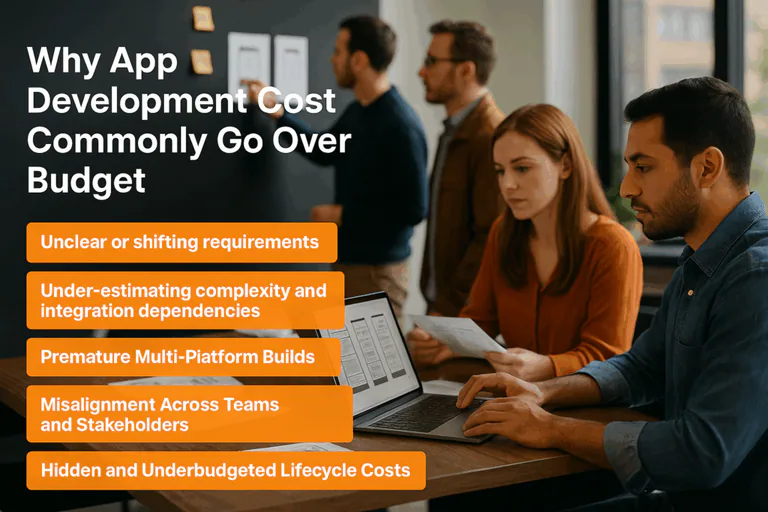
Your app development costs commonly go over budget because of:
Unclear or shifting requirements
What happens when you team builds a base based on their understanding, only to find that expectations have changed? Starting a project with unclear requirements or goals overshoots your app development costs. Research shows that, on average, one in six IT projects has a cost overrun of 200% and a schedule overrun of almost 70%.
For example, a project may start with adding a basic social-sharing feature. Then the team walks through the prototype, and suddenly the wish list grows. Someone wants in-app messaging, another person asks for deeper analytics, and eventually, offline access comes up too.
Each addition means more design work, more development time, and extra rounds of testing. Over time, the original budget increases because the team was building a moving target.
Under-estimating app complexity and integration dependencies
iOS app development can feel pretty simple in the beginning, but things change fast once you plug it into the back-end systems. This hidden complexity shows up, especially around integrations, where you can run into things like:
- Inconsistent data structures
- Unpredictable API response times
- Authentication constraints
- Version mismatches
- Legacy systems that require custom handling
These challenges rarely appear in early scoping sessions. They emerge when the team begins connecting the dots, turning what was estimated as a simple workflow into a multi-step engineering effort. This gap between perceived complexity and actual complexity is one of the biggest drivers of cost expansion.
Premature Multi-Platform Builds
Choosing to launch on multiple platforms too early multiplies timelines, testing, and design requirements before the core product matures. Each platform brings its own constraints, patterns, and technical considerations. When UX flows evolve mid-project, as they almost always do, replicating revisions across platforms is tough.
Teams lose efficiency because they build and refine in parallel rather than learning from a single, validated version. This approach reduces your team’s ability to prioritize what truly matters at each stage of the mobile app development.
Misalignment Across Teams and Stakeholders
Mobile app development cost overruns come from communication gaps rather than technical problems. When teams hold different expectations, decisions get undone, features move up or down the priority list, and everyone ends up working toward slightly different versions of “done.” This happens because ownership is unclear or feedback arrives too late.
A common situation is when design, engineering, and the business team each interpret a feature differently. Engineering builds it one way, design expected another, and the business wanted a third outcome. The team then circles back to rework what was already finished, stretching both time and budget.
Hidden and Underbudgeted Lifecycle Costs
The real cost of developing an app shows up after launch. Ongoing needs never disappear once an app goes live. Things like maintenance costs, updates, security patches, performance tuning, monitoring, and the steady stream of “can we add this?” requests all require real-time budgeting. And once real users get their hands on the product, the roadmap almost always shifts. Features that were never a part of the planning become non-negotiable.
A common scenario is when an app developer launches without any significant issues, everyone feels good, and then a couple of months in, users start saying the screens feel slow or the workflow doesn’t quite match how they work day to day. Since these costs were never planned, teams end up searching for extra budget.
Get expert support to reduce the cost of launch and scale of your mobile app
How to Prevent App Development Cost Overruns
Start With a Structured Discovery Phase
Many teams overspend when they rush into development before taking time to agree on what the app needs to accomplish. A disciplined discovery phase removes ambiguity. So, map the user journeys, break down every core feature, and define the success metrics. Clarity up front prevents expensive rework later. The discovery phase is synonymous with risk-reduction.
Define a Clear MVP and a Prioritized Roadmap
Budget overruns often happen when teams try to build “version 3.0” right out of the gate. So, focus on an MVP to slow down and really sort out which features are essential and which ones can wait.
Look at each feature and ask whether it helps the user right now, supports revenue, or teaches you something early. Once you focus on a true MVP, you stop paying for features users don't want.
Teams that work this way move faster. They deliver apps sooner and avoid the high costs of trying to do everything at once.
Choose Intentional Technical Architecture
Architecture is where projects bleed money, significantly impacting the cost of app development. Over-engineering too early or choosing unscalable or misaligned frameworks creates cost traps later. So, use scalable, battle-tested frameworks and make choices that align with your team’s capacity. The goal is to create a technical foundation that grows with the product, not ahead of it.
Implement Transparent Project Governance
Budget issues often appear when no one’s really looking. So, a bit of structure helps you spot problems early, before they turn into something messy.
Simple habits like these go a long way:
- Regular sprint planning and quick end-of-sprint reviews to keep everyone on the same page.
- The light change-control mobile app development process prevents ideas from slipping into the build unnoticed.
- Weekly budget checks reduce the chance of late surprises.
Good governance can feel light and supportive when the team communicates often, helping everyone stay aligned even as timelines or priorities shift.
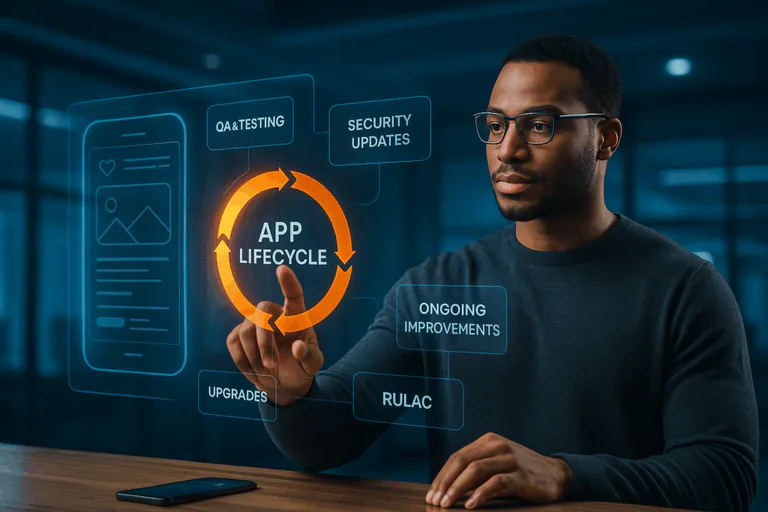
Budget for the Full App Lifecycle
Development is only one part of the total cost. Many teams overlook the expenses that continue after launch:
- QA and multi-device testing cycles
- Security updates and periodic audits
- Framework or operating system upgrades
- Ongoing improvements that keep pace with user expectations
An app functions more like a living product than a one-time project. A budget that covers only the launch always leads to overruns later. Lifecycle planning maintains predictability and keeps the team in control of future costs.
Wondering what the cost of mobile app development really looks like?
How Openforge Keeps Your App Projects on Budget
Openforge keeps app projects on budget by grounding every build in a discovery-driven process that brings cost clarity before development begins, ensuring teams understand exactly what they’re building and what each decision means financially.
Instead of overbuilding, the mobile app development company follows an MVP-first approach that focuses your spend on features that actually move the needle, helping you validate faster and avoid paying for “nice-to-haves” disguised as requirements.
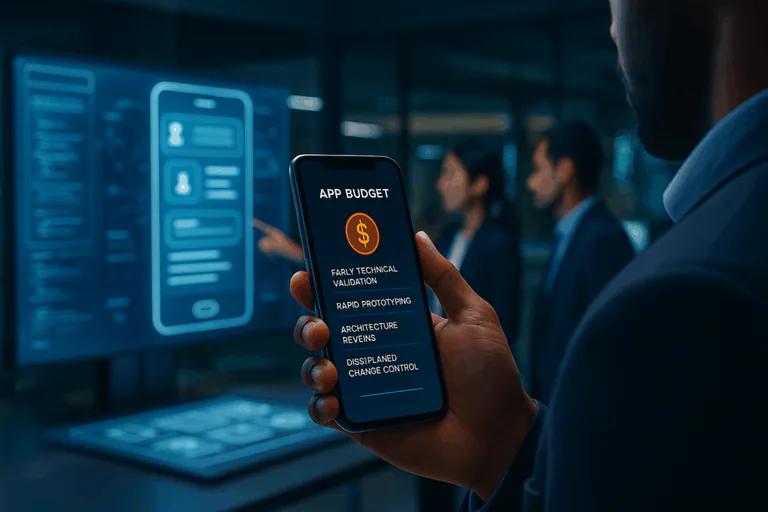
Throughout the project, you get transparent communication, weekly checkpoints, and real-time reporting so you always know whether you’re overshooting the project. Our app development company uses proven methods, such as those mentioned below, to reduce mid-project risks that cause overruns:
- Early technical validation
- Rapid prototyping
- Architecture reviews
- Disciplined change control
With Openforge’s mobile app development services, you build high-quality apps and manage the final app development cost.
Build Smart Apps, Stay Aligned, and Protect Your Budget
Sticking to a budget gets easier when everyone agrees on what really matters. If the team slows down for a bit at the start and sorts out the essentials, the work feels clearer, and it’s simpler to focus on the features customers want.
Such early clarity keeps the build moving in the right direction.
Teams that handle this well usually talk often, share what’s happening on the ground, and adjust when real issues come up. They make decisions with a sense of what they’re gaining and what they’re giving up, which keeps the whole project steady as it grows. With such an approach, your app will have a much higher chance of launching smoothly, creating value, and boosting your business without the budget going out of control.
Schedule a call with us to know how Openforge keeps your app development projects in check.
Frequently Asked Questions
Depending on what you're building, how many features you want upfront, and how complex the integrations are, an app can cost anywhere from about $40,000 to $300,000.
Apps go over budget due to poor requirements at the beginning, scope creep, underestimation, and communication issues.
You ensure your projects don’t go over budget is by taking discovery seriously, building an MVP first, staying closely aligned, and making mid-project changes only when necessary.
You usually adjust the scope, shift the timeline, or secure more budget, and often a mix of all three.
Identify what’s causing the overrun, re-prioritize the scope, and tighten the plan to bring the budget back in line.