OpenForge insight
What Email Flows Help Mobile Apps Increase LTV in 2026?
Discover which email flows help mobile apps increase LTV in 2026 and how to build scalable, high-retention apps that power lifecycle email marketing.
February 18, 2026

OpenForge insight
By OpenForge editorial team · Published February 17, 2026 · Updated February 18, 2026
Schedule a Free Demo Schedule a Free Demo TALK TO AN EXPERT 1) What are AI storytelling platforms? 2) Which AI storytelling platform is best in 2026? 3) Is Summon Worlds good for writers and worldbuilding? 4) Is Friends & Fables good for D&D-style campaigns? 5) What does it cost to build an AI storytelling app like these?
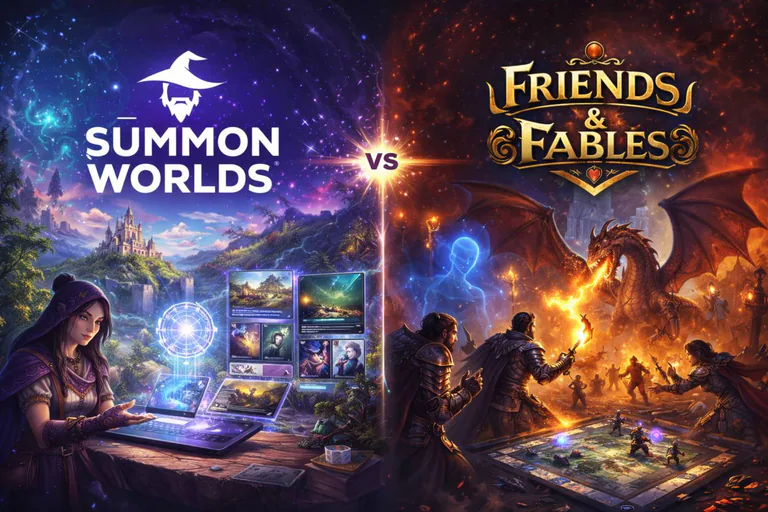
If you asked “What are the best AI storytelling platforms in 2026?” The honest answer is: it depends on whether you want to build worlds or play campaigns.
Now the bigger question for business leaders is more interesting: Why do these apps retain users, and what does it take to build something like this without burning a budget on a bloated GenAI prototype?
That’s where product discipline, scalable architecture, and mobile performance come in.
Generative AI apps are everywhere, but most don’t stick because they ship as “cool demos” instead of products.
Gartner has been blunt about this: many GenAI initiatives struggle to prove business value, and a meaningful portion of GenAI projects are expected to be abandoned after proof-of-concept if they lack clear ROI, data readiness, and risk controls.
In AI storytelling, users forgive “creative surprises.” They do not forgive:
The best platforms succeed because they behave like complete products:
That “structured constraint” idea is showing up across the space. For example, The Verge described how newer AI storytelling experiences can feel better than totally freeform chat when the system enforces narrative rules and limits.
If you’re building an AI-led mobile experience, OpenForge can help you avoid the “prototype trap” and ship a product users actually keep.
Summon Worlds markets itself as a mobile-first world generator for fantasy creators, with collaborative creation and an integrated AI roleplay/chat layer.
Based on the platform’s published feature set, Summon Worlds leans into:
Summon Worlds is a strong fit if your users are:
Product lesson for founders: Summon Worlds sells speed and accessibility. Mobile-first creation is a retention strategy, not just a platform choice.
Thinking about building an AI storytelling or worldbuilding app for your users?
Friends & Fables positions itself as an AI RPG platform where you create and play campaigns run by an AI GM, with worldbuilding tools and tactical 5e combat.
The core differentiators (from their public product page) include:
Friends & Fables is a strong fit if your users want:
Product lesson: Mechanics create stickiness. A narrative is fun. A game loop is retention.
Want to build an AI product with real retention loops (not just prompts)? OpenForge helps teams design systems that scale and keep users coming back. Schedule a Free Consultation.
Curious what it would cost to build a scalable AI narrative app?
Here’s a practical view for 2026 buyers (and for teams building in this category).
In AI storytelling, onboarding is not “create an account.” It’s: get the user into a story state fast.
Summon Worlds leans into “generate quickly on mobile,” while Friends & Fables leans into “start a campaign and play.”
Both brands emphasize context and continuity:
The product reality: memory is expensive (compute + engineering) and it’s also the feature users judge you by hardest.
These platforms aren’t just “AI.” They are networked creative systems:
If you’re evaluating this market or building in it, expect:
This is where many GenAI products fail: cost scales faster than revenue unless the architecture and pricing are designed together. Gartner’s guidance around unclear business value and escalating costs is relevant here.
If you’re a CMO, CTO, product lead, or innovation director looking at AI storytelling, the real takeaway is not “which app is cooler.”
It’s: what capabilities do we need to build an AI-led mobile product that performs, scales, and retains?
A high-performing AI storytelling app typically needs:
Gartner’s broader adoption outlook shows GenAI-enabled apps are becoming standard across industries by 2026, but the organizations that win will be the ones that operationalize it, not just pilot it.
For teams building AI-led mobile products quickly, cross-platform frameworks can be a strategic advantage when done right:
OpenForge helps teams choose based on your real constraints: time-to-market, UX needs, offline behavior, and long-term maintenance.
OpenForge is built for companies that need:
If you’re exploring an AI storytelling product, a narrative game, or any AI-native mobile experience, OpenForge can help you go from idea to a market-ready build. Schedule a Free Consultation.
If you’re a user choosing between tools:
If you’re a business leader, here’s the bigger point: AI storytelling is now a product category with real UX expectations, retention mechanics, and scaling costs. The winners in 2026 will be the teams who treat AI as part of a well-built mobile product, not the product itself.
AI storytelling platforms are apps that use generative AI to help users create or play interactive stories, often with features like worldbuilding tools, character chat, or an AI “game master” that adapts to user choices.
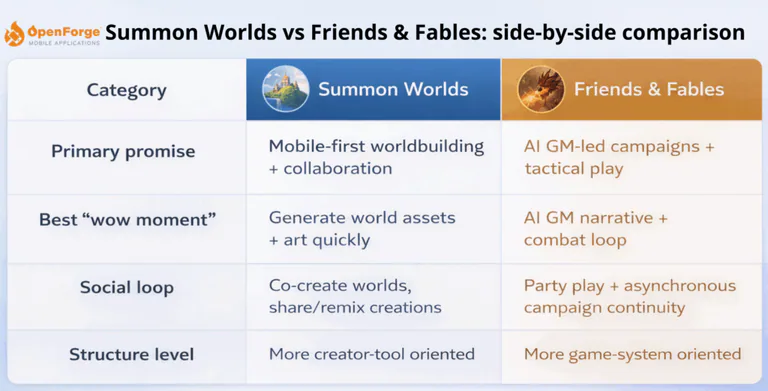
In 2026, the best AI storytelling platform depends on your goal: Summon Worlds is better for mobile-first worldbuilding and collaboration, while Friends & Fables is better for AI GM-led campaigns and tactical RPG play.
Yes. Summon Worlds is designed for writers and creators who want fast generation of lore, characters, and world assets, plus in-world character chat and collaboration features.
Friends & Fables is positioned for D&D-inspired play, including an AI GM experience and tactical 5e-style combat systems with battlemaps, spells, and monsters.
Costs vary based on scope, but the biggest drivers are AI usage (model + image generation), memory/context systems, multiplayer/community features, and mobile performance requirements. Many GenAI projects struggle when costs escalate without clear ROI and product discipline.
These logos represent OpenForge’s broader client history. They do not imply that every organization purchased the specific service described on this page.
Continue reading
OpenForge insight
February 18, 2026
OpenForge insight
February 22, 2026
OpenForge insight
February 19, 2026