
OpenForge insight
What’s the Best Business Model for Mobile App Games in 2026?
Choosing a business model for a mobile game is no longer just a monetization decision.
January 27, 2026

OpenForge insight
By OpenForge editorial team · Published February 19, 2026 · Updated March 2, 2026

Schedule a Free Demo Schedule a Free Demo TALK TO AN EXPERT 1) What is the best attribution stack for 2026? 2) Do I still need an MMP if I use SKAdNetwork? 3) Which is better for deep linking: AppsFlyer, Branch, or Adjust? 4) What changes most in attribution from 2025 to 2026? 5) How do I choose between AppsFlyer vs Branch vs Adjust?
Mobile attribution in 2026 feels a bit like trying to measure a race while someone keeps turning the stadium lights on and off.
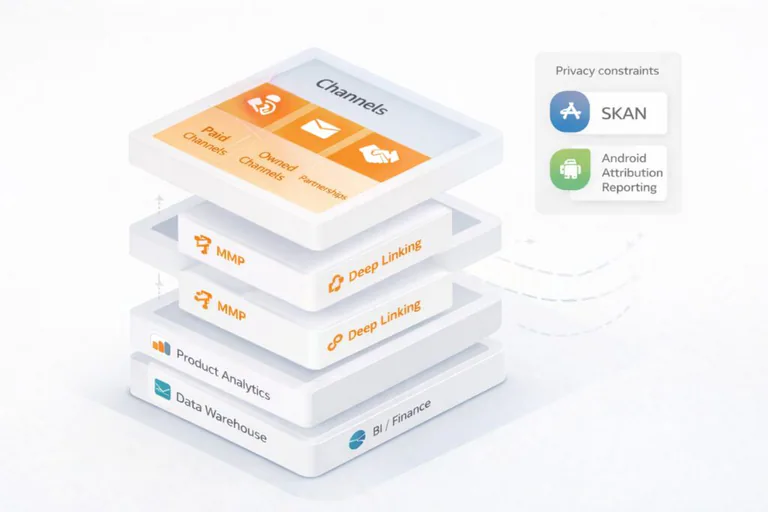
You still need to know which channels drive installs and revenue. But privacy frameworks now decide what you’re allowed to see, when you’re allowed to see it, and how noisy the data might be. On Android, attribution reporting is evolving quickly. On iOS, SKAdNetwork is still a core reality, and Apple is also pushing privacy-preserving approaches through AdAttributionKit for certain flows.
If you’re a CMO, product lead, or CTO trying to pick an attribution stack, you’re not just buying “a dashboard.” You’re buying a measurement system that influences budget decisions, growth strategy, and ultimately ROI.
Below is the practical, buyer-first guide to choosing between AppsFlyer vs Branch vs Adjust, plus the stacks we recommend for startups, SMBs, and enterprise teams in 2026.
On iOS, privacy-preserving attribution means:
SKAdNetwork attribution also has practical constraints around how attribution is initiated and what qualifies (for example, how clicks or view-through eligibility works in ad SDK flows).
Meanwhile, Apple has also expanded privacy-preserving attribution tooling through AdAttributionKit in certain contexts (notably with Apple’s own ecosystem changes and registrations).
Translation for decision-makers: in 2026, “attribution accuracy” is partly a tool problem and partly a platform physics problem.
Google’s Android Attribution Reporting documentation shows the system is designed to support app-to-app measurement with privacy constraints, including specific windows and reporting behaviors.
Translation: your MMP selection matters, but so does how your app is instrumented, how your campaigns are structured, and how you unify reporting across sources.
Before comparing vendors, align your stakeholders on what “best” means. In our experience, the best stack is the one that makes these six things true:
If your team debates the dashboard every Monday, you’re paying for confusion.
Some teams are 90% paid social and search. Others are partnerships, influencer codes, email, and web-to-app. Your tool must match your reality.
If you run re-engagement, referrals, or web funnels, deep linking is not “nice to have.” It is a conversion infrastructure.
Your stack must handle delays, noise, and aggregation without breaking decision-making. For example, SKAN-style reporting has known processing delays in certain workflows.
Attribution fraud is still real. Your stack should help you detect it early and operationalize responses.
Attribution data is only powerful when it connects to revenue, retention, and LTV.
For a deeper look at optimizing high-ROI mobile channels, read our Mobile App Marketing Playbook for 2026
Do you have the right attribution setup and the right app infrastructure to support it?
Where AppsFlyer tends to fit best
Tradeoffs to plan for
Best for
Teams that need a mature measurement operating system
Where Branch tends to fit best
Branch’s SKAdNetwork FAQ content also highlights an important reality: SKAdNetwork is built for paid install attribution and intentionally limits what data you receive (which affects how you interpret “organic vs paid” and downstream event richness).
Tradeoffs to plan for
Best for
We’ve outlined the key performance, privacy, and cost tradeoffs in on-device mobile AI systems in a separate deep dive
Ready to build an app and attribution stack that your team trust?
Where Adjust tends to fit best
Adjust markets itself heavily around privacy-first measurement and next-gen attribution solutions, including SKAN and AdAttributionKit support, which can be relevant if you’re building for 2026 realities.
Tradeoffs to plan for
Best for
Organizations aligning attribution, automation, and decision-making
Here’s the part most articles skip: the “best tool” depends on what else you have.
Goal: get trustworthy channel ROI without building a data science project.
Recommended pattern
Tool lean
Goal: unify spend, performance, and LTV so budget decisions get easier.
Recommended pattern
This is also where privacy-first reporting delays and noise must be expected and communicated. Some platforms note processing delays for privacy-sandbox-style aggregated reporting flows.
Goal: measurement that is accurate enough for finance, compliant enough for legal, and usable enough for marketing.
Recommended pattern
Also, Android’s attribution documentation includes explicit constraints (windows, limits, reporting behavior) that should be reviewed by your technical team during implementation planning.
Use this as your 2026 launch checklist:
Fraud monitoring: alerts, thresholds, and response playbooks.
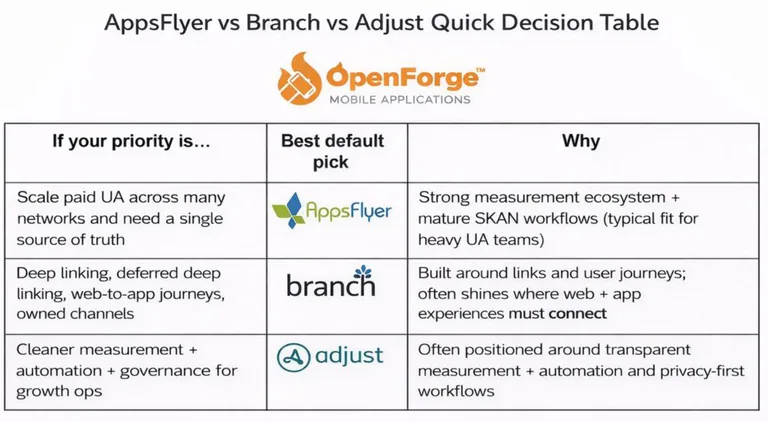
The best attribution stack for 2026 is the one that matches your channel mix and privacy constraints: AppsFlyer for broad paid UA operations, Branch for deep linking and web-to-app journeys, and Adjust for measurement clarity plus growth automation. Platform privacy systems like Apple’s SKAdNetwork and Android’s Attribution Reporting influence what any stack can measure.
Yes. SKAdNetwork is a privacy-preserving attribution framework primarily for paid install campaigns, but teams still use an MMP to unify reporting, manage integrations, and operationalize measurement across networks and channels.
If deep linking is a core growth engine (web-to-app, referrals, re-engagement), Branch is commonly selected because links and journeys are central to the platform. (Still validate fit against your full stack and channels.)
The biggest change is that privacy-preserving measurement keeps tightening: iOS attribution remains constrained and delayed in certain ways, and Android attribution reporting continues evolving with explicit system limits and reporting behaviors.
Choose based on:
Your team’s operational capacity to maintain the stack
Continue reading
OpenForge insight
January 27, 2026
OpenForge insight
January 28, 2026
OpenForge insight
December 20, 2025