Schedule a Free Demo Schedule a Free Demo TALK TO AN EXPERT 1. What is a fintech vendor due-diligence checklist? 2. Why is due diligence more important for fintech vendors? 3. What certifications should fintech vendors have? 4. How do I evaluate fintech mobile app development vendors? 5. When should fintech companies start vendor due diligence?
Choosing the wrong fintech vendor in 2026 is no longer just a technical risk. It is a business risk, a compliance risk, and often a brand risk.
Founders, CTOs, and product leaders are under pressure to move faster, ship secure products, and meet rising regulatory expectations. At the same time, budgets are tighter and tolerance for rework is low. That combination makes vendor due diligence one of the most important decisions fintech teams will make this year.
This guide walks you through exactly what should go in a 2026 fintech vendor due-diligence checklist, with a practical, business-first lens. Whether you are building a new fintech mobile app or scaling an existing platform, this checklist is designed to help you reduce risk, protect ROI, and choose a partner that can grow with you.
Table of Contents
Why Fintech Vendor Due Diligence Looks Different in 2026
In 2026, fintech vendors are expected to handle:
- Sensitive financial and personal data
- Regulatory compliance across multiple frameworks
- High-availability systems with zero tolerance for downtime
- Consumer-grade UX expectations
Over 60 percent of fintech failures are tied to vendor or technology execution issues, not market demand. That means vendor evaluation is no longer a procurement task. It is a strategic decision.
The 2026 Fintech Vendor Due-Diligence Checklist
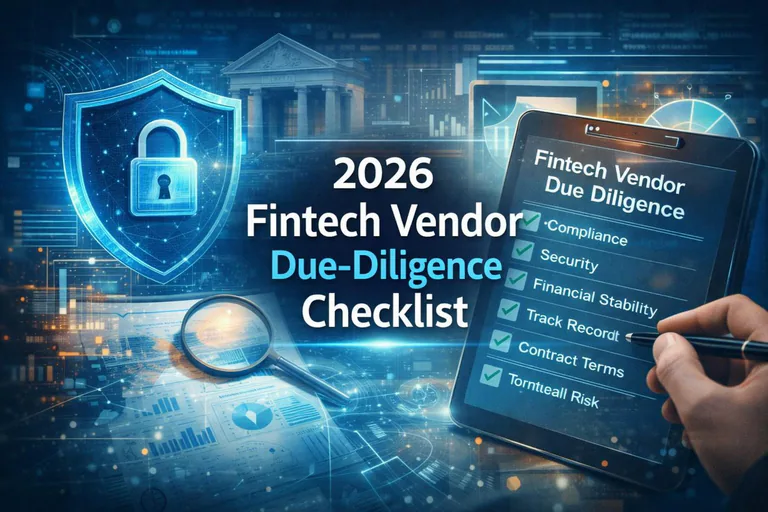
If you are evaluating fintech vendors in 2026, your checklist should include nine core areas:
1. Security and Data Protection Readiness
Security is non-negotiable in fintech. A vendor that treats it as a feature instead of a foundation is a red flag.
What to verify
- SOC 2 Type II certification or roadmap
- Secure API design and encryption standards
- Mobile app security practices
- Incident response and breach protocols
Key takeaway: If a vendor cannot clearly explain how they protect user data, move on.
2. Regulatory and Compliance Alignment
Compliance is not static. In 2026, fintech vendors must adapt quickly to evolving regulations.
Look for experience with
- PCI DSS
- GDPR and CCPA
- KYC and AML workflows
- Financial data retention policies
A strong vendor does not just comply. They design systems that make compliance easier to maintain as regulations change.
3. Technology Stack and Architecture
Your vendor’s tech stack will determine how fast you can ship and how expensive it is to scale.
2026 best practices include
- Cross-platform frameworks like Ionic or React Native
- API-first architecture
- Cloud-native infrastructure
- Modular and maintainable codebases
At OpenForge, we focus on modern stacks that reduce technical debt and accelerate future development, especially for fintech mobile apps.
4. Scalability and Performance Planning
Many fintech apps fail after launch, not before. The reason is poor scalability planning.
Ask vendors
- How do you handle traffic spikes?
- What happens when user volume doubles?
- How do you monitor performance in production?
Scalability should be part of the architecture from day one, not a phase two problem.
5. Mobile App Development Capabilities
In 2026, your mobile app is often your primary fintech product.
Evaluate vendors on
- Native-like performance with cross-platform tech
- Secure mobile authentication flows
- App store deployment and maintenance
- Ongoing performance optimization
A fintech vendor that treats mobile as an afterthought will slow your growth.
Is your fintech app vendor truly built for scale, security, and regulatory pressure?
6. UX and Product Design Maturity
Fintech users expect clarity, speed, and trust. Poor UX directly impacts retention and revenue.
Strong vendors should demonstrate
- User-centered design processes
- Proven onboarding optimization
- Clear error handling and data visualization
- Accessibility and usability standards
Good UX is not subjective. It is measurable and tied to business outcomes.
7. Delivery Process and Development Velocity
Slow delivery is a hidden cost that compounds over time.
Look for vendors who:
- Use agile development processes
- Ship in short, testable iterations
- Provide transparent timelines and reporting
- Collaborate closely with internal teams
Speed without structure leads to rework. Structure without speed leads to missed opportunities. You need both.
8. Vendor Stability and Transparency
You are not just buying code. You are entering a partnership.
Due diligence should include
- Financial stability indicators
- Team structure and seniority
- Clear ownership and communication models
- Long-term support commitments
If a vendor disappears or reshuffles teams mid-project, your roadmap suffers.
9. Long-Term Partnership Fit
The best fintech vendors think beyond the initial build.
Ask yourself
- Do they understand your business model?
- Can they support future features and integrations?
- Do they challenge assumptions constructively?
A true partner helps you make better product decisions, not just faster ones.
Do you have a development partner who understands fintech risk, not just code?
Common Mistakes Companies Make When Vetting Fintech Vendors
- Over-prioritizing cost over capability
- Ignoring mobile UX and performance
- Treating compliance as a checkbox
- Choosing vendors without fintech-specific experience
Avoiding these mistakes often saves more money than negotiating a lower rate.
How the Right Development Partner Reduces Vendor Risk
At OpenForge, we help fintech teams:
- Build secure, scalable mobile apps faster
- Reduce vendor and delivery risk
- Align technology decisions with business outcomes
- Launch products that are ready for growth, not rework
Our agile approach, modern tech stack, and design-driven process are built specifically for high-stakes industries like fintech.
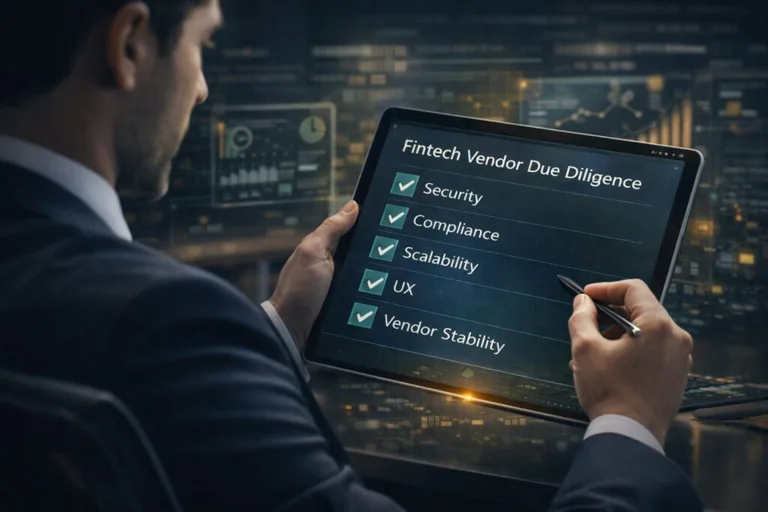
Final 2026 Fintech Vendor Due-Diligence Checklist
Before selecting a fintech vendor, confirm they can:
- Protect sensitive financial data
- Meet evolving compliance requirements
- Build scalable mobile applications
- Deliver quickly without sacrificing quality
- Act as a long-term strategic partner
If any of those boxes remain unchecked, keep looking.
Frequently Asked Questions
A fintech vendor due-diligence checklist is a structured evaluation framework used to assess vendors for security, compliance, technology, scalability, and long-term fit before engagement.
Fintech vendors handle sensitive data, regulatory requirements, and critical infrastructure. Poor vendor selection increases legal, financial, and reputational risk.
Common certifications include SOC 2 Type II, PCI DSS compliance, and strong data privacy controls aligned with GDPR and CCPA.
Focus on security, performance, scalability, UX maturity, and experience with modern frameworks like Ionic or React Native.
Vendor due diligence should begin before technical architecture decisions are finalized, ideally during early product planning.