OpenForge insight
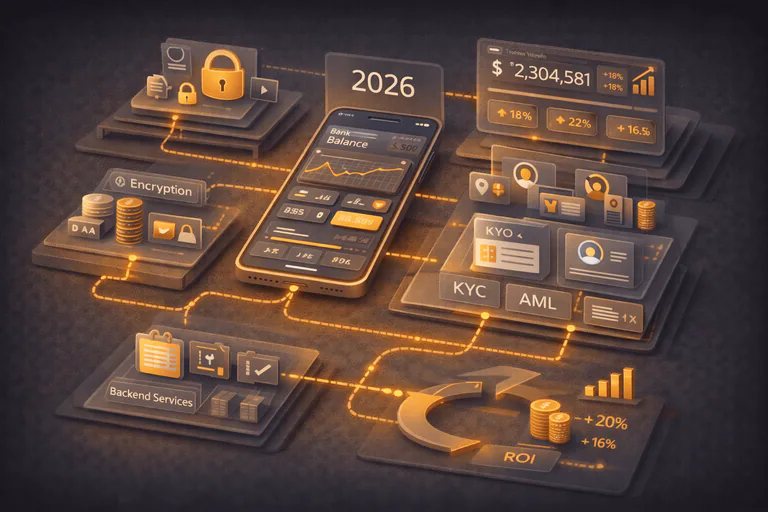
Fintech App Development in 2026: Secure Architecture, Compliance & ROI
Fintech app development is no longer just about building fast, elegant products.
January 28, 2026

OpenForge insight
By OpenForge editorial team · Published October 15, 2025 · Updated October 14, 2025
Schedule a Free Demo Schedule a Free Demo Book Your Free Consultation TALK TO AN EXPERT 1. ❓How to develop your own fitness app? 2. ❓How much does it cost to develop a fitness tracker application? 3. ❓How long does it take to develop a fitness app? 4. ❓Are fitness apps in demand? 5. ❓Can you build an app in a week?
Discover how fitness app development uses AI, personalization, and gamification to create engaging wellness experiences. Learn what it takes to build high-performing, user-centric fitness apps to increase motivation and retention.
In 2014, everyone was downloading the same mobile fitness app. You know the one, blue logo, endless charts, and a cheerful “Good job!” after every jog. It promised motivation, accountability, and transformation. But a decade later, those same apps are buried on your phone, somewhere between a food delivery tracker and a meditation app you swore you’d open one day.
Because here’s the thing: counting calories and steps was never the problem. The problem was thinking that numbers alone could keep people engaged. The one-size-fits-all fitness app era is officially over, and users aren’t coming back for graphs and generic plans. They want something more innovative, more personal, and a lot more human.
This is why the future of the wellness platforms is user-centered. AI-based and behavioral science-powered, personalized and gamified applications follow the user's routine, congratulate them when they make progress, and encourage continued engagement.
Let’s explore the future of fitness app development and the must-have features in your app.
In 2024, the fitness app market pulled in nearly $4 billion in revenue, with more than 345 million people using them regularly. By 2030, analysts say that number could soar past $56 billion. So, when everyone is losing interest, why is the industry doing so well?
Because what’s really growing is smarter, more human fitness experiences. AI-driven personalization and behavioral science are quietly reshaping the industry. Apps are no longer just digital logs. They’re learning companions that know when you’re burning out, when you’re slacking, and when you just need a small win to keep going.
North America still holds nearly half the global market, but the real surge is coming from Asia, especially India, which is growing at nearly 16.5% annually. The message is clear for fitness app development companies: people everywhere are craving connection. You need to think beyond workout tracking apps.
Get expert support to launch and scale your fitness apps
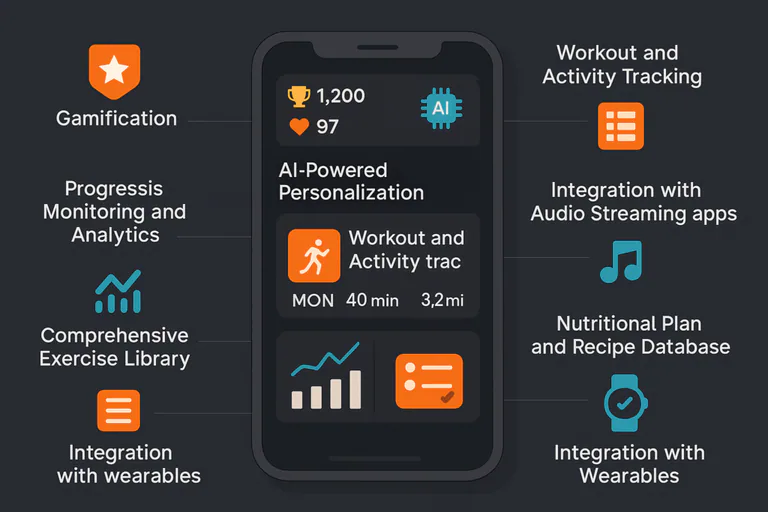
Points, levels, streaks, and sound are features from a video game, but they’re quietly redefining how people stay fit. Because let’s face it: most of us don’t wake up thrilled to run three miles or lift the same weights again. Gamification changes that. It swaps obligation for a good kind of addiction. Each challenge, badge, and leaderboard makes progress feel like progress, not punishment.
The most innovative custom fitness apps understand this psychology. They know users are more likely to chase a new level than a lower number on a scale. Streaks trigger pride, rewards spark dopamine, and friendly competition keeps people coming back long after motivation fades.
For instance, Zombies Run converts your run into a mission. Nike Run Club adds challenge, leaderboards, and social missions to keep you competing (and competing against others).
Users hate generic plans because they want a plan that truly breathes with them. HealthifyMe offers “Ria,” an AI nutritionist that tailors meal plans based on your health metrics and activity. Fitbit is moving in this direction. The app became an AI-tailored personal health coach. It analyzes trends to provide adaptive recommendations.
Apart from bringing background music, music is a powerful motivator in motion. Integrating audio streaming can improve user engagement dramatically. RockMyRun syncs music tempo with your heart rate or running pace, curating a soundtrack that evolves with your performance. You provide personalized playlists and rhythm, encouraging users to reach their goals.
Users are fond of seeing progress, but what truly matters is insights. Most workout apps promise “insights,” but what you usually get is a sea of numbers that look more like a spreadsheet than motivation. Users have information on calories in, calories out, step counts, and heart rate graphs, but it’s hard to care when the data doesn’t tell a story. The best apps display information and translate it into something you can feel proud of.
Everyone claims to have a rich exercise library, but few actually deliver. Most apps toss in a few GIFs and call it a day. But users want more than looping animations. They want clear instructions, proper form, and the reassurance that they’re doing it right. A well-built exercise library builds trust. It teaches beginners without patronizing them and keeps experienced users from second-guessing every move.
Half of your users’ fitness journey is about exercising, and the other half is about nutrition. A practical nutritional aspect provides the user with direction outside the workouts and creates long-term habits rather than the attainment of short-term outcomes. By catering to individualized diets, recipe ideas, and macro tracking, a successful fitness app idea can evolve into a life coach. When you relate their training to what they consume, users become more regular, experience faster results, and develop a better balance between work and reward.
Wearables have changed fitness tracking. It turns every heartbeat and step into instant feedback. When apps sync with smartwatches and sensors, users don’t have to think about tracking. This will allow users to monitor workouts, sleep, and recovery without additional work, thereby streamlining the process and making it less complicated. The user's rhythm is maintained through the iOS or Android app.
The custom fitness app development process is as follows:
Decide whether you are a premium personal-coach app, a freemium social tracker, or a lightweight companion for wearables? This shapes features and user experience (UX). You need to sort your pricing. If you plan to charge $20–30/month, expect high user expectations in terms of UX and customer support.
Talk to real users, interview coaches, and survey wearables owners. Audit competitors for gaps, like onboarding pain, missing integrations, or weak analytics. Use those gaps as your differentiation.
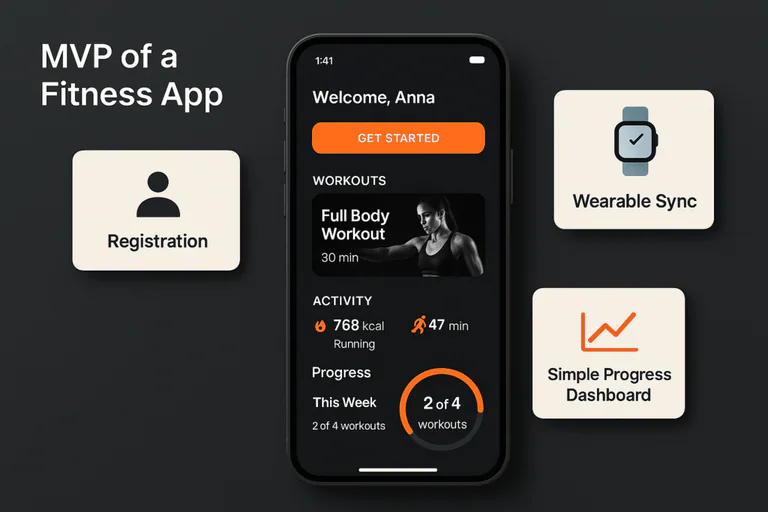
List only must-have features for launch, like registration, basic workouts, tracking, wearable sync, and a simple progress dashboard. Everything else is a future update. Ship fast, iterate faster.
Wondering what fitness app development really looks like?
The next step is to map the user experience of the app, starting with the onboarding process and continuing until the exercise routine becomes routine. The onboarding process should not exceed 90 seconds, as this will cause you to lose potential buyers.
Keeping your screens clean and purposeful. Avoid clutter or distractions. Allow design to work quietly in the background, giving users the information they need to go. High contrast CTAs, predictable icons, and a solid hierarchy of colour combination keep users informed at a glance about where and how far they've come and the most important metrics for their experience.
The technology stack and architecture used by your app should be based on your intended creation. Swift or Kotlin should be used to develop quick and easy apps. React Native and Flutter are, however, excellent for iOS and Android apps.
You can integrate your app with Apple Health, Google Fit, and other popular wearables. It can be used with audio streaming (Spotify/Apple Music) to play music during workouts.
Begin with simple AI models that recommend personalized workouts based on user history, goals, and device data. Maintain transparency to show why a workout was suggested.
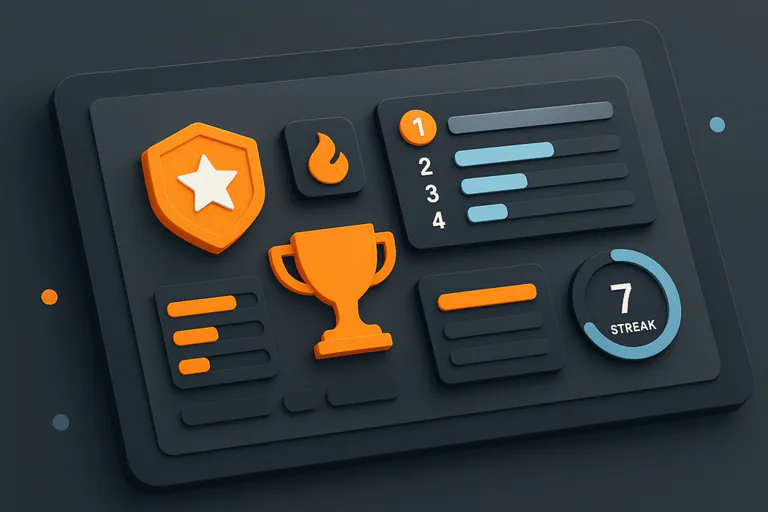
Badges, streaks, leaderboards, and progressive leveling make rewards meaningful and not just a confetti animation. If you charge a premium, these must feel earned and useful.
Partner with a team that understands technology and user psychology because building a fitness app creates lasting engagement. At OpenForge, we focus on mobile app development for iOS to build secure, high-performance fitness apps that are human-centered, habit-forming, and scalable.
You could hire any fitness application development services to build a fitness app. Hundreds promise “custom solutions” and “cutting-edge features.” But here’s the thing: most of them hand you a generic template with a new logo and call it innovation. The result? Another app that looks like everything else on the Google Play Store or Apple App Store.
OpenForge develops fitness platforms that are entertaining and fact-driven, and truly inspiring. Each interaction is intentional, and each design decision contributes to the development of users.
Our fitness app developers have technical and behavioral integrity to ensure that fitness mobile app development is smooth. Beginning with the AI-personalization and integration of wearables, all features translate to the real world, where they will make a difference.
Whenever you use OpenForge, you receive a fitness ecosystem that integrates, inspires, and develops with users.
If you’re nodding along, then you're ready to take the next step
The future of the personal training app industry is changing into more complex environments that are motivating and smart about the individual user. Now people do not just want numbers. They desire experiences that comprehend and motivate them. The best apps combine personalization, gamification, and smooth design.
At OpenForge's fitness app development service, we use AI, real-time analytics, and wearable integrations to create a fitness app that is personal, intuitive, and addictive.
Schedule a call to turn your vision into a next-gen wellness experience.
For building a wellness app, you need to first define your niche, create user-friendly user flows, and find an effective app development team.
The fitness app development costs range from 30,000 to 150,000, depending on its features, platform, and complexity.
On average, it takes 3 to 6 months to design, develop, and launch a fully functional fitness tracking mobile application.
Yes, the global fitness app market is booming, with user growth and revenue projected to keep rising through 2030.
A simple prototype or MVP can be created in a week, but a polished, feature-rich fitness app takes longer to get right.
Continue reading
OpenForge insight
January 28, 2026
OpenForge insight
October 21, 2025
OpenForge insight
September 22, 2025