Accelerate app delivery with rapid app development. Learn how modern teams cut dev time in half using RAD, CI/CD, and automation frameworks. Schedule a Free Demo Schedule a Free Demo TALK TO AN EXPERT 1. ❓What is rapid application development? 2. ❓What are the 4 phases of rapid application development? 3. ❓What is an example of rapid application development? 4. ❓Is the RAD model expensive? 5. ❓What is low-code development?
Table of Contents
Your dev team’s sprint board is overflowing with mobile and web applications. Features keep piling up, deadlines slip, and the competition releases updates twice as fast. That’s the cost of falling behind in rapid app development, where speed is the new currency of innovation.
According to Google’s DORA 2024 Report, high-performing teams deploy 973× faster and recover from issues 6,500× quicker than lagging ones. Every delay means lost users, missed revenue, and frustrated teams. IBM found that 41% of enterprises cite legacy systems and outdated business processes as a barrier to faster app delivery, highlighting how legacy processes hinder agility.
This article reveals how modern teams slash dev time in half using rapid app development frameworks, automation, and agile collaboration. You’ll also see how OpenForge’s partnering model with Capawesome tools accelerates from idea to launch.
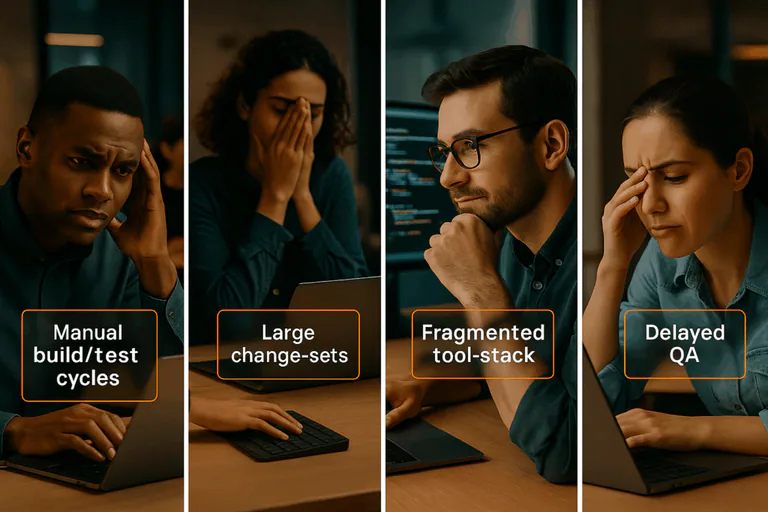
Where Dev Teams Lose Time: Pain Points in the Rapid App Deployment
Manual build/test cycles
Manual build and test cycles are silent productivity killers. Every time a developer waits hours or, worse, days for a manual QA or build verification, momentum dies. Context switches pile up. Those long feedback loops stretch deadlines and open the door to human error. Teams that switch to automated pipelines flip that story by validating and shipping code in minutes instead of days, enabling continuous feedback. Automation:
- Speeds up delivery
- Improves consistency
- Catches bugs earlier
- Keeps every release stable and repeatable
Large change-sets
The larger the batch, the slower the delivery. Scheduling dozens of updates simultaneously makes testing a workout, and rollbacks a nightmare. High-performing teams move in a smaller burst, shipping daily, perhaps even hourly, thanks to iterative development. They work smarter as more minor releases bring faster feedback, fewer failures, and constant momentum.
Fragmented tool-stack
Flow is the lifeblood of developers, but when developers switch between five dashboards and six integrations, a problem occurs. Lack of interoperating tools causes time to creep out. There is dependency management, context switching, sync issues, not to mention that all of it adds friction. The fix itself is a single tool-stack, and the building, testing, and deploying app is done in a smooth motion. Integration is equal to acceleration.
Delayed QA
Manual QA still haunts many teams. Endless approval queues, email sign-offs, and test backlogs turn what should be a quick sprint into a slow crawl. When testing lives in automation instead of spreadsheets, the lag disappears, allowing for greater user involvement. Continuous testing keeps feedback instant and releases predictably, avoiding “three-month QA cycles” that block your progress.
Low deployment frequency
If you're releasing once a quarter, that’s a red flag. Low deployment frequency results in slow feedback, innovation stalls, and users drift away. The best teams deploy small changes often, learn fast, and adapt faster. Regular releases are more than a metric because they demonstrate your pipeline's actual performance.
Get expert support to launch and scale your mobile app
The Modern Framework for Rapid Application Design and Deployment
Speed in software coding process doesn’t come from cutting corners. It comes from building smarter systems. Modern teams rely on three pillars: RAD, CI/CD, and IDP:
Rapid application development (RAD)
RAD is the remedy for rigid planning. It replaces months of documentation with fast iterations, working prototyping, and the sincere feedback of the user. Teams put ideas to the test, iterate quickly, and develop products that change with customers. In an environment where needs change weekly, RAD tools keep your mobile application development ahead.
CI/CD (Continuous integration / continuous delivery)
CI/CD is a foundational method for high-velocity teams. By automating builds, tests, and deployments, teams reduce lead time and risk. As noted in the literature, CI/CD helps “reduce build and test time in continuous integration (CI)” and supports frequent releases. Combined with RAD’s iterative approach and other software development models, this forms a potent speed formula.
Internal developer platform (IDP) approach
An internal developer platform (IDP) is a starter kit for your development teams. It’s standardized in nature, automates configuration, and incorporates all tools into one system. The developers can create, test, and deploy without human intervention.
Developers can build, test, and deploy without waiting for operations or manual approvals. Builds automatically occur, environments are automatically started, and dependencies are pre-started. Having an IDP would ensure that your workflow is more predictable, faster, and less complicated.
Must-Have Tools to Cut Dev Time in Half
RAD and low-code Platforms
Speed in app development starts with the proper foundation. Low-code platforms and visual development tools, along with Rapid Application Development tools, such as Capawesome tools, help teams transform ideas into working software. Drag, drop, and connect, and the prototype is ready when you return to your cup of coffee. These platforms enable developers to quickly test, tweak, and add new functionality, all while maintaining the freedom to tailor.
CI/CD and deployment automation
Speed without structure is chaos. That’s where CI/CD steps in. Picture this: every time a developer pushes code, a chain reaction begins. The system is set to automatically build, test, and deploy without manual handoffs or 2 am merge drama. Having an adequate CI/CD pipeline schedule means that developers work on what is important, whereas automation takes care of the boring, bug-ridden processes.
Monitoring, feature flags, and progressive delivery
Monitoring, feature flagging, and progressive delivery provide teams with the confidence to roll and hold risks substantially under control. When you monitor real-time data, you determine any uncoded operation or user pain.
Progressive delivery involves releasing to a small number first, then measuring, learning, and increasing. Together, these practices enable you to be fast and safe. You deploy on a one-time basis, maintain control, minimize the blast radius, and scale once you are certain it functions as expected.
Wondering what mobile app development really looks like with AI?
How to Evaluate What Fits Your Team
Every team has its own priorities and requirements, which decide the app deployment tools they need. Here’s a quick checklist to evaluate which tool fits your team:
- Look for compatible tools: You need tools that integrate with your existing systems and tools.
- Focus on ease of adoption: Simple enough for your team to learn and start using quickly.
- Prefer scalable options: Look for mobile app development tools that grow with your projects, traffic, and team size.
- Choose tools offering ROI: They deliver clear value in terms of time and efficiency, compared to setup or licensing costs.
- Ensure robust support and community: Offers dependable help, updates, and documentation.
Why Partner with OpenForge for Rapid App Deployment?
Working with OpenForge enables you to deploy your app faster without loss of control or quality. To a large degree, this acceleration is propelled by Capawesome, a developer productivity tool aimed at accelerating the speed of delivering enterprise apps.
Our development team is very proficient in using different tools, process streamlining, and improving automation and supervision offered by Capawesome.
Everything your team depends on, such as CI/CD pipelines, testing, and deployment, comes together in Capawesome, and as a result, releases become visible and controllable. The developers have the ability to track their builds in real time, undo changes immediately, and release features without strain.
OpenForge and Capawesome work together to simplify the whole process of coding to production, regardless of the size or stack of the team. Our initial step is to review your existing configuration and see what you are possibly losing in time or effort, followed by a recommendation of what the best tooling mix would be (including Kubernetes, GitOps, observability dashboards, and feature management systems that are specific to the actual workflow of your team).
We provide a gradual modernization even in the case of legacy systems, with minimum disruption.
Even for legacy systems, we enable gradual modernization with minimal disruption. Transparent pricing, measurable results, and deployment improvements within weeks with OpenForge and Capawesome, fast means ready, reliable, and built for growth.
Build Apps Like Never Before
In today's fast-paced world, success is often determined by speed, and development teams require systems that are fast and reliable. Balanced use of RAD, CI/CD automation, and an internal developer platform forms the basis of constant improvement and foreseeable results.
Together with OpenForge and Capawesome, the processes become simple, and you add automation across all your application development platforms and processes. All phases, such as build to deployment, are rapid, transparent, and manageable.
OpenForge modernizes without disruption, integrates better practices, and improves the user interface while measuring improvement within weeks. With Capawesome handling the complexity behind the scenes, developers can focus on building, confident that each release will perform smoothly. Talk to us to know more.
Frequently Asked Questions
Rapid Application Development (RAD) is a quick iterative approach to software development that emphasizes rapid prototyping and user feedback rather than long planning cycles.
These four phases of the development cycle include planning, user design, rapid construction, and cutover (deployment and testing).
The best example is the development of a mobile application using low-code development platforms or systems, like Capawesome. You can create a prototype, test, and refine functionality within the shortest possible time.
The rapid application development model is not necessarily expensive. Although the initial setup and tooling might increase the cost, the rapid application development process can often prove to be cost-effective in the long run, as it may save time in development and help to minimize rework.
Low-code development is based on visual interfaces and existing components to speed up the development process of a program, reducing the need for manual code writing.