Discover how AI budgeting apps help users manage money smarter with predictive insights, automation, and personalized financial guidance. Schedule a Free Demo Schedule a Free Demo TALK TO AN EXPERT 1. ❓Can I develop an app using AI? 2. ❓How much does it cost to build an AI app?pid application development? Cost of development varies between $30,000 to $150,000, among others, depending on the features, complexity of data, and integration requirements. 3. ❓Can AI budgeting apps adapt to different financial goals? 4. ❓Are AI budgeting apps safe to use? Yes, AI budget apps are safe because they follow end-to-end encryption, zero-knowledge security, and GDPR-compliant data practices to protect users. 5. ❓What makes an AI budgeting app different from traditional budgeting tools? The AI budgeting apps offer predictive information, real-time feedback, and customized financial advice, which traditional tools fail to provide.
Table of Contents
Why do most “smart” AI budgeting apps still leave users stressed and disengaged? Nearly 68% of Americans live paycheck-to-paycheck, yet only 37% use budgeting tools to manage their money. Even those who do often give up finance apps retain only 4.2% of users after 30 days.
The reason? Most apps show data, but don’t lead to direction. As one financial advisor told Nasdaq, “People become so fixated on tracking every minor monthly expense that it creates anxiety and a negative relationship with money.”
Users hate another dashboard because they want guidance, encouragement, and confidence for making progress.
AI budgeting apps can transform the narrative. Adaptive insights and personalized nudges allow users to make smarter decisions and feel supported.
In this article, you’ll learn to:
- Develop advanced budgeting tools and apps that go beyond mere graphs
- How to design AI budgeting apps
- How to motivate and empower users to take control of their finances.
Let’s explore.
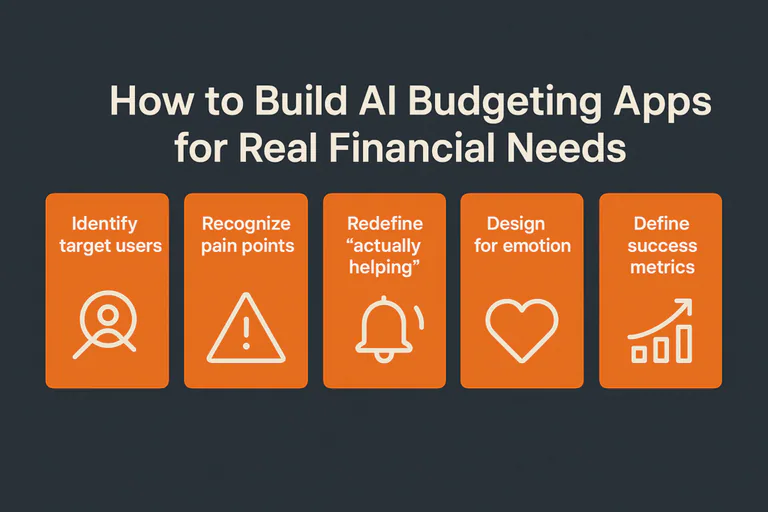
How to Build AI Budgeting Apps for Real Financial Needs
Designing a financial budgeting app solves real money problems for real people. Before you even think about code, start by understanding who you’re building for and what “help” actually looks like in their world.
Identify your target users
Your users aren’t one-size-fits-all. A Gen Z freelancer seeks a quick overview of spending behavior, while a young professional requires an assistant who tracks spending patterns, makes predictions, and sends reminders. Whereas a busy parent wants a tool that reduces stress. When you understand their habits, triggers, and comprehensive financial planning, you design an experience that feels personalized.
Recognize the common pain points
Most budgeting apps fail because they focus on numbers and not on emotions.
Users often drop off because:
- The interface feels complex or judgmental
- The advice is generic and lacks personalization
- The app points out problems but fails to guide users toward solutions
An AI budgeting assistant should feel like a coach and be supportive. It should anticipate needs and react to them.
Redefine what “actually helping” means
Helping isn’t about visualizing how much users spent last month. You need to offer timely, actionable guidance. The AI financial advisor app provides:
- Personalized alerts when spending habits shift
- Predictive insights before bills are due
- Simple language that makes finance feel human
When users feel understood, they stay, and when they feel judged, they churn.
Design for emotion, not just function
Money management is not just math; it’s emotional. Stress, guilt, or fear tend to influence the financial decisions of people more than logic does. This is why the design of your app should not just show some numbers. Apply warm colors, easy progress pointer, and positive and encouraging texts. Appreciate achievements, such as the saying that you saved 100 dollars in the wee,k rather than criticising the same. Users return when they feel that they have been supported.
Define success metrics that matter
Before you launch your AI finance app, decide what “success” means for you and your users.
Track metrics like:
- Adoption rate: Are new users completing the onboarding process?
- Engagement: Are they returning weekly?
- Savings rate: Is the app helping users improve their finances?
Data tells you what’s working, but empathy tells you why. A good app for budgeting combines both.
Get expert support to launch and scale your mobile app
Key Features of Every AI Budgeting Apps
The majority of budgeting applications are good at displaying historical transactions and, in most cases, they fail to provide a preview of what’s in store. To create an AI budgeting assistant that is useful to users, you must focus on graphs and clarity over complexity. Here’s how to design and develop one that feels personal, helpful, and human.
Begin with features that resolve user pain.
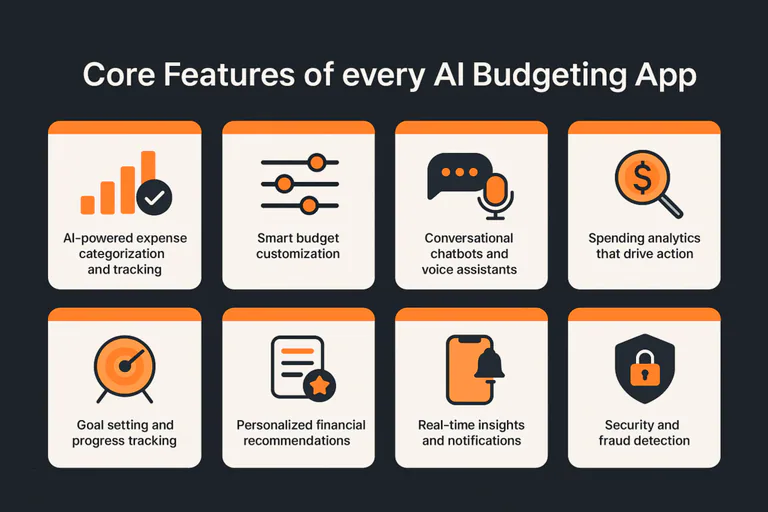
- AI-powered expense categorization and tracking
This feature organizes transactions into clear categories, giving users insight into how they spend money.
- Smart budget customization
This feature optimizes goals based on your income, expenditure patterns, and the financial lifestyle of your user.
- Spending analytics that drive action
Including spending analytics turns complex data into easy-to-understand insights and practical suggestions.
- Goal setting and progress tracking expenses
This feature defines personal financial goals and helps stay motivated with clear progress indicators.
- Personalized financial recommendations
Using personalized recommendations provides users with past behavior and AI insights to offer tailored advice for saving money.
- Real-time insights and notifications
Insights and notifications in real-time send an immediate alert regarding a higher expenditure or bill alerts, or saving opportunities to keep the user informed.
- Security and fraud detection
Concentrate on the security, suspicious activity, and build trust through safety and transparency.
UX Principles for Making Finance Feel Simple and Friendly
Good budgeting tools simplify numbers and shape how users feel about their personal finances. Focus on these UX principles:
- Design with emotional intelligence: Use reassuring animations and progress cues that reward consistency. Replace “You overspent” alerts with solution-oriented messages like “Let’s rebalance next week’s goal.”
- Make onboarding conversational: Guide users through small wins instead of long forms. You can use visuals (like spending heatmaps or gentle trend arcs) to show progress intuitively.
- Keep transparency in the limelight: Let the user know why an AI recommendation is present and how you use the data. In situations where users feel in control, they engage willingly.
How AI powers real help
AI brings the “app” to life by:
- Predictive analytics involves forecasting expenditure and savings based on real behavior.
- Behavioral nudges remind users on time.
- Giving reasonable instructions on the next actions to take, like “To remain on track”, or “Move $500 to savings now.”
Every communication must be relevant, timely, and emotionally intelligent.
Choose the Right Tech tack
You require new, quick, safe, and scalable platforms to develop an AI-based budgeting assistant that users can trust. With thousands of logins, transactions, and personal insights being handled every second, you need a scalable tech stack.
Scaling is easily achieved without crashing or downtime on platforms such as AWS, Google Cloud Run, or Kubernetes.
You have a choice of frameworks that you want. PyTorch, sensorFlow, and Hugging Face Transformers enable you to re-train models and apply new user data for updates. You can combine it with consistent data pipelines like Apache Kafka or AWS Kinesis. Provide insights in real time without sacrificing performance or privacy.
Data protection can never be negotiable. With role-based access, encrypt data as soon as possible. Wherever possible, focus on zero-knowledge configuration. Many users require information on their data, as well as options to erase or transfer it.
Lastly, develop resilience. The monitoring tools identify problem areas and deploy updates safely and non-disruptively, leveraging the CI/CD pipelines.
Go-To-Market and User Adoption Tactics
The best apps attract and retain users. Start with a smooth, story-driven onboarding flow that makes users feel in control from the first tap. Use progressive disclosure to reveal advanced features gradually and reduce friction.
Create engagement loops that reward consistent use. You can think of personalized insights or weekly “money wins” summaries that celebrate savings progress. Add gamification where it makes sense. You can add badges for hitting saving goals, streaks for daily check-ins, or visual milestones that reinforce positive behavior.
Most importantly, give users a sense of momentum. When they feel progress, they’ll come back.
Wondering what mobile app development really looks like with AI?
How OpenForge Helps You Create AI Budgeting Apps?
OpenForge assists fintechs to create ideas and bring concepts to market and scale more quickly, accurately, and empathetically. We have a team that uses AI skills, UX design, and mobile app development to develop budget apps.
We begin with the insight into the actual aspirations and customer frustrations and financial activities of users, and we map this against the points of performance AI can contribute practical value, whether it is predictive saving or custom guidance.
Our interfaces are user-friendly yet emotionally aware and simple enough to make making money feel like magical power. At the development front, our engineers get machine learning models, real-time data pipes, and behavioral analytics to give accurate and human-like recommendations.
Security is built in, and we offer end-to-end encryption and zero-knowledge to ensure user trust, general compliance with GDPR standards, and use of the PCI tools, upon keeping your MVP open. Our apps help you to drive traffic, streamline the user process, and scale.
Build an AI Budgeting App That Truly Helps
Most “smart” budgeting apps promise clarity but deliver stress. Users do not desire another tracker; they need directions, understanding, and actual headway. Budgeting apps are number crunchers, confidence builders, and lead individuals to improved financial habits. Fintech will likely evolve with more empathetic technology, which understands human behavior and provides real and actionable help. When design meets emotional intelligence, users stop feeling judged and start feeling in control, and that’s when true financial empowerment begins.
OpenForge helps fintech teams bring that vision to life. Schedule a call with us to know more.
Frequently Asked Questions
Yes, you develop AI solutions and models more easily than ever before. Using AI, you develop smart apps that process data, forecast behavior, and personalize user experiences.
Yes, AI analyzes human activity to change the recommendation based on the goals, such as debt repayment, savings, or investment portfolio development.