Mobile Academy guide
App Store Optimization for Health and Wellness Apps
Plan a clear health or wellness app listing: match search intent, show real workflows, explain access requirements, and measure beyond installs.
September 18, 2026

OpenForge insight
By OpenForge editorial team · Published September 30, 2025 · Updated September 29, 2025

Schedule a Free Demo Book Your Free Consultation Book Your Free Consultation TALK TO AN EXPERT 1. ❓What is the difference between AI and enterprise AI? 2. ❓What is the difference between generative AI and enterprise AI? 3. ❓What is meant by enterprise AI? 4. ❓What is the difference between AI and Business AI? 5. ❓How is AI used in enterprise?
Discover how creative founders are using AI and worldbuilding tools to design immersive, story-driven apps that emotionally connect with users
A customer reaches out with a problem, and instead of being bounced around by menus or scripts, they actually get a quick, helpful response. In another corner of the business, a supply chain lead isn’t caught off guard by delays thanks to the use of AI tools. The system gave them a heads-up weeks ago, and they had already lined up a smarter option. Their AI systems identify a delay weeks in advance and direct them to an effective backup plan.
That’s the promise of enterprise AI. And, for this reason, you need an effective enterprise AI strategy.
Enterprise AI is the large-scale application of artificial intelligence across your systems, data, and workflows to drive efficiency, innovation, and growth. Contrary to experimental pilots or consumer-level AI features, enterprise artificial intelligence forms the backbone of your business.
Pfizer and AWS saved 16,000 hours of search time annually and cut infrastructure costs by 55% through generative AI efforts. Also, according to McKinsey, 78% of organizations now use AI in at least one business function.
In this guide, we’ll explore:
Enterprise AI is the large-scale use of artificial intelligence across systems, data, and workflows to deliver measurable business value and showcase enterprise AI benefits. The AI goes far beyond a single chatbot or small pilot. Large data warehouses connect with ERP and customer relationship management platforms, creating a network that supports business functions. Supply chains run with stronger forecasts, finance teams gain sharper models, and customer service becomes faster and more helpful.
This definition of enterprise AI is significant because of its impact on operational efficiency. Companies are reducing costs, making decisions with greater speed, and finding insights that were once hidden in complex customer data.
And here’s how real people describe it:
“Enterprise AI is not just another chatbot or recommendation engine. It’s when AI becomes part of how a company runs day to day, plugged into data, processes, and decisions.”
Enterprise AI is often confused with other types of AI:
Consumer AI is the kind most of us interact with every day. It’s behind Netflix suggestions, the route Google Maps recommends, or the way Siri answers quick questions. These tools are convenient, but they’re designed for individuals. They don’t have the scale or complexity that big enterprises demand.
Narrative AI is artificial intelligence created to comprehend, create, and evolve narratives or discourse in a human-fashioned manner. It’s applied in chatbots, games, marketing, and storytelling platforms to facilitate natural and interactive interactions that are natural and engaging.
Enterprise AI is different. An artificial intelligence enterprise doesn’t reside in a single department. It runs across the company, linking up with ERP systems, CRM tools, and those giant data warehouses every big business depends on. The point is simple: give teams faster ways to make decisions on risk management and reduce wasted effort.
Here are examples of enterprise AI:
Amazon adopted AI to improve the management of its delivery chain and forecast demand. This improvement saved transportation expenses by $1.6 billion in 2020.
Or look at Tesla. Inside its factories, AI and computer vision assist with quality checks, reduce waste, and maintain energy efficiency. The new “Unboxed” production reduces costs by nearly half and the space for building cars by 40%.
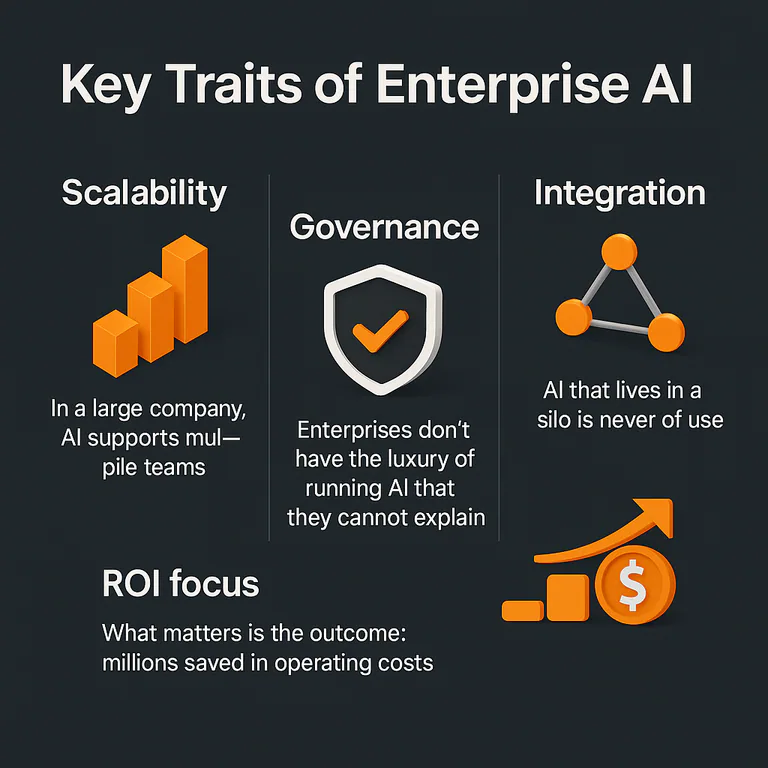
In a large company, AI supports multiple teams. It’s designed for use with multiple apps or departments. The same system should support sales in Europe, logistics in Asia, and customer service in the U.S.
Enterprises don’t have the luxury of running AI that they cannot explain. When a model makes a decision, leaders want to know why, and regulators expect clear evidence. That’s why governance is so important.
AI that lives in a silo is never of use. The real value lies in integration with ERP, CRM, and other core systems, allowing data to flow naturally. When that happens, insights guide decisions in real time.
The high accuracy score is hardly celebrated in a vacuum by enterprises. It's the result that matters: millions of dollars in operating expenses saved, new sources of revenue created, or hours of manual labor cut.
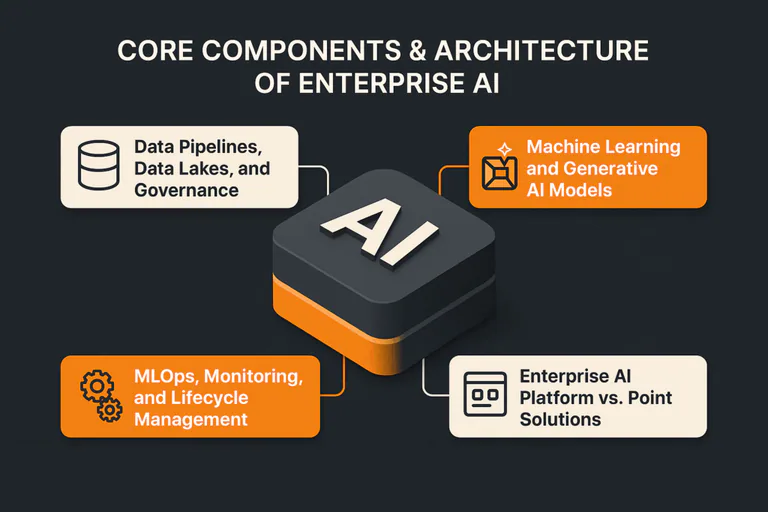
Enterprise AI is based on the consistent flows of data and huge storage. Every data-driven decision and every model is based on clean, guided data.
Models transform data into forecasts, knowledge, or innovations. These models influence the way businesses operate in terms of predicting their sales and coming up with product designs.
There is no single use of AI in business. Data changes require deployment, tracking, refreshing, and improvement of models. Monitoring ensures stability and trust.
Some organizations adopt a full enterprise AI software that covers integration, governance, and scalability. Others, like point solutions, are ready to be used in specific cases. The correct decision will be based on target, finances, and maturity.
Wondering what enterprise app development really looks like with AI?
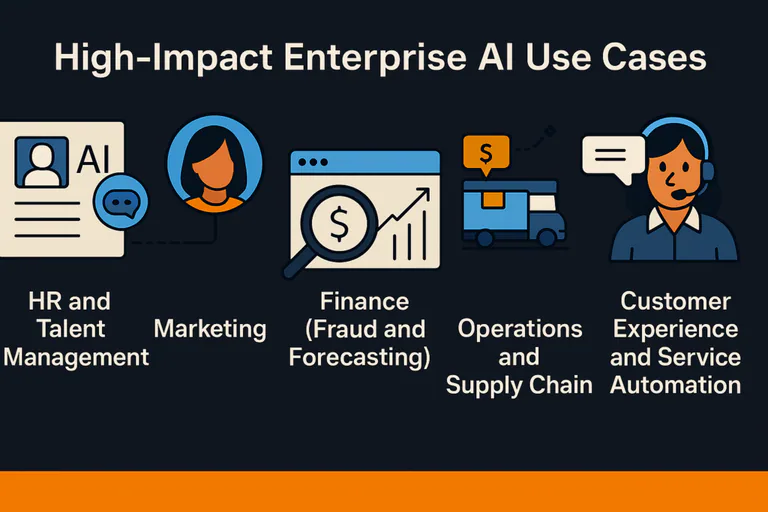
Implementing enterprise AI in daily business operations is where its true value comes to life. These are the ones where organizations realize actual returns.
AI helps screen resumes, match candidates to roles, and predict turnover. Google’s Sundar Pichai put it simply: “The future of AI is not about replacing humans, it’s about augmenting human capabilities.”
With AI-driven personalized recommendations and messaging, campaigns will be smarter. Blue Prism believes that 84% of business leaders have developed a new perspective that AI is both disruptive and innovative.
The sphere of financial services is dependent on AI to identify suspicious actions in real time and predict revenue more precisely. According to research by the European Commission, 41.17% of large businesses already use AI, as opposed to 11% of smaller ones.
AI has revolutionized logistics in terms of predicting demand and route optimization. With the adoption of enterprise AI solutions accelerating, 78% of organizations reported using AI in at least one function in 2024, up from 55% the year before.
Generative AI-driven chatbots and routing systems resolve routine queries quickly and pass complex cases to human agents. These artificial intelligence enterprise software reduces response times and increases customer satisfaction, greatly enhancing service delivery.
Let’s explore how to bring your app to life, custom, scalable, and future-ready.
A full enterprise AI requires a significant amount of effort. The smart way is to move gradually and build confidence along the journey:
Pick one use case and run AI in a controlled, low-risk setup. See what works, what doesn’t. This phase inculcates trust in the process and ensures teams are familiar with the technology.
As soon as the pilot is promising, create a POC that connects directly with business metrics. Focus on real value. Confidence leads to solid evidence or proof of concept, streamlining the process of leadership buy-in as well as the achievement of resources that support growth.
Once it has been successful in one area, expand it to additional teams or functions. Scaling will guarantee that AI is a part of everyday operations, but not as an isolated experiment.
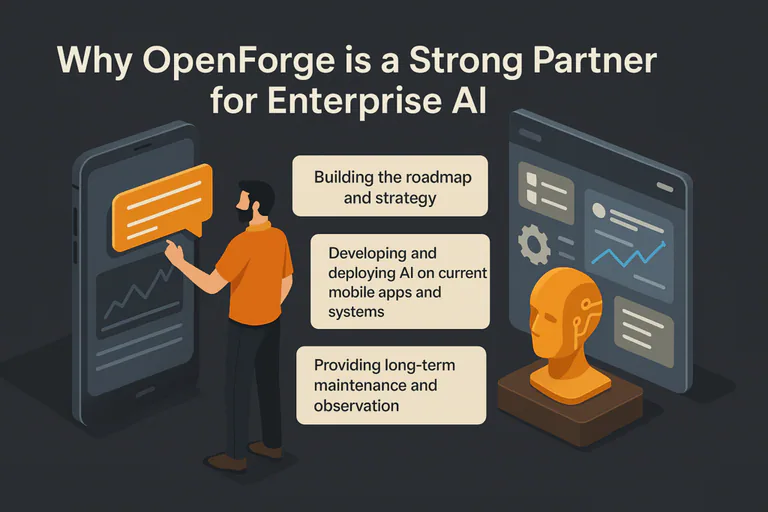
OpenForge is more than a development shop. The team boasts extensive experience in app development and a deep understanding of the practical application of AI to enterprise systems. On the mobile and backend, they have assisted organizations in integrating AI into a scalable platform that seamlessly integrates with existing tools and delivers measurable outcomes.
OpenForge supports clients through the journey:
Such a combination of technical expertise and business orientation makes OpenForge a reliable option for enterprise AI companies willing to go past experiments and integrate an enterprise AI solution into their operations.
If you’re nodding along, then you're ready to take the next step
You know how chatbots and virtual assistants can bounce you through menus until you’re halfway insane, or how a logistics manager only spots a supply chain delay once it’s already hurting margin? That’s the gap enterprise AI technology closes.
Enterprise AI is your systems, workflows, and data speaking the same language, cultivating insights, preventing problems, and powering decisions in real time.
In case you want to go beyond the pilot project phase and into building a platform for AI, OpenForge is here to assist you. Schedule a call to see what adopting enterprise AI looks like in your company.
Enterprise AI is more of a problem-solver. It plugs into everyday business operations, using natural language processing to make work faster, smarter, and more efficient. AI, in general, is just the big umbrella term for any technology that can mimic human-like intelligence.
Generative AI produces new text, images, videos, or even code. Enterprise AI focuses on weaving AI into day-to-day business operations and workflows to drive efficiency and growth.
Enterprise AI refers to the application of AI technologies tailored to the specific needs of an enterprise. It also imparts models into the business systems, which are compliant, scalable, and offer a higher ROI.
Business AI refers to a narrower sense of AI used to provide a solution to a business problem, whereas AI is the broader term used to refer to intelligent systems.
Some ways AI can be applied in businesses include the automation of activities, improved decision-making, personalization of customer experiences, the detection of anomalies, optimization of processes, and prediction of trends.
Continue reading
Mobile Academy guide
September 18, 2026
OpenForge insight
February 17, 2026
OpenForge insight
February 13, 2026