Schedule a Free Demo Schedule a Free Demo TALK TO AN EXPERT 1. What are the top mobile app development trends in 2026? 2. Why are mobile app development trends changing so fast? 3. How does AI affect mobile app development today? 4. Is performance really more important than features?
Every year, mobile development teams are flooded with “trends” they need to follow. Some promise speed, scalability, and innovation, but many fail to survive real-world pressure. Running after many of the over-hyped trends only leads to disappointment. In practice, it means rewrites, pushed launch dates, and features that never quite land with users.
By 2025, close to 70% of companies cited technical debt as a reason releases slowed down. Teams are fixing yesterday’s decisions instead of building what actually moves the product forward.
In 2026, mobile app development budgets will be unforgiving, and app store rules will leave less room for guesswork.
Users don’t give apps much grace anymore. When performance slips or trust feels shaky, they leave. For mobile teams, the work now comes down to choosing the right mobile app development trend.
Table of Contents
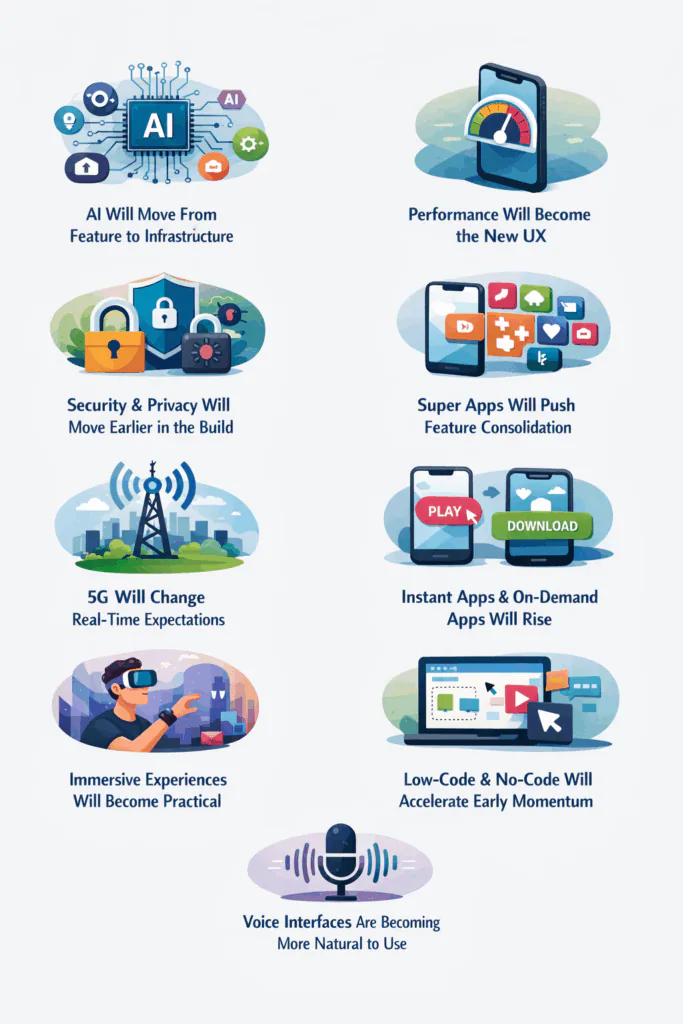
9 Mobile App Development Trends Reshaping How You Build Apps
Mobile app development looks less like chasing what’s new and more like making deliberate decisions that hold up under real users, real constraints, and real business pressure.
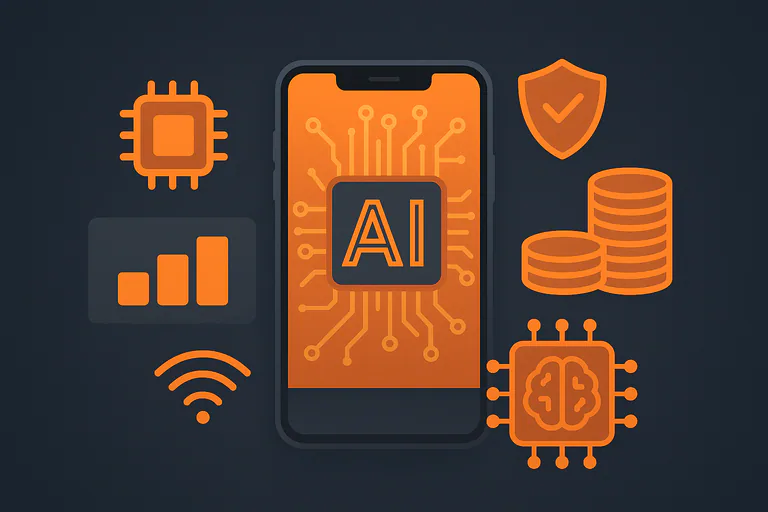
Trend 1: AI Will Move From Feature to Infrastructure
In 2026, AI will rarely appears as something users tap. Product teams rely on it in the background. Rather than selling AI as a feature, teams use it in the background. It helps surface bugs earlier, highlights risky builds, and catches performance problems before they reach users. Some teams rely on it daily.
Others are still experimenting. Either way, AI is slipping into regular development work, speeding things up and reducing last-minute surprises.
Trend 2: Performance Will Become the New UX
Users never talk about app performance, but they feel it. A screen loading half a second slower, a checkout stuttering, or a battery draining they can’t explain. By 2026, small moments like these will drive user decisions. Most apps never recover from a weak first impression. Close to 77% of users stop opening an app within three days of installing it.
This is changing how you build apps. You no longer have to add more features, especially those your customers rarely use. Extra dashboards, background services, and secondary tools often slow apps down without adding real value.
Many teams are simplifying user flows and choosing lighter architectures to keep the app fast and predictable. Speed will keep users around for longer.
Trend 3: Security and Privacy Will Move Earlier in the Build
Earlier teams worried about app security right before submission. Now those decisions will happen much earlier. During discovery, or architecture planning, or the first conversation about what data the app needs.
In the coming year, app stores will apply more pressure with stricter reviews. Users will pay closer attention to how their data is handled. Around 90% of users check security or privacy details before downloading an app, and many walk away if something feels off.
You should focus on building apps capable of surviving real usage, scrutiny, and constraints.
Trend 4: Super Apps Will Push Feature Consolidation
Not long ago, apps were built to do one thing and do it well. Today, many super apps open every day and pull related tasks like payments, messages, bookings, and support in one place. It reduces logins and app hopping, which makes the whole experience feel easier. When things feel easier, people tend to stick around.
But as features pile up, performance can suffer, and load times can increase. The scalability of cutting-edge mobile apps is increasingly dependent on backend discipline rather than on UI.
Trend 5: 5G Will Change Real-Time Expectations
Is 5G just about speed? It’s about removing waiting from the experience.
With lower latency and faster data transfer, mobile apps can respond in near real time. Live video, interactive streams, multiplayer gaming, and remote collaboration feel smoother and more reliable. What once required Wi-Fi and patience now works on the move.
For developers, this changes expectations. Users will not tolerate lag when the network can handle more. Apps streaming data continuously or reacting instantly to user input are now achievable.
Gaming and AR/VR will benefit the most. Real-time rendering, live multiplayer sessions, and richer visuals will no longer feel constrained by mobile networks.
Trend 6: Instant Apps and On-Demand Apps Will Rise
Users are spending less time waiting for apps to install or set up. They expect access to what they need without extra steps. This has increased interest in instant and on-demand app experiences that open quickly and focus on a single task.
For teams building apps, this affects early design decisions. Functionality is often broken into smaller entry points, with attention on load time and responsiveness. Some retail apps open directly to a product view, service apps allow quick bookings, and content and gaming apps load specific sections without requiring a full install.
As humans’ attention span is shorter than that of a goldfish, teams are building apps that feel immediate. The focus moves from pushing full installations to creating fast, accessible moments.
Trend 7: Immersive Experiences Will Become Practical
AR and VR aren’t novelty features anymore. As devices have improved, teams are starting to use them in practical ways, showing products before someone buys, making training more hands-on, or adding depth to fitness and media apps. When these features solve a real problem, users tend to stick.
In the coming year, predictive analytics will enhance immersive experiences and be chosen for their usefulness, helping users understand and act more easily within the app.
Trend 8: Low-Code and No-Code Will Accelerate Early Momentum
You will use low-code and no-code tools when you want to see an idea take shape quickly. A rough version gets built, shared, and reacted to. Conversations become clearer once something tangible exists.
Early screens help you spot what works and what doesn’t. As products gain traction and requirements grow, many teams move toward custom development to support scale and performance.
In 2026, these tools will play their role early, then step aside as the product matures.
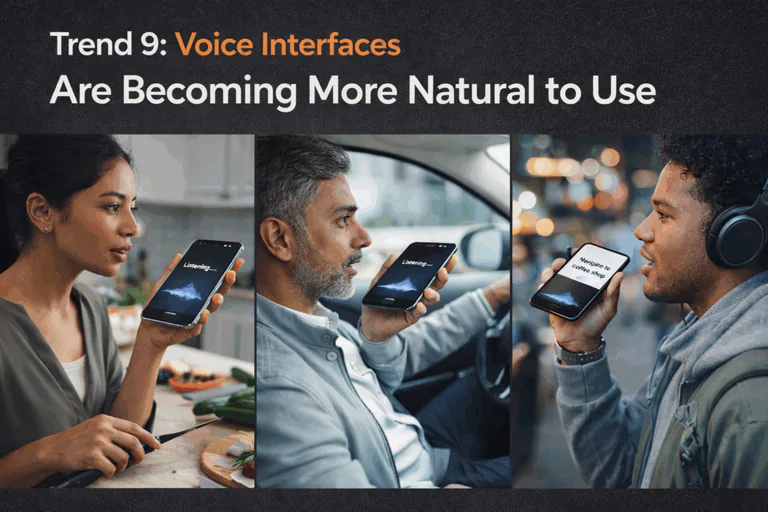
Trend 9: Voice Interfaces are Becoming More Natural to Use
Voice is showing up in apps in quieter ways. It helps when typing feels unnecessary or awkward, like searching, quick actions, or using an app while doing something else.
Teams are becoming more selective about where voice fits. Voice tends to work when it fits into what the user is already doing. It helps in moments where typing feels unnecessary or inconvenient and stays quiet the rest of the time. As apps evolve, voice becomes one of several ways users interact, used when it makes sense and ignored when it doesn’t.
Get expert support to launch and scale your mobile app
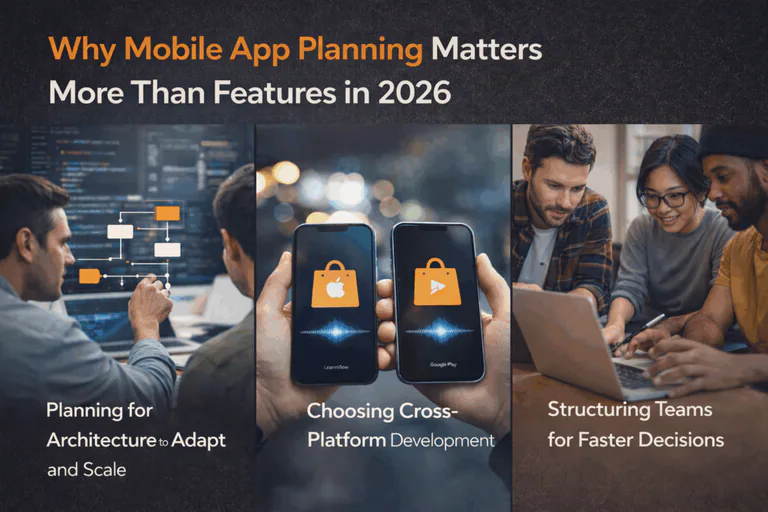
Why Mobile App Planning Matters More Than Features in 2026
In 2026, mobile app industry success is less about what you ship first and more about how well your app can adapt once real users use it. Teams planning for change early move faster. Here’s why mobile app planning matters more than features:
Planning for Architecture to Adapt and Scale
Companies are building mobile apps to evolve with time.
Teams rely on modular systems so they can make changes without reopening the entire app. When features live behind clear APIs, updates stay contained, and growth feels manageable as usage, integrations, and requirements expand.
When you plan in advance, you avoid the trap of full rebuilds every time priorities change. They also reduce long-term technical debt, like slow releases, limit experimentation, and turn simple updates into risky deployments.
Choosing Cross-Platform Development
Cross-platform app development will still matter, but only when you use it wisely. Some use cases benefit from shared codebases and faster reach. Others demand native performance, deeper platform access, or long-term scalability, which cross-platform shortcuts fail to support. What matters most is how the app holds up as it grows. Performance, stability, and flexibility over time are what shape the product long after launch.
Cross-platform works best when deliberately chosen. When teams treat it as a strategic fit rather than a shortcut, the app is easier to maintain and scale as needs evolve.
Structuring Teams for Faster Decisions
Planning extends beyond tools and architecture into everyday collaboration.
When mobile app developers share working hours, communication feels easier and decisions happen naturally. You resolve all questions, your context stays intact, and your feedback flows while work is still in progress.
This is why many teams are choosing collaboration models to prioritize real-time access and close coordination. Working in aligned time zones supports smoother iterations, clearer ownership, and steady progress. In 2026, teams valuing proximity and consistent collaboration will move with greater confidence and deliver with fewer surprises.
Wondering what mobile app development trends really looks like?
What do These App Development Trends Mean for Your Industry?
These trends show up differently depending on what you build and who you build for. The common thread is planning for change, not just launch.
- SaaS and B2B platforms Modular setups make change easier to manage. Teams can add integrations, adjust pricing, or introduce new roles without rewriting what already works. A SaaS product, for example, can launch an analytics module without changing how existing users move through the app.
- Ecommerce and marketplaces App performance and platform choices directly affect conversion. Teams planning for scale can support seasonal traffic spikes, new payment methods, or regional launches without slowing checkout or search.
- Healthcare and fintech Planning-first development makes compliance updates and security changes easier to manage. Apps can adapt to new regulations while keeping patient or financial data protected and systems stable.
- Consumer apps and media Cross-platform strategies chosen with longevity in mind support faster content updates and consistent experiences as audiences grow across mobile devices.
How Openforge Aligns With Mobile Application Development Trends
Openforge aligns with mobile app development trends by focusing on the decisions that matter long after launch. Work starts with discovery so teams can align on goals before building begins. This helps decisions settle early and keeps changes manageable later. Apps are planned with growth in mind, including security and performance, so they can adapt as usage and platforms shift.
Openforge’s Android app development stays involved beyond launch. The team works alongside clients as the product evolves, supporting updates, improvements, and new priorities over time.
Planning For What Comes Next
Mobile app development process and trends will depend on how teams plan, not how many features they ship. More attention is going into early decisions around architecture, platform choice, and collaboration. These choices influence how an app grows and how stable it remains over time.
The impact becomes clearer after launch. Products need to continue working as usage increases and priorities change. Apps planned with flexibility tend to adjust more smoothly as requirements and platforms evolve.
The trends shaping the coming year will reward teams thinking beyond the first release and focus on building products that users love to come back to.
Schedule a demo to see how OpenForge helps you meet your mobile app trends in the next year and beyond.
Frequently Asked Questions
Teams are prioritizing apps that stay fast, stable, and flexible over time. Fewer flashy features. Better foundations.
App development trends are changing because users hate to wait. App stores tighten rules, devices evolve, networks get faster, and expectations rise all at once.
Mostly behind the scenes. It helps teams spot issues earlier, smooth performance, and reduce last-minute surprises.
For most users, yes. If an app feels slow or drains the battery, they leave — even if the features look good.