Schedule a Free Demo Schedule a Free Demo Schedule a Free Demo TALK TO AN EXPERT 1) Why do lifestyle and food brands perform so well with membership apps? 2) What features drive the most repeat usage in lifestyle and food apps? 3) Is wallet-based loyalty worth it? 4) How should membership ROI be measured? 5) What’s the biggest mistake brands make with membership apps?
In 2026, “having an app” isn’t what separates winners from everyone else. Having a reason to come back does.
Lifestyle and food brands sit in a weirdly high-stakes zone: customers love them, but they’ll also ghost them the moment ordering feels annoying, value feels unclear, or the experience becomes too expensive to justify. That’s why the most resilient brands aren’t just pushing discounts, they’re building membership-driven mobile experiences that make the customer feel like, “Yeah… this is my place.”
Mobile wins here because it’s the only channel that can combine three things at once: convenience, personalization, and owned retention. It’s not just “order again.” It’s reorder in seconds, get the right perk, and feel seen without being creeped out.
This is also where product teams get stuck: you can’t ship a bloated app, you can’t rely on acquisition forever, and you definitely can’t design membership as an afterthought. Brands that win treat membership as a product loop, with UX, performance, and measurement built in from day one.
If you’re building in this space (or fixing an app that’s underperforming), OpenForge’s work in lifestyle app development is rooted in that retention-first thinking, modern UX, scalable engineering, and business outcomes, not feature clutter.
Table of Contents
Why lifestyle & food brands are “membership-native” in 2026
Some industries have to force membership into the model. Lifestyle and food don’t. They’re already habit categories.
People don’t “shop” for food the way they shop for furniture. They repeat. They crave. They follow routines. The best brands simply reduce friction and increase perceived value until returning feels obvious.
What changed in 2026 is that customers are more price-sensitive and more selective, especially in dining. Recent reporting highlights growing frustration around value, price increases, fees, and disappointing experiences, pushing brands to prove “worth it” more clearly. That pressure actually favors membership brands, because membership is a cleaner value story than constant coupons.
At the same time, off-premises behavior is still crucial. The National Restaurant Association’s off-premises trends emphasize how takeout, delivery, and drive-thru behaviors vary by consumer segment, and how loyalty tactics need to match those patterns instead of guessing.
So the big idea is simple: membership brands win on mobile because mobile is where habits live.
The membership advantage: it’s not “points,” it’s momentum
Most loyalty programs fail for one painfully basic reason: customers don’t feel progress.
A membership app wins when it creates momentum:
- the user sees their status
- the user understands what happens next
- the user can redeem without effort
- the user feels smarter for coming back
That “momentum” is the product.
In practice, this means your app shouldn’t feel like a menu or a catalog. It should feel like a shortcut into a relationship: reorder fast, benefit immediately, and know what you’re earning.
This is where UX becomes a revenue lever, not a design preference. OpenForge’s approach to UX & UI design is positioned around reducing drop-off and increasing engagement, which is exactly what membership models depend on.
Get expert support to launch and scale your mobile app
What winning lifestyle & food apps actually do differently
Here’s the pattern you’ll see across successful membership-driven apps in 2026: they build a loop, not a funnel.
1) They optimize the “first 60 seconds” like it’s a paid landing page
The first session is where membership lives or dies. Users don’t want onboarding theater. They want a quick win.
A strong first session usually includes:
- one clear value proposition (“Members get X”)
- one frictionless action (save favorites, set preferences, start a trial, join a tier)
- one visible future benefit (progress, perks, next reward)
If your app takes too long to deliver value, users disappear and your CAC becomes a donation.
This is one reason retention systems matter as much as acquisition systems. If you want a framework for reducing churn and creating repeat behavior, OpenForge’s mobile app retention playbook maps the steps clearly (onboarding, personalization, re-engagement) without drowning you in buzzwords.
2) They design membership like a product tier, not a marketing tactic
Membership isn’t a banner that says “Join.” It’s a set of experiences that feel better than non-member experiences.
For lifestyle and food brands, the most common membership value types are:
- convenience (faster reorder, saved routines)
- access (drops, limited menus, early booking)
- economics (bundles, member pricing, monthly credits)
- identity (status, tier, community)
When you mix those well, you reduce reliance on discounts and build predictable repeat revenue.
3) They make “reorder” the default behavior
The second purchase is the real conversion in this category. Winning apps get users to the second purchase quickly by making repeat actions effortless.
That can look like:
- one-tap “order again”
- smart substitutions when items are out of stock
- reminders tied to real habits (not spam blasts)
- favorites that actually stay updated
This is where “performance-first” matters, if the app is slow, reorder behavior collapses. OpenForge’s view on mobile app development emphasizes high-performance foundations (speed, scalability, clean architecture), which is exactly what habit-based apps require.
Why personalization is a superpower for membership brands
Personalization isn’t about being fancy. It’s about being relevant at the right moment.
Lifestyle and food brands have one huge advantage: they can personalize based on repeat patterns (routines, preferences, dietary constraints, favorite flavors, typical order times). That’s a goldmine if you use it responsibly.
McKinsey’s research-based explainers note that personalization can lift revenues by 5–15% and improve marketing ROI, depending on execution. The reason this matters for membership brands is that personalization increases the feeling that the membership is “worth it.”
In real app terms, the highest-impact personalization isn’t weirdly predictive. It’s practical:
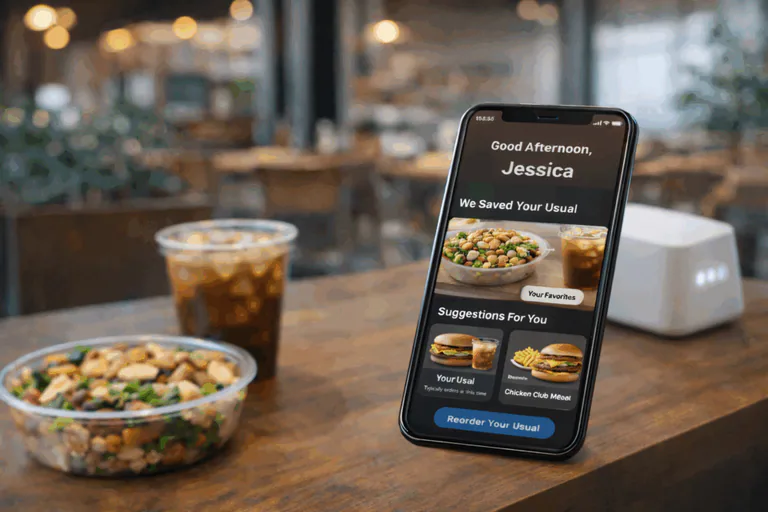
- smart reorders (“your usual”)
- relevant bundles (based on prior baskets)
- lifecycle offers (welcome, winback, tier-up)
- discovery that feels curated (not random)
If you’re exploring how AI supports this without turning your app into a gimmick, OpenForge’s guide on AI app development explains realistic ways apps “learn and adapt” with retention outcomes in mind.
Wallet-based loyalty: the underused retention lever
A lot of brands obsess over rewards… and then hide redemption behind friction.
Wallet-first loyalty fixes that.
When customers can access loyalty passes and redemption flows through native wallets, rewards become easier to use in-store and on the go. For iOS flows, teams commonly rely on Apple Wallet passes to deliver loyalty cards and offers in a trusted system UI. (Apple’s documentation is a stable reference point for how wallet passes function.) For Android ecosystems, Google Wallet loyalty cards support similar “always available” access to membership benefits.
For lifestyle/food brands with in-store moments, wallet matters because it lowers the “I forgot my account” problem. If redemption is easy, customers feel the benefit more often, and that makes membership feel real.
Wondering what mobile app development really looks like?
Subscriptions, bundles, and “credits”: why membership economics work here
Membership models in lifestyle and food tend to succeed when they’re structured around value clarity, not complexity. The simplest winning patterns are:
- monthly credits (feels like “I’m getting something back”)
- bundles that match routines (weekly meals, coffee cadence, snack kits)
- perks that reduce friction (priority pickup, faster booking, member support)
- limited-time exclusives (drops, seasonal items)
If you’re building an app where subscriptions are part of the model, it’s worth grounding decisions in what actually improves retention and early engagement. The RevenueCat State of Subscription Apps 2025 emphasizes the importance of optimizing early engagement and retention because monetization fails when users churn before value lands.
This is where product teams sometimes get it backwards: they add a paywall before they’ve built a habit.
Membership works best when the user experiences real product value first, then membership accelerates it.
What to measure (so membership isn’t a “vibes” strategy)
Lifestyle and food brands win when they can prove membership impact without doing financial gymnastics. The cleanest measurement stack usually includes:
Behavior metrics
- repeat purchase rate
- purchase frequency
- time-to-second-purchase
- member vs non-member conversion rates
Revenue metrics
- average order value (AOV) lift for members
- churn and retention by cohort
- lifetime value (LTV) trend by membership tier
Channel metrics
- push/email conversion (owned channel efficiency)
- paid efficiency changes (CAC payback improvement)
The point isn’t to track everything. It’s to track what shows the loop is working: customers returning faster, buying more often, and staying longer.
If you need a practical system for scaling acquisition without wasting spend, OpenForge’s mobile app marketing playbook for 2026 connects ASO, paid, and lifecycle messaging into one growth picture.
Discovery still matters: ASO is membership’s silent partner
A strong membership loop doesn’t help if the app can’t attract the right users, or if store listing conversion is weak.
Lifestyle and food are crowded categories. You’re competing with every meal planner, fitness tracker, recipe app, wellness brand, and delivery experience on the planet. That’s why brands that win invest in ASO like it’s a product discipline, not a marketing afterthought.
OpenForge’s App Store Optimization service is relevant here because ASO affects not just installs, but install quality, who downloads, and whether they activate. And if you’re operating in a space where store rules and policy shifts shape monetization and tracking, OpenForge’s discussion of app store policy impacts in 2026 is a useful reference for planning early instead of reacting late.
Want to explore solutions tailored to your team?
Real-world proof: cooking and lifestyle apps win on trust + UX
Lifestyle and food apps aren’t just transactional. Trust matters. The user is literally putting something into their body, or changing how they live.
That’s why UX quality correlates strongly with retention in this category: good UX reduces doubt, reduces friction, and increases confidence. OpenForge’s work around the America’s Test Kitchen case study is a clean example of how UX innovation can transform app engagement in a cooking/lifestyle context. And the deeper breakdown on cooking application success highlights how trust, community, and personalization come together to keep users active.
The takeaway is straightforward: in food and lifestyle, your app isn’t just a tool, it’s a relationship. And relationships don’t survive messy UX.
What OpenForge brings to membership-driven lifestyle & food apps
If you’re building or scaling a membership app in lifestyle/food, the hard part is rarely “can we build it.” The hard part is: can we build it fast, keep it clean, and scale without rewrites?
OpenForge positions itself as a partner for teams that need performance and velocity without chaos, covering UX, engineering, and growth loops. Depending on your needs, that can mean:
That combination matters because membership apps fail when teams ship the “app” but never ship the loop.
A practical build roadmap (without turning this into a 40-step checklist)
You don’t need a gigantic plan. You need a sequence that protects momentum:
Phase 1: Define the membership promise (and cut the fluff)
If you can’t explain why someone should become a member in one sentence, stop and fix that first. Membership should be clear, immediate, and measurable.
Phase 2: Ship the retention-critical core
For lifestyle/food, this is typically:
- fast reorder or repeat action
- membership visibility (tier/status/benefits)
- redemption simplicity (including wallet where relevant)
- lifecycle messaging foundations
Phase 3: Improve personalization and measurement
Start with “simple personalization” (rules and segmentation), then scale into richer models once you trust the data.
This approach avoids the classic trap: building everything, launching late, and then discovering users don’t care.
Final takeaway: lifestyle & food brands win when mobile becomes the membership engine
Lifestyle and food apps win in 2026 when they behave like a well-designed membership product, not a digital menu.
The brands that grow:
- make repeat behavior effortless
- make benefits feel immediate
- personalize in practical ways
- measure impact without guessing
- keep the UX fast and clean
If you’re building a new app or trying to turn installs into repeat revenue, the smartest move is to align product, engineering, and growth around one question: “Why would a user come back next week?”
When you’re ready to map that loop to a real roadmap, 📅 schedule a free consultation and we’ll help you define what to build, what to cut, and how to ship a membership app that actually retains.
Frequently Asked Questions
Because they’re habit categories: repeat actions are natural, and memberships make returning easier, more valuable, and more measurable.
Fast reorder flows, clear membership status, simple redemption (often wallet-based), and personalized recommendations tied to real routines.
Yes, wallet flows reduce redemption friction. Many brands use Apple Wallet passes and Google Wallet loyalty cards to keep rewards accessible in real-world moments.
Track member vs non-member lift in repeat purchase rate, frequency, AOV, and cohort retention, then tie behavior lift to incremental gross profit.
They build membership as a marketing layer instead of a product loop, so users never feel momentum, and retention never compounds.