Schedule a Free Demo Schedule a Free Demo TALK TO AN EXPERT 1. What is AI for customer retention? 2. How does AI churn prediction actually work? 3. Which AI features have the biggest impact on retention? 4. Do I need a data science team to use AI for retention? 5. How do I know if my AI for customer retention features are working?
If you run a mobile app or SaaS product, you already feel it: getting people in the door is not the real problem anymore. Keeping them is. Most apps lose the majority of their users within the first 30 days, with average day-30 retention often under 10 percent in many categories.
That is why AI for customer retention is no longer a nice experiment. It is one of the few practical ways to spot churn early, respond in time, and turn a leaky product into a stable growth engine.
Two simple numbers explain the pressure:
- Acquiring a new customer can cost 5 to 25 times more than keeping an existing one.
- Increasing customer retention by just 5 percent can increase profits by 25 to 95 percent.
So the math is brutal: if you keep throwing budget into acquisition while ignoring retention, you are paying more for a customer who is statistically likely to disappear within weeks.
AI does not magically fix a weak product. What it can do is:
- Spot at-risk users early through AI churn prediction, not months after they leave.
- Trigger the right intervention at the right time: onboarding help, discount, feature recommendation, or a human outreach.
- Scale AI customer engagement journeys that respond to real behavior instead of static rules.
At OpenForge, we see the same pattern across mobile products: teams are drowning in dashboards and events, but very few of those insights show up as real features in the app. This article is about fixing that gap. We will start with the basics of AI for customer retention, then move to specific AI features that actually improve it, and finally show how a partner like OpenForge can help you ship them safely.
Table of Contents
Retention 101 – The Metrics You Actually Need To Fix
Before you buy a new AI tool or brief your data team, you need a clear view of what you are trying to improve. Retention is not a vague “people like our app” feeling. It is a set of hard numbers that tell you whether your product is working or bleeding out.
Why Retention Beats Acquisition For Serious App Businesses
Most leadership teams still obsess over signups, installs, and free trials. Those numbers feel good in a slide deck. But from a business standpoint, retention usually has more impact:
- New customer acquisition can cost 5x or more compared to retention.
- Existing customers are far more likely to buy again and try new offers than new ones.
Moreover, if your churn rate is high, every new campaign just refills a leaking bucket. That is why AI for customer retention is powerful, as it focuses effort where it multiplies the value of customers you already have, instead of only chasing fresh ones.
Additionally, for mobile apps in particular, retention is brutal:
- Many apps see over 70 percent churn within 24 hours and more than 90 percent churn by day 30.
If you ignore these numbers and only celebrate downloads, you will always feel like growth “should be higher” without understanding why.
The Core Metrics Behind Retention And Churn
You do not need fifty KPIs to start. Focus on a small set that actually describes user survival over time:
- Retention rate: How many users are still active after X days (for example, day 1, day 7, day 30).
- Churn rate: The percentage that stops using or cancels within a period. Churn is just the mirror of retention.
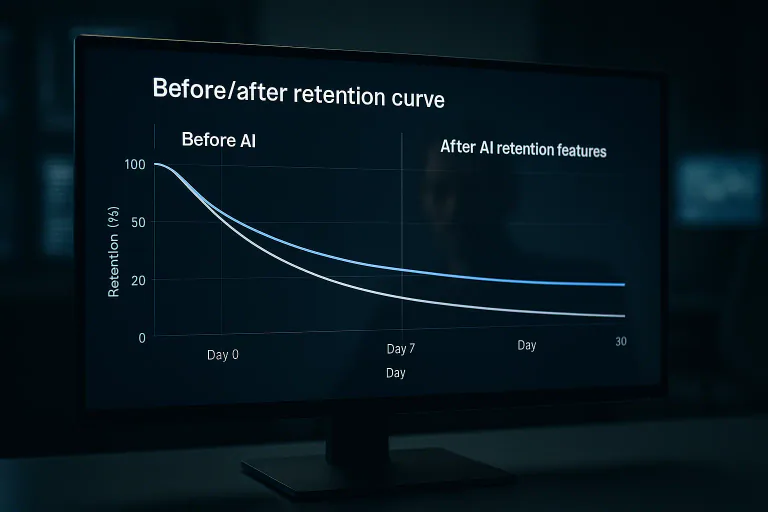
- Cohort curves: Lines that show how each signup group behaves over time. A flat curve is good. A steep drop tells you where to dig.
- DAU / MAU (stickiness): How many monthly users return daily. A healthy share of your monthly active users returning every day is a good sign of engagement, and a higher daily return rate signals robust product–market fit.
Once you track these consistently, AI churn prediction can start doing real work, because the models have something meaningful to learn from.
The Real Drivers Of Churn In Mobile And SaaS Products
Churn is rarely “random.” Most users leave because of a handful of predictable problems:
- Weak onboarding: They never reach the first “win” inside the product.
- Unclear value: They forget why they installed you in the first place.
- Friction and bugs: Crashes, laggy screens, confusing flows.
- Bad timing or irrelevant messages: Notifications that interrupt instead of help.
- No ongoing reason to return: No new content, features, or habits forming.
AI helps most when you already understand these human problems, because then you can design AI customer engagement features that address them instead of building a random chatbot.
Where AI Fits In The Retention Picture
With the basics in place, AI becomes a multiplier, not a distraction. Additionally, it slots in at three main levels:
- Models scan behavior, demographics, usage frequency, support history, and more.
- They assign a churn risk score long before a user actually cancels or stops opening the app.
- Instead of blasting the same campaign to everyone, AI identifies which segment needs which message or offer.
- It can also detect which channels work best for each group, such as push, email, or in-app banners.
- AI decides when to nudge, when to wait, and when to escalate to human outreach.
- Over time, it learns which interventions actually reduce churn for each cohort.
- Prediction
- Targeting
- Timing and orchestration
In the next part of the article, we will move from theory to practice and walk through seven concrete AI features you can embed directly into your product to lift retention, from smarter push notifications to guided onboarding and pricing experiments. That is where OpenForge spends most of its time with clients: turning ideas like “AI churn prediction” into visible, testable product features that help real users stay.
7 AI Features That Actually Improve Retention
Once your metrics are in place, the next question is simple: what should AI actually do inside the product to keep people around? Not in theory, but as visible, shippable features.
Below are seven AI-powered features that we see consistently help teams improve retention when implemented properly.
1. AI churn prediction inside your product analytics
Most teams already have dashboards full of usage charts. The problem is they tell you who churned, not who is about to churn.
What this feature does AI churn prediction models scan behavior signals like:
- Login frequency and session length
- Feature usage drops
- Support tickets and negative sentiment
- Plan downgrades or payment issues
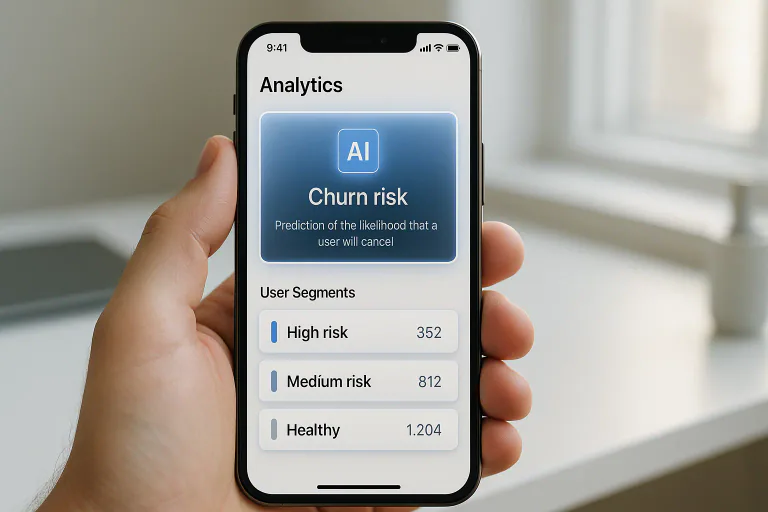
and assign each account a churn risk score. Companies using AI for churn prediction report more accurate risk detection and the ability to act before a user leaves.
Where it lives in the product
- As a churn risk column inside your analytics or CRM
- As segments like “High risk – 30 days” or “Medium risk – 7 days inactive”
- As triggers for lifecycle journeys and CSM workflows
Why it improves retention
Instead of treating all users the same, your team can:
- Proactively reach out to high-risk customers
- Trigger in-app help, custom discounts, or education flows
- Prioritize success resources where they have the highest impact
For OpenForge projects, this usually means wiring AI churn prediction into the analytics layer and then designing specific in-app and push interventions for those at-risk cohorts.
Get expert support to launch and scale your mobile app
2. Smart, behavior-based push notifications
Most users do not churn because you did not send enough notifications. They churn because you sent the wrong ones at the wrong time.
What this feature does
AI-driven push systems learn:
- Which actions predict long-term retention
- When each user is most responsive
- Which wording or offers perform best for each segment
Then they send targeted, just-in-time pushes instead of generic blasts. AI-powered engagement like this is linked to higher customer retention when it personalizes timing and content.
Where it lives in the product
- Mobile push notifications
- In-app messages and banners
- Email follow-ups for key behaviors (or lack of behavior)
Why it improves retention
- Fewer annoying “spam” pings
- More “you read my mind” nudges that bring users back to finish something they started
- Better alignment between product milestones (trial ending, feature not used, payment due) and the communication users see
OpenForge’s strength here is making sure these messages are not just automated, but wired into real mobile UX patterns that feel native, not bolted on.
3. AI-powered customer engagement journeys
Most lifecycle journeys are static: day 1 email, day 3 tooltip, day 7 “we miss you.” AI for customer retention allows those journeys to adapt in real time.
What this feature does
An AI engagement engine:
- Watches how each user interacts with onboarding, core features, and support
- Adjusts the sequence, channel, and intensity of touchpoints
- Skips irrelevant steps and doubles down where a user is clearly stuck
Research on AI-driven personalization shows it significantly boosts engagement and repeat behavior when experiences are tailored to the individual.
Where it lives in the product
- Onboarding flows that change based on what a user has already done
- Feature education that surfaces only when it is actually needed
- Re-engagement campaigns that differ for power users vs casual users
Why it improves retention
- Users see a path that feels designed for them, not for a “typical persona”
- You avoid overwhelming them with irrelevant tips or offers
- You guide people toward the behaviors that correlate with long-term retention
OpenForge typically works with clients to map the actual user journey, then define the decision points where AI should branch the next step, rather than forcing everyone through the same script.
4. In-app recommendations and next-best-actions
If your product has more than a handful of features, many users never discover the ones that would make them stay.
What this feature does
AI recommendation engines look at:
- Features used by high-retention customers
- Sequences that lead to successful outcomes
- Similar users and their behavior
and then suggest “next best actions” inside the app: a feature to try, a workflow to set up, or content to explore. AI-powered personalization like this has been linked to large gains in engagement and repeat usage across sectors.
Where it lives in the product
- Home screen modules (“Based on how you use the app, try this next”)
- Empty states that suggest actions rather than showing a blank page
- Dashboards highlighting underused but high-value features
Why it improves retention
- Users hit more “aha” moments without hunting through menus
- Teams can steer behavior toward the patterns that correlate with long-term value
- Power users feel the product is evolving with them, not against them
OpenForge usually designs these as small, contextual cards in key screens rather than giant recommendation blocks that distract from core tasks.
5. AI-guided onboarding and in-app coaching
Early sessions make or break retention. If a user does not see value quickly, no amount of AI later will save them.
What this feature does
AI-guided onboarding:
- Detects what a new user is trying to achieve (from setup steps and early clicks)
- Adapts the onboarding checklist in real time
- Surfaces tooltips, tours, or micro-tasks that match that intent
In complex products, AI-driven guidance can significantly reduce time-to-value and smooth out the steepest parts of the learning curve.
Where it lives in the product
- First-run experience after install or signup
- “Setup wizards” that change based on progress and errors
- Ongoing in-app coaching that appears when users hit known friction points
Why it improves retention
- Fewer users stall out in the first session
- People reach their first meaningful outcome faster
- You collect cleaner data from early behavior, which feeds back into your AI models
For OpenForge, this is a classic place to combine UX design with AI, not just drop a chatbot into the corner of the screen.
6. AI support agents that prevent frustration before churn
Support is often where a customer makes their final decision to stay or leave.
What this feature does
AI support agents and triage systems:
- Handle common questions instantly through chat or guided flows
- Use sentiment analysis to detect frustration in messages
- Escalate high-risk, high-value cases to humans with full context
Studies on AI-driven support and predictive analytics show better engagement and retention when issues are solved faster and outreach is personalized.
Where it lives in the product
- In-app chat widgets
- Help centers and FAQ search
- Email auto-responses that pull from a unified knowledge base
Why it improves retention
- Users feel heard and helped quickly
- Serious problems reach the right human, with AI doing the heavy sorting
- Data from support flows straight back into churn models and engagement journeys
When OpenForge designs these, we focus on clear guardrails so the AI agent is useful and honest, not overconfident or misleading.
7. AI-led experimentation on pricing, messaging, and UX
Even with great features, small details in copy, layout, and pricing can quietly increase churn.
What this feature does
AI-assisted experimentation platforms:
- Analyze patterns across experiments in paywalls, onboarding variants, and layouts
- Propose new variants or combinations based on what has worked
- Allocate traffic automatically toward winners
AI-driven predictive analytics has been shown to improve retention by enabling faster, more targeted optimization of customer experience.
Where it lives in the product
- Pricing pages and subscription upgrade prompts
- Trial-to-paid conversion flows
- Key UX surfaces like dashboards, home screens, and navigation
Why it improves retention
- You stop guessing what keeps users around and start testing it
- Teams learn which designs, messages, and offers correlate with long-term usage
- You can adapt faster to changes in user behavior or market conditions
OpenForge’s role here is less about “installing a tool” and more about closing the loop between what experiments reveal and how the product roadmap evolves.
Implementing AI for Customer Retention Without Breaking Your Product
A lot of teams get excited about AI for customer retention, then stall when they realize their data is messy and their product is not ready. You do not need a perfect stack to start, but you do need a plan.
Step 1 – Instrument the journey, not just vanity metrics
Most products track events, but not the journey. If your data is only “login,” “clicked button,” “opened screen,” your AI churn prediction model will be guessing.
Focus first on:
- Example: completed onboarding, connected data source, invited teammate, created first project.
- Example: weekly active use of a core feature, reports viewed, conversations started.
- Example: failed payments, error messages, rage clicks, long gaps between sessions.
- Key activation events
- Habit-forming events
- Risk signals
Practical moves:
- Map 3–5 “moments that matter” in your user journey.
- Ensure those are tracked cleanly across web, mobile, and backend.
- Keep event names simple and consistent so data can be used by your AI tools and product team without translations.
Once this is done, AI for customer retention has something meaningful to learn from, instead of noise. If you’re building or scaling an education product, you can also read our case-focused guide on AI in EdTech apps and personalized learning at scale.
Step 2 – Choose the right data and AI stack for your stage
You do not have to build a research lab to use AI.
Think in three rough levels:
- Use existing tools that offer ai churn prediction or AI customer engagement out of the box.
- Examples: product analytics platforms, marketing automation tools, customer engagement suites.
- Pros: faster to launch, less engineering.
- Cons: limited customization, you are bound to vendor capabilities.
- Keep your existing tools, but feed them a custom churn or propensity model built by your data team or a partner.
- Pros: more control over what the model cares about.
- Cons: you need solid data engineering and someone who owns the model.
- Only for later-stage or very data-heavy companies.
- You own the data pipelines, models, and serving infrastructure.
- High flexibility, but also high responsibility.
- Tool-first approach (most teams start here)
- Hybrid approach
- Fully custom approach
For most OpenForge-type clients (serious about product, not a giant data science org), a tool-first or hybrid approach is enough as long as you design the product features around it properly.
Step 3 – Design the feature, not just the model
This is where many AI projects die. Someone builds a nice churn model, then it lives forever in a dashboard that nobody uses.
Ask one simple question:
Where will this AI show up for the user or the team?
Examples:
- A “risk” label in your admin or CS dashboard.
- A dynamic segment that automatically feeds retention journeys.
- A simple badge in the account list: “High churn risk – take action.”
- Adaptive onboarding flows inside the app.
- Smart banners that suggest the next step instead of a static checklist.
- Contextual hints: “Most teams that succeed with this feature also do X.”
- A small module on the home screen with one clear suggestion.
- Empty states that show “Try this next” instead of blank space.
- For churn risk scores
- For AI customer engagement journeys
- For recommendations / next best actions
Good AI features are boring in a good way. They feel like natural parts of the product, not a separate “AI section” your user has to discover
Step 4 – Respect privacy, consent, and trust
AI for customer retention often touches sensitive behavior data. If you mishandle that, you will hurt trust and retention at the same time.
Baseline rules:
- Be clear in your UI and policy about what data is used and why.
- Avoid creepy outputs like “We see you stopped using feature X, want a discount?” if the user never agreed to that kind of tracking.
- Let users control some aspects: notifications, data sharing, personalization intensity.
Trust is itself a retention driver. If customers feel tricked, no algorithm will save them. For a deeper dive into how onboarding itself can become an AI retention feature, check out our guide on AI onboarding vs traditional onboarding and the future of personalized UX.
The OpenForge Playbook for AI Retention Features in Mobile Apps
This is how an engagement usually looks when a team comes to OpenForge saying, “We want AI for customer retention, but we are not sure where to start.”
1. Discovery – Find the real retention leverage points
OpenForge does not begin with tools; it begins with what is already happening in your product. However, the team looks at your current retention curves and churn rates, the key journeys (onboarding, activation, upgrade, renewal), and the analytics and event tracking you already have in place. Moreover, your roadmap and tech stack (Ionic, Capacitor, Flutter, native, backend APIs, and so on) are reviewed to understand what is realistic in the next one or two quarters.
In that context, you and OpenForge agree on one or two concrete business goals, such as improving month-3 retention or lifting trial-to-paid conversion, and then pick one or two candidate AI features that could actually move those numbers, for example “churn prediction feeding smarter push notifications” or “AI-guided onboarding. This keeps the scope grounded in measurable outcomes instead of chasing AI for its own sake. Forrester’s 2024 US Customer Experience Index shows that customer-obsessed organizations enjoy 51% better customer retention, which is exactly the sort of advantage this phase is designed to unlock.
2. UX and technical design of the AI features
Once the priorities are clear, OpenForge turns those ideas into tangible product changes. Meanwhile, instead of talking abstractly about “using AI,” the team redraws user flows to show where AI will appear, what a “high churn risk” customer will see that others do not, and how AI-driven customer engagement will change the order or content of onboarding steps.
Wireframes and UI mockups cover things like risk labels in admin views, subtle recommendation cards on dashboards, smart in-app banners, or dynamic onboarding checklists. Additionally, on the technical side, specs define which events must be tracked, which APIs and external platforms will be involved, and how model inputs and outputs need to be structured so the feature is stable in production. This planning stage also answers hard questions early: what happens if the AI is wrong, if confidence is low, or if the service is temporarily unavailable?
Research on customer expectations backs up this design focus. A Salesforce study on spending and loyalty found that 65% of consumers stay loyal when experiences are more personalized and 72% stay loyal when service is faster, highlighting why AI-driven personalization and responsiveness need to be wired directly into the product, not just left in reports.
3. Build, integrate, and ship
With UX and technical design agreed, implementation starts. On the front end, OpenForge adds or updates screens, components, notification hooks, and in-app messaging so AI outputs can actually appear where users and internal teams work. Similarly, on the back end, the team connects to AI services or models, wires event data into the right systems, and configures any third-party tools needed for segments, experiments, or journeys.
Quality assurance focuses on both correctness and experience: does the right user see the right message, what happens when the model cannot return a result, and how does the app behave if the AI integration is slow or offline? Ultimately, the aim is not a risky “big bang” launch but a controlled release of a single AI retention feature that can be measured clearly against your baseline. To see how Openforge designs and ship AI-powered features for mobile products, visit our Artificial Intelligence page.
4. Measure, learn, and iterate
After launch, OpenForge helps you treat the feature like an experiment with real stakes. Beforehand, you have already agreed on baseline metrics such as day-30 retention for a specific cohort or time-to-first-value. Now you run an A/B or holdout test where only a portion of your audience experiences the AI-driven flow, while a control group uses the previous version.
You monitor retention curves, engagement with the new AI surfaces, and any support tickets or negative feedback linked to the change. Consequently, if the feature is clearly positive, you keep and possibly extend it; if the impact is mixed, you adjust copy, timing, or UX; if it damages trust or confuses users, you switch it off and regroup. Afterward, once the first feature proves itself, you can layer on additional AI capabilities starting with churn prediction, then AI-guided onboarding, then in-app recommendations so that each one earns its place by improving AI for customer retention in measurable ways. Furthermore, benchmarks from mobile analytics platforms underline why this matters: industry analyses of app behavior show that many categories see day-30 retention in the low single digits, making even modest gains extremely valuable.
Wondering what mobile app development really looks like?
Conclusion – Plan your first AI for customer retention experiment
AI will not fix a weak product or a random strategy, however it can help you spot at-risk users earlier with AI churn prediction, power smarter and less intrusive engagement, and guide people through a journey that reliably leads to value. Additionally, the mindset shift is to treat AI as a set of concrete features inside your app, not a slide in an AI strategy deck.
If you run a mobile app or digital product and you are serious about retention, moreover a practical starting point is to map your core journeys, instrument the right events, pick one high-impact area such as churn prediction, onboarding, or recommendations, and design a small, visible AI feature around that flow. Therefore ship it, test it, and learn from the results. Finally iterate based on the insights so each step leads to measurable improvement.
When you want a partner who understands both mobile app development and AI for customer retention, this is exactly where OpenForge lives. Bring your metrics and a rough picture of where churn hurts most, and OpenForge can help you design and build the AI features that actually keep your customers around. You can also check the OpenForge FAQs for more common questions about working with our team.
FAQs – AI for Customer Retention
AI for customer retention uses data and machine learning to spot who is likely to churn and why. It then powers targeted actions (offers, guidance, messaging) to keep those users engaged longer.
It analyzes past user behavior from customers who stayed vs left, then learns patterns that signal churn. Moreover, each current user gets a risk score, so your team can intervene before they disappear.
Typically: churn prediction, smart push notifications, adaptive onboarding, in-app recommendations, and AI-led support. Additionally, these features turn raw data into timely nudges that prevent drop-off.
No, many tools ship with built-in AI for churn prediction and engagement. You mainly need clean event tracking and a product that can surface AI insights as real features.
Set a baseline for churn and retention, then A/B test the new AI feature against a control group. Similarly, if the AI cohort retains better without hurting trust, it is working.