Schedule a Free Demo Schedule a Free Demo TALK TO AN EXPERT 1. ❓What are push notifications? 2. ❓What is an example of a push notification? 3. ❓What are the types of push notifications? 4. ❓What are push notifications used for? 5. ❓How to write good push notifications?
At 7:42 p.m., a user gets a gentle nudge on their phone: “Your saved seats for the weekend are almost gone. Want us to hold them for 10 more minutes?”
Within seconds, the user taps. These few words, delivered with intention, turn passive interest into action.
Most brands want their push notifications strategy to work this hard. Many end up sending templated messages that feel disconnected from what users actually care about. Push strategy messages crafted with empathy, fueled by customer data, and aligned with real user behavior work wonders.
In this blog, we’ll walk through push campaigns and push notification best practices using real examples, and examine how smart timing, thoughtful segmentation, personal context, and subtle behavioral cues come together to create push messages worth tapping.
Table of Contents
What Makes Push Notifications Convert?
Push notifications for apps convert when a message arrives at the exact moment a user thinks, “I needed this reminder.” When someone is weighing a purchase or drifting back to something that matters to them, a small window opens for a quiet, well-placed reminder. A push step into that moment to make users feel supported rather than a typical marketing message.
What “Conversion” Means for Push?
Conversion is not the same for every brand. For an eCommerce app, it might be a purchase or an abandoned-cart recovery. For a fintech product, it could be a balance check, a bill payment, or a loan application started. But for a content platform, it’s getting a user back into the app to finish what they began.
A push notification converts when it drives the user to the next meaningful step in their journey after a tap.
Why Some Notifications Perform Better (Value, Timing, Relevance)
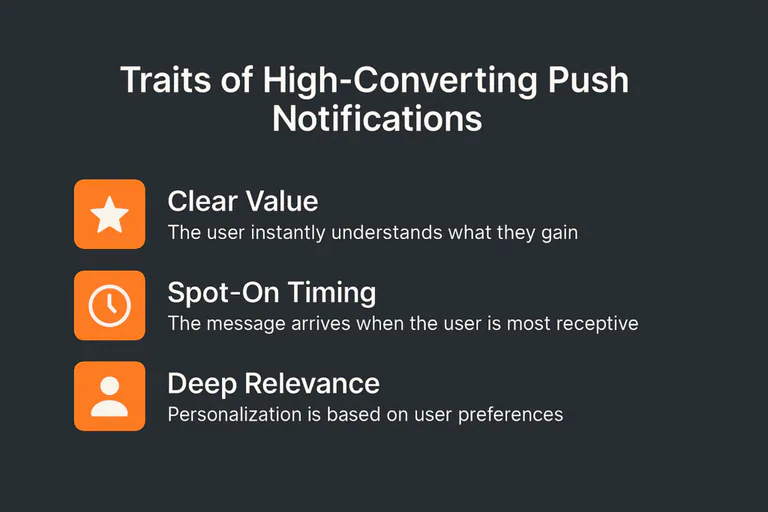
Some push notification services outperform others because they respect the user’s context and attention. High-converting messages tend to share three traits:
Clear value
The user instantly understands what they gain; a saved seat, a relevant update, a last-chance offer, and a reminder that actually helps.
Spot-on timing
The message arrives when the user is most receptive: right after a key behavior, at a daily habit moment, or before something expires.
Deep relevance
Personalization based on user preferences no longer comes from adding a name. A clear message gives users a reason to tap right away. When a push calls out something helpful, solves a small problem, or brings up something the user already cares about, the response is stronger. Generic messages slow people down, while clear value helps them decide instantly.
Get expert support to launch and scale your mobile app
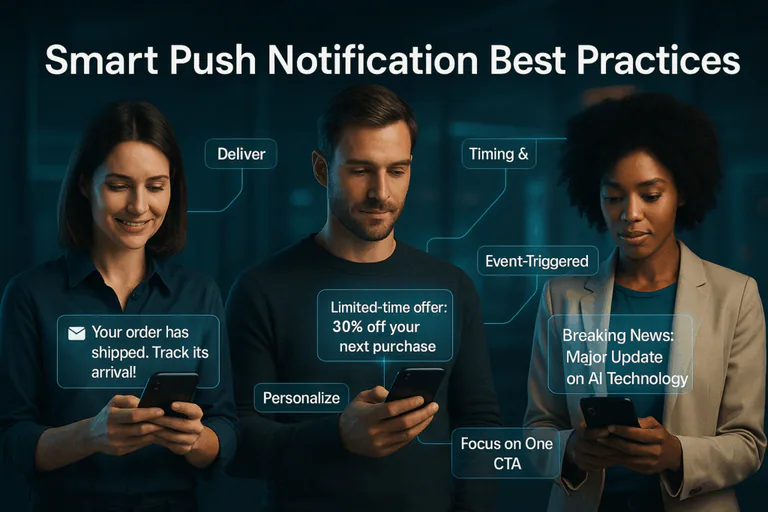
6 App Push Notification Best Practices
Follow these best practices for high converting Android push notifications:
Deliver Clear, Immediate Value
Clear value gives users a reason to tap right away. A good push points to something useful, fixes a small problem, or brings attention to something the user already cares about. Messages that feel vague slow people down, while specific and meaningful ones make the decision easy.
Examples:
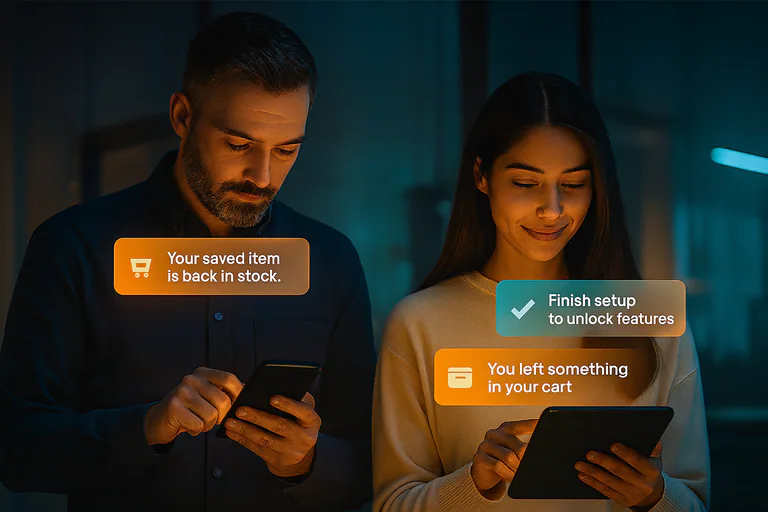
- “Your saved item is back in stock.”
- “Your bill is due tomorrow. Pay in one tap.”
Keep Copy Short, Specific, and Actionable
App push notifications sit alongside many other alerts, so a clear message stands out. Short copy works best, especially when every word points to the outcome you want the user to see. Strong action verbs give the message direction and make the next step easy.
Examples:
- “Finish your setup to unlock advanced features.”
- “Save 20% on items in your cart.”
Personalize Based on Behavior
What really works is noticing what people actually do, what they look at, what they hesitate on, or what they might come back to. When a notification aligns with that kind of real behavior, it feels natural, and people are way more likely to tap it.
Examples:
- “Still comparing travel plans? Here are updated prices.”
- “You listened to 3 wellness podcasts—try this new one.”
Use Event-Triggered and Contextual Messages
Static broadcast notifications rarely convert. Business apps that rely on triggers, like abandoned carts, session drops, new activity, viewed products, and expiring trials, see higher user engagement.
You can send push notifications at the right moment, making you feel helpful rather than disruptive.
Examples:
- “You left something in your cart. Complete checkout!”
- “Your order is arriving soon. Track it live.”
Optimize Timing and Frequency
Users respond when they are active on their devices. Late-night alerts or sudden pings during quiet hours feel intrusive and can affect how people view the app. A thoughtful schedule that reaches users when they are present, supported by fewer well-timed messages, leads to stronger engagement.
This approach produces stronger results than sending many notifications without a clear plan.
Best practices:
- Use user-local time zones
- Avoid sending more than 1–2 promotional pushes daily
- Pause pushes when engagement drops, or opt-outs rise
Focus on One Strong CTA
A good web push alert doesn’t try to do everything at once. It gives the user one thing to act on and makes that action obvious. When the message points in a single direction, people don’t have to stop and think; they just tap. Strong CTAs use verbs, imply urgency or benefit, and are in line with the value promised.
Examples:
- “Track order”
- “Finish checkout”
- “Claim offer”
- “Continue watching”Bus
Real Examples of Push Notifications That Convert
With push notifications, timing, customization, and context are the best factors to consider. Here are successful case studies, each of them designed to push CTR, traffic and increase income.
Wondering what mobile app development really looks like?
eCommerce
Abandoned Cart Recovery Example: “Still thinking it over, Steven? Your saved items are almost gone. Complete your order before they sell out.”
Why it works:
- Uses first-name personalization
- Creates urgency (“almost gone”)
- Encourage users and remind them of an intent they already showed
- High probability of conversion (warm audience)
Price Drop Notification Example: “Good news! The sneakers you viewed just dropped $100. Grab them before the price goes back up.”
Why it works:
- Anchored in user behavior (recent view)
- Value-driven trigger (price drop)
- Uses scarcity to nudge immediate action
- Ideal for high-intent but hesitant shopper
SaaS (onboarding, feature adoption)
Onboarding Activation
Example:
“Welcome aboard! Finish setting up your dashboard to unlock personalized insights.”
Why it works:
- Encourages completion of a key onboarding step
- Value-oriented: “unlock personalized insights”
- Reduces churn during the first 24–48 hours
Feature Adoption Prompt
Example:
“Try the new Automation Builder—teams are saving 5–8 hours a week. Want to see how?”
Why it works:
- Social proof (“teams are saving…”)
- Encourages discovery of sticky features
- Drives deeper product engagement
Milestone Celebration
Example:
“Nice work! You just completed your first project. Here’s what you can try next.”
Why it works:
- Positive reinforcement increases retention
- Uses momentum to drive the next key action
Delivery/Travel Apps
Real-Time Order Update
Example:
“Your order is on its way! Ray is arriving in 8 minutes.”
Why it works:
- Extremely high open rate
- Reduces anxiety + increases trust
- Keeps users inside the app (map view, tracking)
Personalized Offer Based on Past Orders
Example:
“Hungry, Paul? Your favorite Chicken Bowl is $8 off today.”
Why it works:
- Personalized to a specific favorite item
- Drives impulse purchases
- High relevance = high CTR
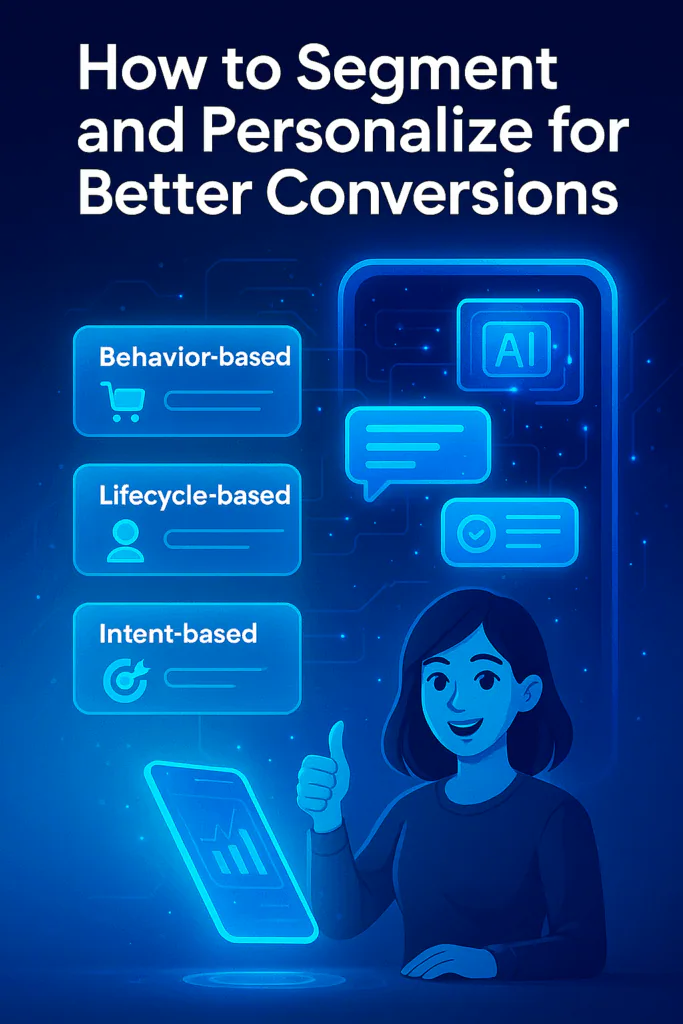
How to Segment and Personalize for Better Conversions
You can segment and personalize for better conversions:
Behavior-based (browsing, purchase)
Send people gentle nudges based on what they just did, what they watched, what they added to their cart, or something they’ve bought before.
Lifecycle-based (new, active, inactive)
Adjust your in-app message to where someone is in their journey. New users need a little guidance, active users need reasons to stay involved, and inactive users need a reminder that you have something valuable for them.
Intent-based (high value, at-risk)
Prioritize high-intent or high-value users with tailored offers and win back at-risk users with personalized incentives.
How OpenForge Helps You Deliver Push Notifications That Convert
OpenForge sends personalized push notifications that actually get noticed by building apps with the proper infrastructure. Every mobile device app we develop supports push notifications, and everything functions the way you want. For real-time alerts, deep links, or personalized messages, we configure your app so everything functions as intended.
This is mainly about clean code, a consistent backend, and taking care of the minor UX details that make your product interact with users.
Once all of those come together, your notifications can be fast, relevant, and can lead the user to where he/she need to be. And that is what is actually driving the needle on engagement and conversions.For
The Moment Push Notifications Work for You
Crafting mobile push notifications with care, become tiny moments of connection. The brands that win are the ones that respect attention, speak with clarity, and show up at the right time with something genuinely useful.
The moment value, timing, and relevance align, a push feels less like marketing and more like guidance that meets the user where they are. If you’re ready to move beyond generic alerts and build notifications people actually want to tap, OpenForge can help you get there.
Want higher-converting push notifications? Let’s schedule a call with OpenForge and build together.
Frequently Asked Questions
Push notifications are messages that an application or website sends to a user's device to deliver timely information.
An easy example of effective app notification is: “Your order is in transit! Track it now.”
Common ones are transactional, promotional, behavioral, personalized, and lifecycle-based notifications.
Push notifications engage users, motivate them to take action, share updates, and reintroduce people to an app or site.
Write notifications that are concise, personalized, timely, and paired with a clear, compelling call to action.